

Milia: From Causes to Removal, Understanding Why These Tiny Bumps Appear Beomgye, Pyeongchon, Beomgye Station, Pyeongchon Station, Hogye-dong, Bisan-dong, Gwanyang-dong, Dongan-gu, Indeogwon, Geumjeong, Anyang
7/5/2026
This is a procedure note for Milia: From Causes to Removal, Understanding Why These Tiny Bumps Appear at Gyeonggi Anyang Beomgye KKEUT Korean Clinic.
Properly understanding the causes of milia makes it clear why self-extraction cannot be a solution.
These small bumps that appear like tiny grains often tempt one to try and squeeze them out, but such an approach is the starting point for recurrence.

What are Milia?
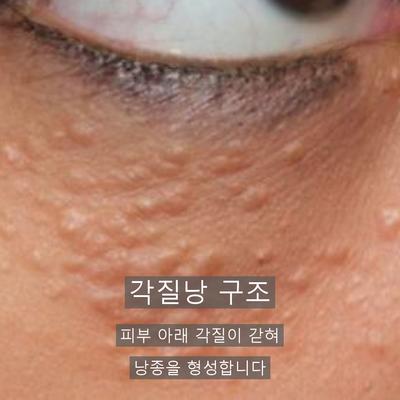
Milia are small cysts formed when keratin, a skin protein, gets trapped beneath the skin's surface instead of shedding normally.
They typically appear as white or yellowish bumps, about 1-2mm in size, often concentrated around the eyes, on the cheeks, or next to the nose.
If you notice white bumps on your lower eyelids or cheekbones, they are likely milia. They are characterized by clear boundaries with the surrounding skin and a smooth, raised surface.
It is rare for milia to disappear naturally, and a characteristic feature is that they do not go away on their own even after a long time.
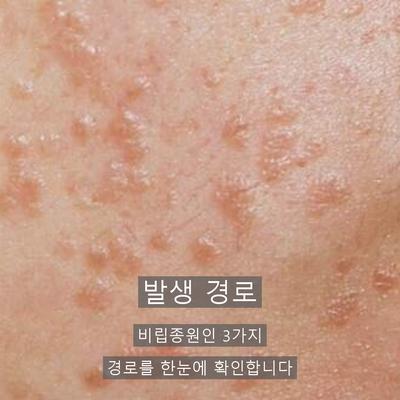
Causes of Milia — 3 Pathways of Formation
The causes of milia are largely divided into three pathways.
The first is a problem with the skin's regeneration process. Skin constantly produces and sheds dead skin cells, but if this shedding pathway is blocked, dead skin cells accumulate beneath the skin, forming cysts.
The second is product residue. Oily products like sunscreens and creams can accumulate around pores over a long period, hindering the shedding of dead skin cells. This is one reason why milia often appear around the eyes.
The third is formation after skin damage. Keratin cysts can newly form during the healing process of inflammation or wounds. Experiences of milia appearing after laser procedures or chemical peels fall into this category.
How are Milia Different from Syringomas and Sebaceous Hyperplasia?
They are often confused due to similar appearances. Syringomas are lesions derived from sweat glands and appear in clusters under the eyes. Sebaceous hyperplasia is a condition where sebaceous glands become excessively enlarged.
Because their causes are completely different, the treatment approach must also differ. If you mistake them for milia and attempt removal with the same method, you cannot expect effective results, and it will only cause unnecessary irritation to the skin.
Accurate differentiation is the starting point for determining the effectiveness of treatment.

Why Do Milia Recur When Squeezed at Home?
Milia do not easily come out even when pressed on the surface. Even if you forcibly squeeze them, only some of the surface contents are expelled, while the keratin cyst itself remains beneath the skin.
As long as the keratin cyst remains, milia will reappear in the same spot. Repeated irritation from self-extraction can lead to inflammation and scarring, actually worsening the skin condition.
To prevent recurrence, the keratin cyst itself must be destroyed. This is why professional laser treatment at a clinic is essential.
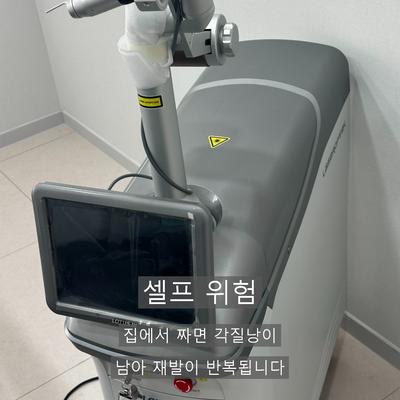
Laser Treatment Process
Milia removal is performed using an Er:YAG laser. The laser precisely targets the superficial skin layer, opening the skin above the milia and completely destroying the keratin cyst along with its contents.
Since the procedure is performed after applying an anesthetic cream, pain during the treatment is minimized. Even if there are many, it is possible to treat them all in one day.
Er:YAG laser causes less damage to surrounding tissue compared to CO2 laser, resulting in a shorter downtime. Once the keratin cyst is completely destroyed, recurrence in the same spot is highly unlikely.

Post-Treatment Aftercare
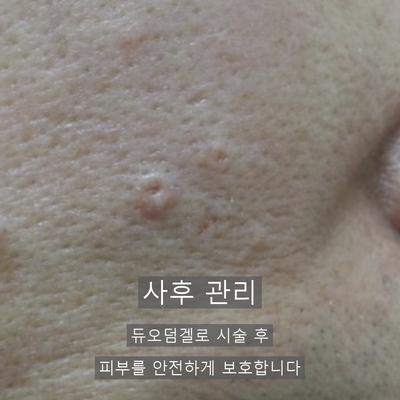
Immediately after the procedure, Duoderm gel is applied to the treated area. Unlike regular Duoderm stickers, its gel type makes it comfortable for individuals with contact allergies and eliminates the hassle of peeling and sticking.
Until the treated area heals, meticulous sun protection must be maintained. Touching with hands or forcibly removing scabs increases the risk of scarring.
How Kkeut Korean Medicine Clinic Addresses Milia Causes
Kkeut Korean Medicine Clinic clearly distinguishes similar-looking small bumps into milia, syringomas, and sebaceous hyperplasia, separating their treatment pathways accordingly.
Milia are directly removed with an Er:YAG laser, syringomas are treated with an Agnes radiofrequency insulated needle program that destroys the sweat glands themselves, and sebaceous hyperplasia is addressed with a sebaceous gland cause removal program, each approached differently.
This is why, even if they appear as similar small bumps, their treatment pathways must differ. This is why the diagnostic stage is crucial at Kkeut Korean Medicine Clinic.
Complete Destruction of Keratin Cyst — Key to Preventing Recurrence
The reason Kkeut Korean Medicine Clinic primarily uses Er:YAG laser for milia treatment is to ensure the complete destruction of the keratin cyst.
Squeezing at home or using general extraction methods leaves the keratin cyst intact, leading to repeated recurrence. Only the precise destruction of this keratin cyst by an Er:YAG laser can prevent milia from reappearing in the same spot.
The protocol, which extends to post-treatment aftercare with Duoderm gel, achieves both recurrence suppression and skin protection simultaneously.

Frequently Asked Questions
Q. Can milia be caused by skincare products?
A. One of the causes of milia is the long-term residue of oily products. Sunscreens or creams accumulating around pores can obstruct keratin shedding. Even if you change products or cleanse thoroughly, existing milia are unlikely to disappear naturally. It is effective to remove them through treatment and then improve your skincare habits.
Q. If I know the cause of milia, can I distinguish them from syringomas?
A. The cause of milia is a disorder in keratin shedding, whereas syringomas are lesions derived from sweat glands. Even if their appearances are similar, their pathways of formation are entirely different. Kkeut Korean Medicine Clinic clearly distinguishes between these two lesions and applies the appropriate treatment pathway for each.
Q. Even if the cause of milia remains, can't it be removed with self-extraction?
A. The keratin cyst, which is the cause of milia, is not destroyed by self-extraction. Even if some contents are expelled, recurrence will persist if the keratin cyst remains. Kkeut Korean Medicine Clinic's Er:YAG laser treatment completely destroys the keratin cyst, preventing recurrence.
Q. What is the downtime after removing the cause of milia?
A. The Er:YAG laser used to remove the cause of milia has a short downtime. Immediately after the procedure, slight redness and scabs may appear, and most patients recover within a few days. Kkeut Korean Medicine Clinic protects the treated area with Duoderm Gel to assist the healing process.
The Sincerity of Kkeut Korean Medicine Clinic
Kkeut Korean Medicine Clinic provides differentiated results through an accurate diagnostic system that clearly distinguishes and approaches milia, syringoma, and sebaceous gland hyperplasia differently.
Kkeut Korean Medicine Clinic achieves recurrence-free removal through a treatment principle that completely destroys the keratin cyst with an Er:YAG laser.
Kkeut Korean Medicine Clinic simultaneously pursues skin protection and safe recovery after the procedure through its Duoderm Gel aftercare protocol.
A Subtle Difference, Remarkable Results — Experience it at Kkeut Korean Medicine Clinic.
Related notes
Procedure notes worth reading next.


Loading menu…