

Tattoo Removal Reviews: What You Need to Know Before Asking How Many Sessions It Takes to Erase a Tattoo Beomgye, Pyeongchon, Beomgye Station, Pyeongchon Station, Hogye-dong, Bisan-dong, Gwanyang-dong, Dongan-gu, Indeogwon, Geumjeong, Anyang
7/3/2026
This is a procedure note for Tattoo Removal Reviews: What You Need to Know Before Asking How Many Sessions It Takes to Erase a Tattoo at Gyeonggi Anyang Beomgye KKEUT Korean Clinic.
When you search for tattoo removal reviews, you often come across statements like 'it was completely gone in 3 sessions' or 'it disappeared cleanly in 5 sessions'.
It's not that those reviews are lies. It really happened to that person.
The problem is the expectation that the same number of sessions will apply to your tattoo.
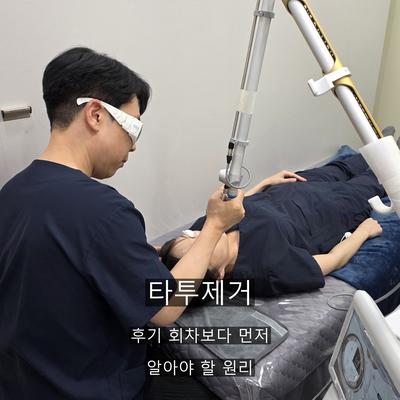
The number of sessions required for tattoo removal varies completely depending on the ink color, depth of ink in the skin, amount of ink, and the patient's skin type.
Even for tattoos of similar size on the same forearm, one person might finish in 6 sessions, while another might need over 15 sessions.
What you must check before tattoo removal is not the number of sessions in a review, but the conditions of your own tattoo and the estimated number of sessions required for it.
In this article, we'll explain the principles you need to know to avoid being swayed by the session counts mentioned in tattoo removal reviews.
How Pigment Is Removed
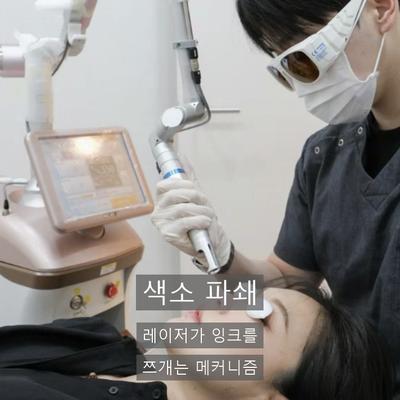
Laser tattoo removal is not about burning or scraping off the ink.
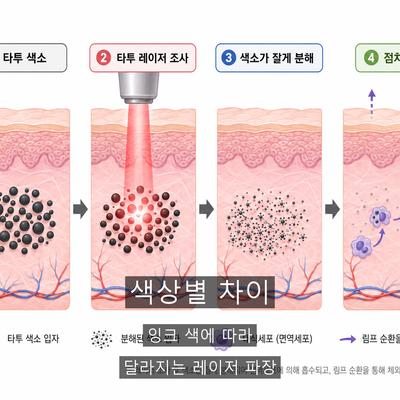
When a specific wavelength of laser is absorbed by ink particles, strong energy is concentrated in a short moment, breaking large particles into very small fragments.
These finely shattered pigment particles are recognized and engulfed by macrophages, which are our body's immune cells.
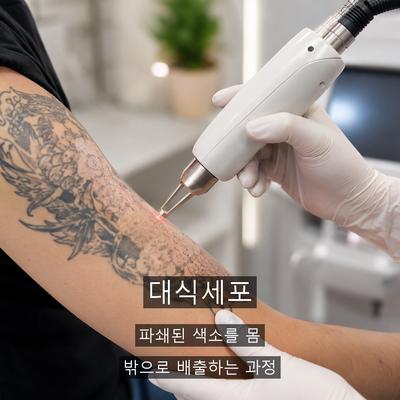
The engulfed macrophages are slowly expelled from the body through the lymphatic vessels, and in that process, the pigment gradually fades.
This expulsion process typically takes 6-8 weeks to complete.
The laser doesn't directly remove the pigment; rather, it breaks it down into tiny pieces, which the body then expels on its own. Understanding this process clarifies the meaning behind setting session counts and intervals.
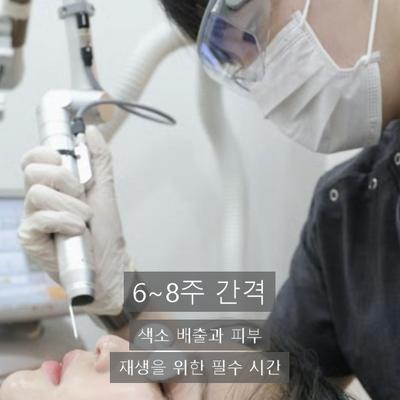
Why a 6-8 Week Interval is Necessary
If the next session is performed too quickly after laser treatment, you end up firing the laser again before the macrophages from the previous session have fully cleared the pigment.
Treating before the pigment has sufficiently faded significantly reduces efficiency, even with the same energy.
Re-stimulating tissue that is still recovering also increases the risk of side effects.
A 6-8 week interval is the minimum biological time needed for both pigment expulsion and skin regeneration to complete.
Reasons to Consider at Least 10 Sessions
Cases in tattoo removal reviews where a tattoo 'disappeared in 3 sessions' are mostly permanent makeup or simple tattoos with very little ink.
For typical tattoos with a sufficient amount of ink embedded deep in the dermis, we recommend approaching it with at least 10 sessions in mind.
This doesn't mean 10 sessions are guaranteed. It means that having a generous number of sessions planned from the start helps you stay steady if expectations aren't met midway.
Each color reacts to a different laser wavelength. Black and dark blue shades generally respond better to lasers, requiring fewer sessions.
Red, yellow, and light blue shades have tricky wavelengths to react to and require more sessions to be completely shattered.
The deeper the ink is embedded in the dermis, the longer the distance the laser energy must travel through the epidermis, and thus, the more sessions are required.
Asian skin, rich in melanin, is sensitive to post-inflammatory hyperpigmentation (PIH) side effects. The principle is to proceed with a sufficient number of sessions within a safe intensity.
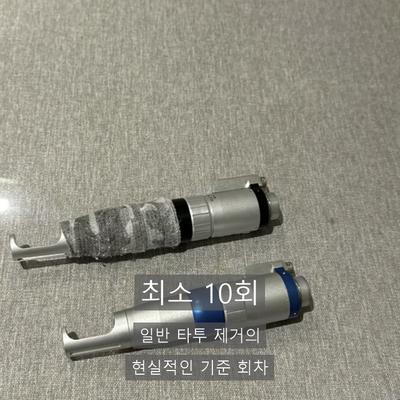
No clinic will give you an exact number when you ask 'How many sessions will it take?' during your first consultation.
This is because there are too many variables. Instead of relying on a single tattoo removal review, it's correct to have your tattoo's color, depth, and quantity evaluated through a direct consultation and set realistic session expectations.
Kkeut Clinic's Unique R0+R20 Hybrid Protocol
At Kkeut Clinic, we don't just stop at applying PFD (Perfluorodecalin) and then immediately treating with a laser.
We wait 15 minutes after applying PFD. This 15-minute period is key to combining the stability of the traditional R20 method.
During these 15 minutes, the medication fully acts and frosting (bubbles) is almost perfectly removed, creating conditions for subsequent laser treatment to reach the pigment more deeply and accurately.
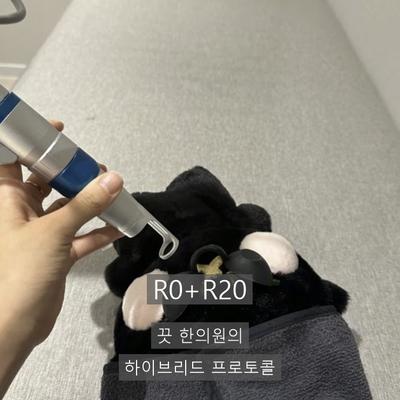
Considering the sensitive melanin response of Asian skin, Kkeut Clinic performs 3 immediate repeat treatments per visit within a safe range, without side effects.
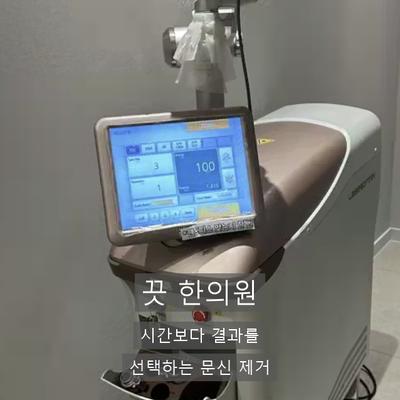
Treatment time at Kkeut Clinic is significantly longer than conventional methods. Kkeut Clinic chooses results over time.
Kkeut Clinic chose this protocol for one reason: reducing the total number of visits is the most realistic benefit for patients.

Frequently Asked Questions
Q. Tattoo removal reviews show varying numbers of sessions. Why is that?
A. The difference in session counts in tattoo removal reviews is determined by the ink color, depth of ink in the skin, total amount of ink, and skin type. Even for tattoos of the same size, the outcome can vary completely depending on the combination of these variables.
Q. Some tattoo removal reviews mention being removed in 3-5 sessions. Can I expect the same?
A. Most tattoo removal reviews completed in a small number of sessions are for semi-permanent makeup or tattoos with a small amount of ink. For typical tattoos embedded deep in the dermis, it is realistic to approach with a minimum of 10 sessions.
Q. I've seen some tattoo removal reviews where the intervals were short. Are 6-8 weeks absolutely necessary?
A. Yes, it is essential. This is why there are cases in tattoo removal reviews where reducing the interval resulted in no effect. It is the minimum time required for macrophage discharge and skin regeneration to complete, so it must be followed.
Q. I was looking at tattoo removal reviews and felt that Kkeut Korean Medicine Clinic's method was different. How is it different?
A. At Kkeut Korean Medicine Clinic, we apply an R0+R20 hybrid method, which adds a 15-minute PFD waiting period to the typical R0 method seen in tattoo removal reviews. Our goal is to maximize pigment fragmentation efficiency with 3 immediate repeated irradiations per visit and reduce the total number of visits.
The Sincerity of Kkeut Korean Medicine Clinic
Kkeut Korean Medicine Clinic maximizes the pigment fragmentation efficiency of a single visit with its R0+R20 hybrid protocol, which involves a 15-minute waiting period after PFD application.
Kkeut Korean Medicine Clinic achieves maximum effect safely and without side effects through 3 immediate repeated irradiations, considering the characteristics of Asian skin, which is sensitive to melanin reactions.
Kkeut Korean Medicine Clinic prioritizes results over time, even if treatment time is longer, aiming to reduce the patient's total number of visits.
A subtle difference, a distinct result — Experience it at Kkeut Korean Medicine Clinic.
Related notes
Procedure notes worth reading next.

For tattoo removal clinics, the total cost is ultimately determined by the 'number of sessions'.
2026. 6. 19.

Underarm Permanent Hair Removal: The principle of achieving lasting results without hyperpigmentation.
2026. 7. 1.

Eyebrow Tattoo Removal: The Laser Principle for Scarless Removal of Semi-Permanent Pigment
2026. 7. 1.
Loading menu…