


Large mole removal. Very large moles may require up to 10 treatment sessions. Beomgye, Pyeongchon, Beomgye Station, Pyeongchon Station, Hogye-dong, Bisan-dong, Gwanyang-dong, Dongan-gu, Indeogwon, Geumjeong, Anyang
6/17/2026
This is a procedure note for Large mole removal. Very large moles may require up to 10 treatment sessions. at Beomgye(Opening Soon) KKEUT Korean Clinic.
Large mole removal, can it really be done in one go?
When considering large mole removal, there's always one question that comes to mind first.
'Will this large mole disappear in one go?'
To get straight to the point, the larger the size and deeper the pigment, the harder it is to expect complete removal in a single session. Large mole removal typically involves multiple laser sessions, and in some cases, more than 10 re-treatments may be necessary.
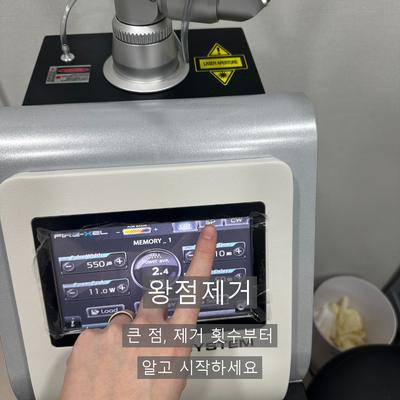
Reasons why large mole removal requires multiple sessions
Mole removal lasers work by ablating skin tissue layer by layer. Laser energy sequentially stimulates the epidermis and dermis, and as the skin heals, it pushes out the remaining pigment.
There are three main reasons why large moles require many removal sessions.
First, the larger the size, the more widely and deeply the pigment is spread. There's a limit to how deep a single laser session can penetrate, so to remove remaining pigment, the next treatment must be performed after the skin has fully recovered.
Second, treating too deeply in a single session increases the risk of scarring. Performing treatments at appropriate depths in stages ultimately leads to smoother skin.
Third, individual responses vary depending on the pigment concentration and penetration depth into the dermis. Skin recovery speeds also differ, so the timing of subsequent sessions is determined after assessing the condition post-first treatment.

Why laser selection is important for large mole removal
The main lasers used for mole removal are Erbium YAG (Er:YAG) and CO2.
The Erbium YAG laser has a strong affinity for water, allowing for precise tissue removal with minimal thermal damage to surrounding tissues. It offers the advantage of shorter downtime and faster recovery, making it primarily used for large mole removal.
The CO2 laser excels in incisional and hemostatic capabilities. Used alone, it can cause significant thermal damage to surrounding areas, potentially extending recovery time. However, when combined with Erbium YAG to control bleeding during the procedure, it is effective in ensuring a clean treatment surface.
Using both lasers appropriately for the situation is the way to achieve clean results with reduced downtime in large mole removal.
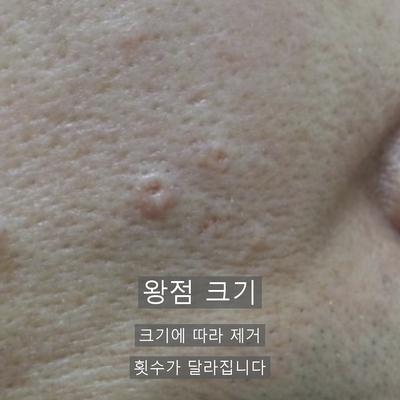
Post-treatment care for large mole removal is as important as the number of sessions. The treated area undergoes a healing process where scabs form and pigment rises. If thorough UV protection is not applied during this process, hyperpigmentation can occur, potentially making the area appear even darker.
Washing your face is possible from the day of the procedure, but be careful not to rub the treated area. It's fundamental for scar prevention to never pick at scabs with your hands and allow them to fall off naturally.

The re-treatment interval for large mole removal is typically between 4 to 8 weeks. Applying the laser again before the skin has fully regenerated can actually hinder recovery. After a sufficient recovery period, residual pigment is checked, and the decision for the next treatment is made.
Raised moles, moles in tricky areas near the eyes, and complex moles with pigment distributed across multiple layers require a more delicate approach. For such areas, accurate assessment of the condition before the initial treatment is especially crucial.

There's a common misunderstanding when considering large mole removal: the idea that 'large moles must always be surgically removed.' A large size doesn't necessarily mean an excisional surgery is required; in many cases, they can be effectively removed with lasers. However, since the removal method varies depending on the size and nature of the mole, choosing the appropriate method after a consultation is the first step.
Conversely, if a mole has rapidly grown in a short period, or if its color is uneven and its borders are irregular, it is correct to first verify its safety rather than proceeding with a cosmetic laser procedure.
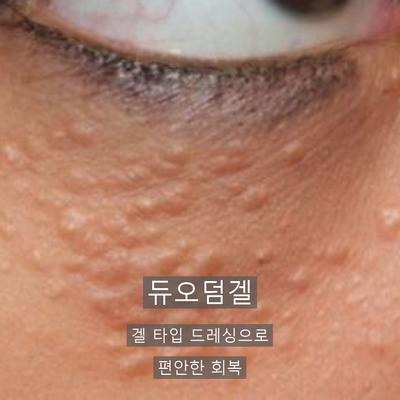
Kkeut Clinic's Unique Approach to Large Mole Removal
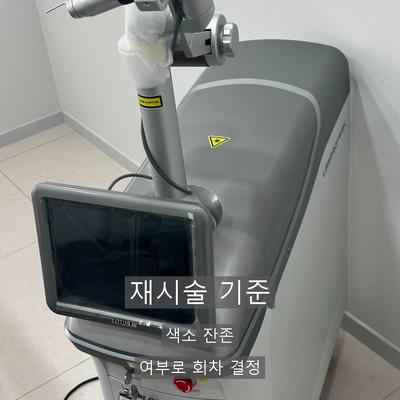
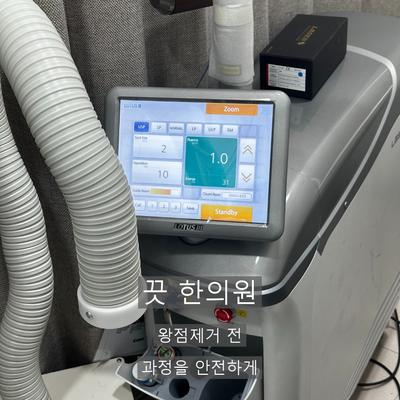
Kkeut Clinic utilizes both advanced Erbium YAG and CO2 lasers for large mole removal. To minimize downtime, Erbium YAG is primarily used, and CO2 is employed concurrently when hemostasis is needed to ensure a clean treatment surface. The core of Kkeut Clinic's mole removal lies in our operational method of coordinating these two lasers according to their specific purposes.
At Kkeut Clinic, if any suspicious findings indicative of malignancy are observed during the mole assessment, we do not proceed with the procedure and immediately refer the patient to a higher medical institution. Kkeut Clinic's mole removal differs in that it has a safety protocol, not just a simple cosmetic procedure.
Kkeut Clinic also differentiates itself in post-treatment care. Instead of the commonly used Duoderm stickers, we use gel-type Duoderm Gel. This allows individuals with allergies to Duoderm stickers to use it comfortably, protecting the treated area without the hassle of peeling and sticking like a sticker.
Frequently Asked Questions
Q. Does large mole removal really require more than 10 sessions?
A. The number of large mole removal sessions varies depending on the size and depth of the pigment. Large moles with deep and widespread pigment often require repeated re-treatments at 4-6 week intervals, with some cases needing more than 10 sessions. At Kkeut Clinic, we assess the condition at each session and aim to complete treatment with the minimum number of necessary sessions, avoiding unnecessary procedures.
Q. Will there be no scars after large mole removal?
A. The risk of scarring can be reduced by performing large mole removal in divided sessions at appropriate depths. Attempting to treat too deeply in a single session can sometimes lead to scarring, so a stepwise approach is safer. Post-treatment UV protection and moisturizing care are also crucial for scar prevention.
Q. How do large mole removal and general mole removal differ?
A. The difference lies in size and depth. General moles can often be removed in 1-2 sessions, but large moles require more sessions due to their wider and deeper pigmentation. Kkeut Clinic first assesses the condition before large mole removal and provides an estimated number of sessions.
Q. Can raised large moles also be removed with lasers?
A. Raised moles can also be removed with lasers. Kkeut Clinic offers large mole removal for raised moles and even tricky areas near the eyes, approaching each area according to its specific characteristics.
Q. Is malignancy checked before treating a large mole?
A. At Kkeut Clinic, we check the mole's condition before large mole removal, and if any suspicious findings indicative of malignancy are observed, we immediately refer the patient to a higher medical institution without performing a cosmetic procedure. Safety verification comes first.
Kkeut Clinic's Sincerity
Kkeut Clinic performs large mole removal using a dual-laser method, combining Erbium YAG and CO2 lasers to minimize downtime while ensuring a clean treatment surface.
Kkeut Clinic has a safety protocol in place: if suspicious findings indicative of malignancy are identified during mole consultation, the patient is immediately referred to a higher medical institution. Safety comes before cosmetic procedures.
Kkeut Clinic uses Duoderm Gel during the post-treatment recovery process to provide skin protection and comfortable care. It can be used without worries of sticker allergies, reducing the burden of aftercare for large mole removal.
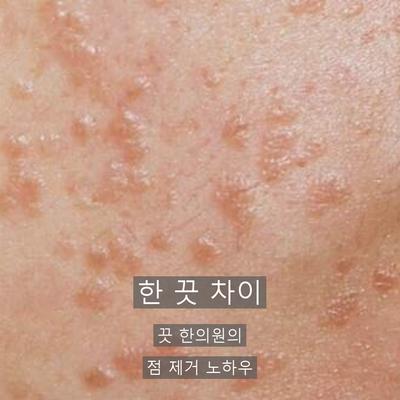
The subtle difference that makes a big impact — Experience it at Kkeut Oriental Medicine Clinic.
Loading menu…