

Laser Toning for Pigmentation: How It Fades Dark Spots Beomgye, Pyeongchon, Beomgye Station, Pyeongchon Station, Hogye-dong, Bisan-dong, Gwanyang-dong, Dongan-gu, Indeogwon, Geumjeong, Anyang
7/30/2025
This is a procedure note for Laser Toning for Pigmentation: How It Fades Dark Spots at Gyeonggi Anyang Beomgye KKEUT Korean Clinic.
What Exactly is the Principle Behind Laser Toning?
Many of you have probably heard of laser toning at least once.
Good for melasma, pigmentation lightens, skin tone brightens
While these phrases are familiar, everyone has similar questions before actually undergoing the procedure.
“Can laser really remove pigmentation?”
“Why doesn't it end after one or two sessions, and why does it require multiple sessions to be effective?"
“Some people say their pigmentation got darker after toning, what could be the reason?”
These are actually the most frequently asked questions in our clinic.
To properly answer these questions, it's essential to understand which cells the laser targets and how it acts deep within the skin,
you need to accurately understand its core principles.
We will explain the principles by which laser toning treats melasma and pigmentation, and why repeated treatments are necessary.
We will explain it as simply yet accurately as possible, so you can understand it even if it's your first time hearing about it.
Laser Toning 1. Decomposing Melanin (Pigment)
The core of laser toning is to break down the pigment itself.
Melasma and blemishes on the skin are essentially pigments called melanin.
This melanin is produced in cells called melanocytes and accumulates in the skin in particle form.
Laser toning precisely targets these melanin particles themselves.
The Q-switched Nd:YAG 1064nm wavelength laser used in laser toning
delivers high-power energy instantaneously over a very short period (nanoseconds).
This short, powerful energy creates not just light, but a shockwave,
generating a ‘photoacoustic effect’.
What is the Photoacoustic Effect?
When laser light is absorbed by a specific target (melanin particles in toning), it causes instantaneous thermal expansion,
and in this process, sound waves (pressure waves) are generated, applying mechanical shock to the surrounding tissues.
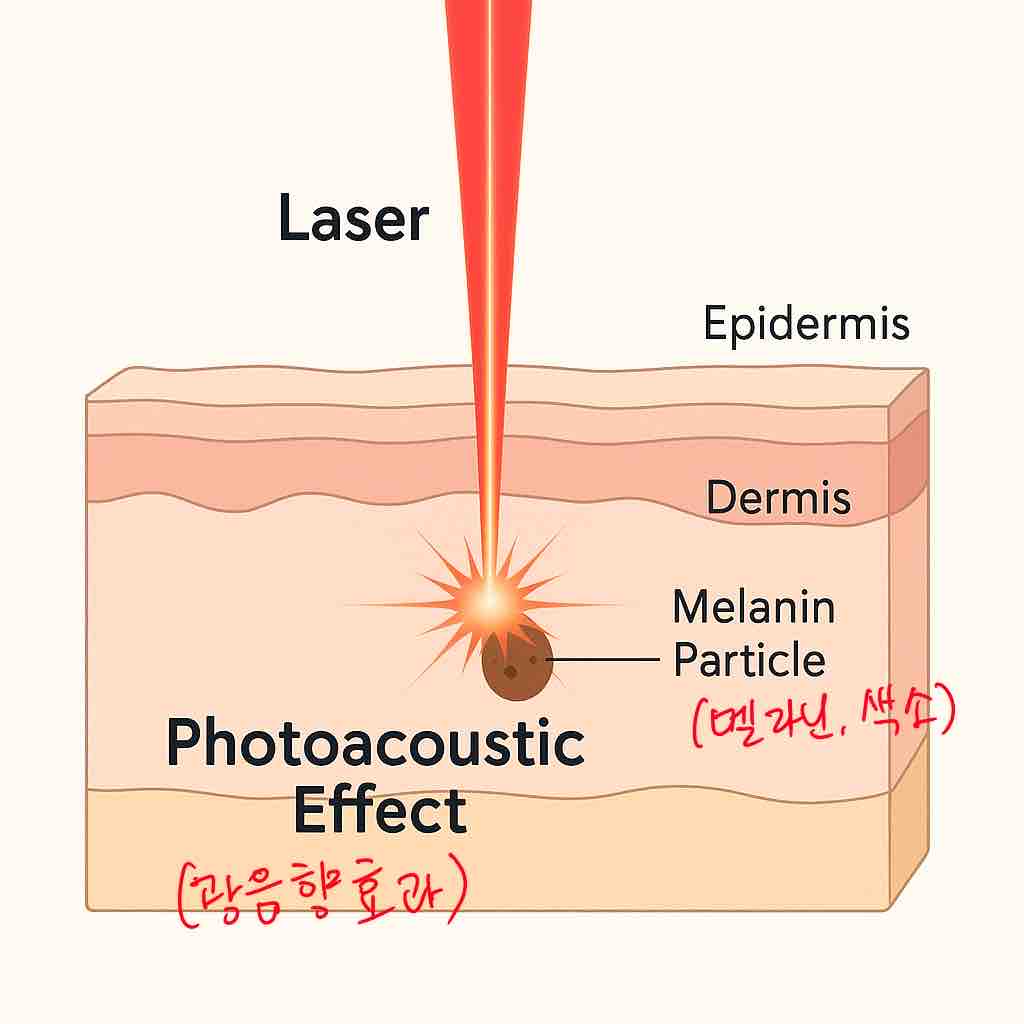
This shock primarily affects structures with high light absorption, such as melanin particles.
Since melanin has the property of readily absorbing 1064nm wavelength lasers,
it can selectively cause microscopic destruction of melanin without stimulating other tissues.
As a result, melanin particles are physically broken down and dispersed,
and these fragments are then naturally expelled from the skin by the lymphatic system and macrophages.
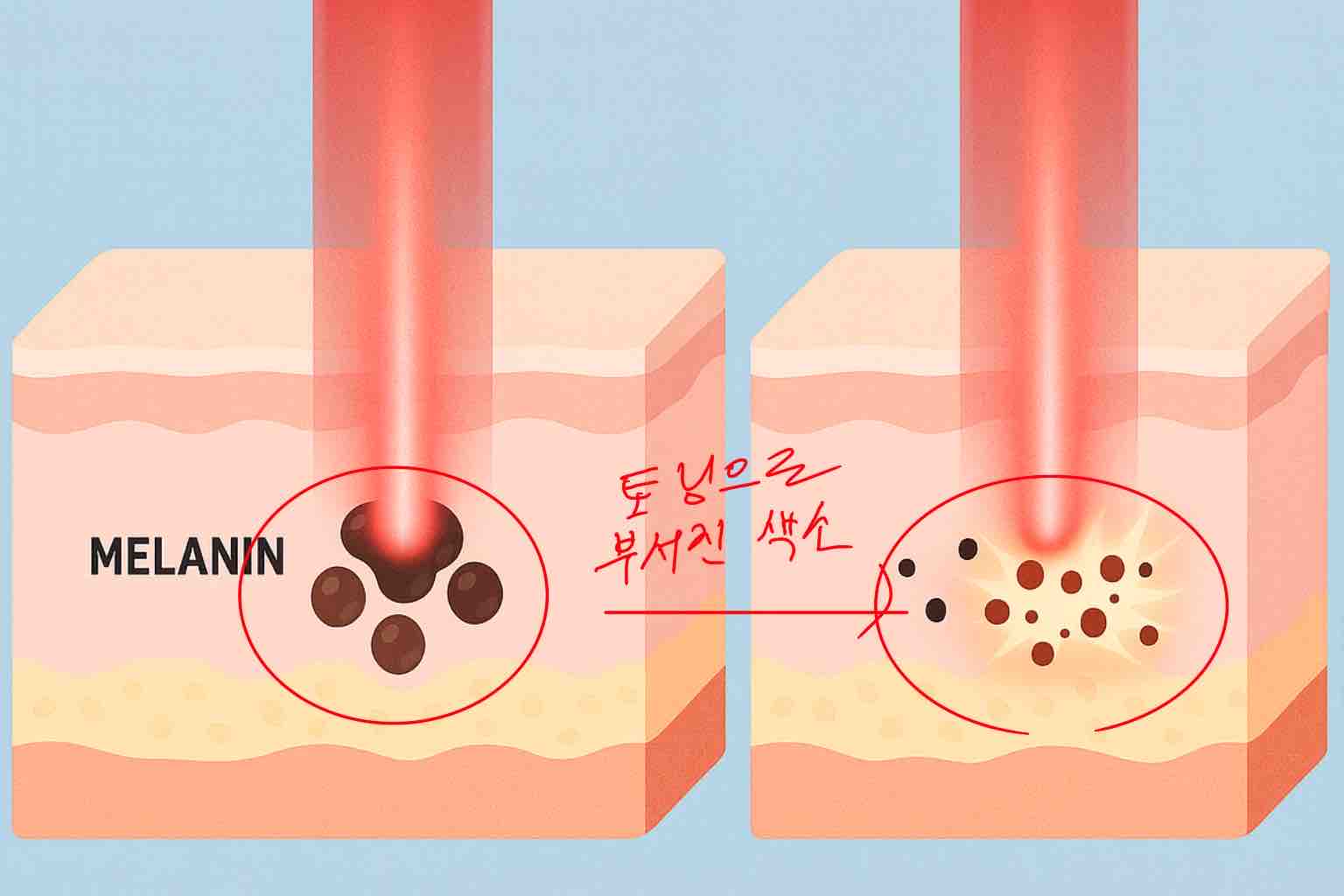
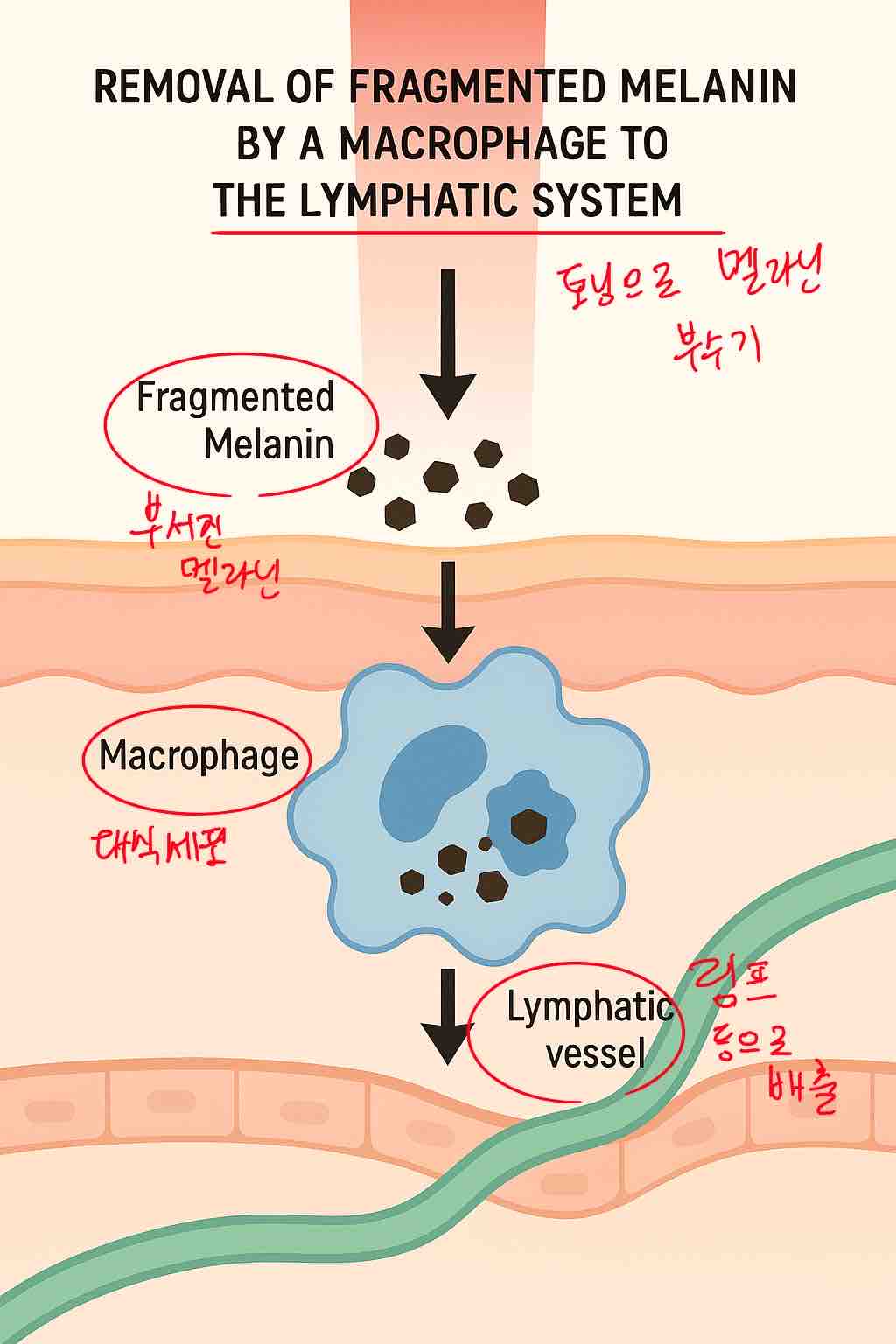
As this process is repeated, the overall amount of pigment decreases, and the skin tone gradually brightens.
Most importantly, this process occurs without leaving any wounds or burns on the skin.
It is precisely this non-invasive and selective destructive action
that makes laser toning widely used and trusted.
Laser Toning 2. Suppressing the Melanin-Producing Cells Themselves to Prevent Re-pigmentation
Simply removing existing pigment does not fully resolve melasma.
This is because melanin can continue to be produced.
Melanin is produced in melanin cells called melanocytes,
and these cells extend dendrites (cell processes) to deliver melanin to the skin's surface.
The more numerous and active these dendrites are, the more melanin moves to the epidermis,
ultimately making melasma or hyperpigmentation appear darker to the naked eye.
Laser toning works by inhibiting or partially destroying these dendrite structures,
thereby reducing the melanin transfer pathway itself.
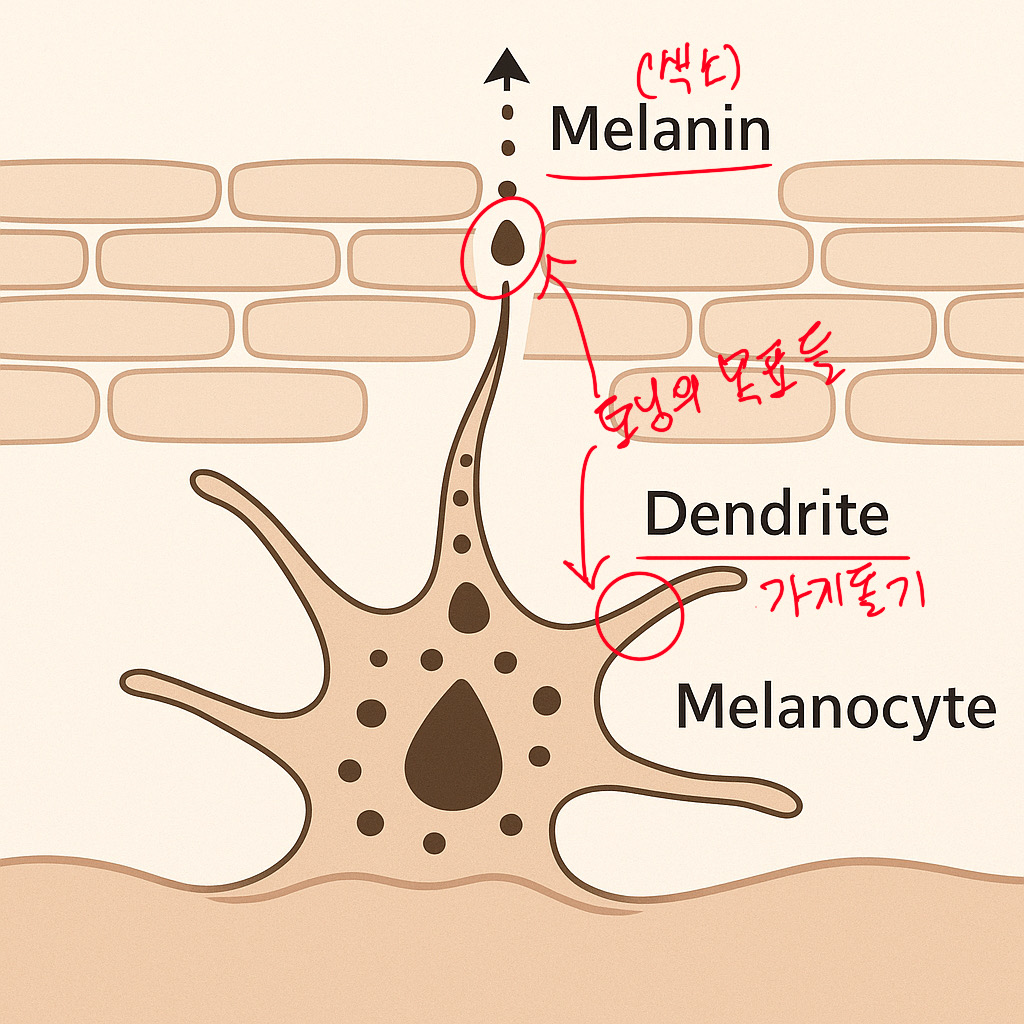
Additionally, during repeated irradiation, it suppresses the excessive activity of melanocytes and,
guides the cells into a stable state.
Thanks to this mechanism, even in chronic pigmentary conditions like melasma,
we can expect results where the pigment is stably maintained without recurrence.
Of course, if Genesis Toning is also performed,
even more powerful suppression of excessive melanocyte activity and prevention of pigment recurrence is possible.
Genesis Toning will be covered in another column.
Laser Toning 3. Why Repetition is Necessary
Skin needs to be persuaded, not pressured, to change.
Laser toning is not a treatment that ends immediately with one strong shot.
Melasma and hyperpigmentation do not appear overnight,
because melanocytes in the skin are highly sensitive cells.
If stimulated with too much energy, more pigment may be produced,
or side effects like post-inflammatory hyperpigmentation (PIH) can occur.
Therefore, laser toning always relies on repeated treatments with low energy as a fundamental principle.
However, simply using weak shots does not guarantee effectiveness.
Within an intensity sufficient for the skin to react,
energy must be precisely adjusted according to the treatment progress and responsiveness.
For example, starting at 1.0J initially, and then adjusting based on skin tone, reaction, and the location of residual pigment at the 3rd to 5th session,
increasing to 1.5J or more, or adjusting the shot speed and spot density is necessary to achieve definite results.
As these fine adjustments accumulate, melanin breakdown, dendrite inhibition, and melanocyte stabilization occur simultaneously,
and the pigment removal effect becomes much more pronounced.
Fundamentally, more than 10 repeated treatments are recommended,
during which melanin decreases, cells stop overreacting,
ultimately leading to clinical changes like 'reduced pigmentation' and 'clearer skin'.
Summary of Laser Toning Principles
Laser toning finely breaks down and removes melanin pigment particles through a photoacoustic effect,
while simultaneously inhibiting the dendrite structures that transfer melanin to the epidermis, thereby blocking pigment migration,
and it is a complex treatment that even stabilizes the excessive activity of melanocytes through repeated irradiation.
To achieve effective results, it's not about continuously using weak shots,
but rather a necessary process of cumulatively designing treatments by adjusting energy according to the skin's reaction over 10 or more sessions.
Related notes
Procedure notes worth reading next.


Loading menu…