

Ultherapy not effective? Is it because the treatment wasn't properly designed or various types of tips weren't used? Beomgye, Pyeongchon, Beomgye Station, Pyeongchon Station, Hogye-dong, Bisan-dong, Gwanyang-dong, Dongan-gu, Indeogwon, Geumjeong, Anyang
5/5/2026
This is a procedure note for Ultherapy not effective? Is it because the treatment wasn't properly designed or various types of tips weren't used? at Gyeonggi Anyang Beomgye KKEUT Korean Clinic.
Many people experience Ultherapy with no results and wonder if it's a 'device problem'.
However, in most cases where Ultherapy yields no results, looking for the cause in the device is often the wrong approach.
There are two decisive factors that determine the outcome: pre-procedure design and tip selection.
First Cause: Procedures started without design while lying down
Ultherapy works by focusing energy at a specific depth beneath the skin.
If the exact locations for energy delivery are not designed in advance, the treated areas become random.
A bigger problem arises when the procedure begins with the patient lying down.
When lying down, facial tissues shift backward as the direction of gravity changes. If energy is delivered in this state, the facial structure and tissue position will differ from when you are actually sitting or standing.
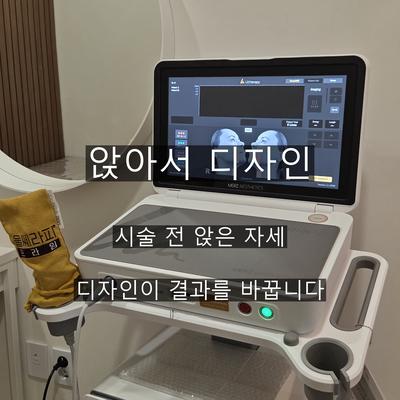
As a result, you might experience sunken cheeks, asymmetric pulling on both sides, or a feeling that the desired areas show no improvement while unintended areas have changed.
At Kkeut Clinic, we always perform the design phase with the patient in a sitting position before the procedure.
We assess the facial structure under the actual influence of gravity, precisely design the areas for energy delivery, and then proceed with the treatment.
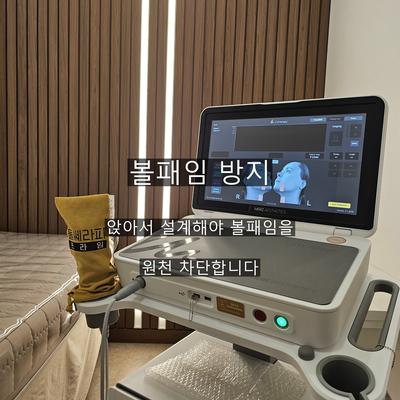
Kkeut Clinic's Unique Sitting Design — The Starting Point for Lifting Without Sunken Cheeks
The design stage takes a little longer. That time is the crucial process for preventing sunken cheeks and asymmetry.
This is why Kkeut Clinic never skips this step.
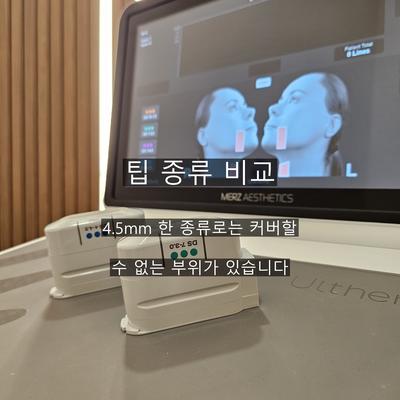
Second Cause: Procedures using only one type of tip
The Ultherapy tip determines the depth at which energy reaches.
The 4.5mm tip is the main tip for delivering energy to the SMAS layer.
However, facial skin thickness and structure vary by area. The forehead, periorbital area, crow's feet, and neck line are much thinner than the cheeks or jawline.
If only a 4.5mm tip is applied to the entire face, the energy will bypass the target layer in areas with thinner skin.
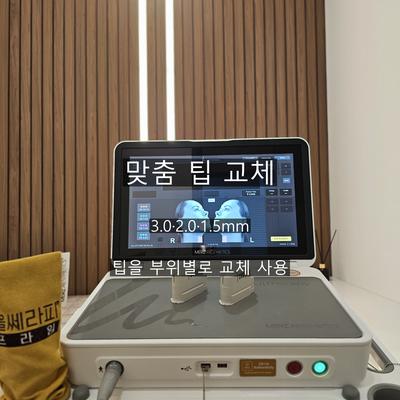
If the energy fails to reach the desired depth, it's equivalent to having no lifting stimulation at all.
At Kkeut Clinic, in addition to the 4.5mm main tip, we have 3.0mm, 2.0mm, and 1.5mm tips available and switch them according to the area.
For areas with thinner skin, such as around the eyes, forehead, and neck line, we switch to tips with shallower depths to precisely target the correct layer.
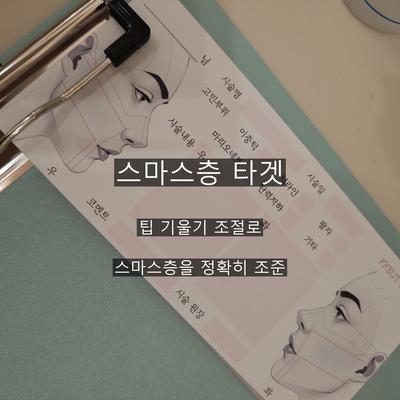
We even adjust the tip angle to precisely target the SMAS layer.
At Kkeut Clinic, in addition to changing tips, we also adjust the tip angle to precisely target the SMAS layer.
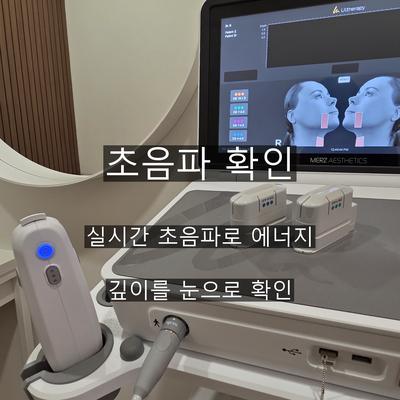
We perform procedures while visually confirming which layer the energy is being delivered to by viewing real-time ultrasound images.
The method that relies solely on sensation and the method that proceeds with ultrasound confirmation are on entirely different levels in terms of precision.
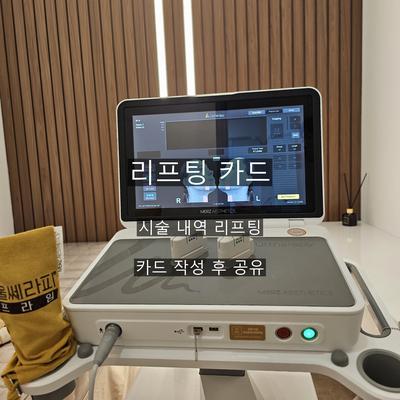
Kkeut Clinic creates and shares a lifting card after each procedure.
We record which tips were used, on which areas, and to what extent, and this information is directly incorporated into the design for the next session.
This approach ensures that each procedure is not an isolated event but part of cumulative management.
Frequently Asked Questions
Q. If Ultherapy showed no results, can getting a re-treatment at a different clinic make a difference?
A. If the reason for Ultherapy having no effect was insufficient design and the use of a single tip, then you can expect different results by receiving treatment at a place that properly applies these two factors. Kkeut Clinic's principle is to first perform the design while the patient is sitting and to switch to customized tips for each area.
Q. To avoid Ultherapy showing no results, what criteria should I use to choose a clinic?
A. The most direct criteria to avoid Ultherapy having no results are whether the design is performed while sitting before the procedure and whether the tip types are changed. Without these two processes, it's as if there is no procedure design at all.
Q. Is having many tip types not necessarily good?
A. How the tips are selected is more important than the variety of tips themselves. Kkeut Clinic confirms the depth with ultrasound and selects tips according to the skin thickness of each area. This is an evidence-based selection, not random tip changes.
Q. If Ultherapy showed no results, will increasing the number of sessions solve the problem?
A. If the procedure method remains unchanged and only the number of sessions is increased, the same results will be repeated. The design and tip selection methods must change first. At Kkeut Clinic, we record the details of each session on a lifting card, ensuring that the design for the next treatment directly reflects previous data.
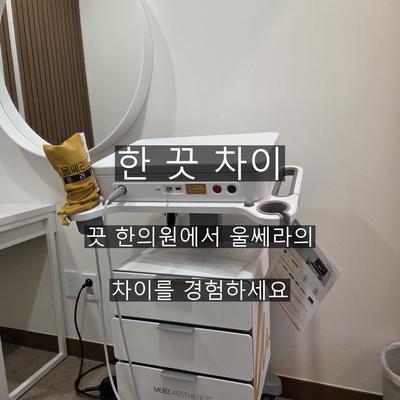
Kkeut Clinic's Sincerity
Kkeut Clinic always performs the design phase with the patient in a sitting position before the procedure to achieve lifting results without sunken cheeks.
Kkeut Korean Medicine Clinic replaces 3.0, 2.0, and 1.5mm tips for each area, in addition to the 4.5mm main tip, and adjusts the tip's tilt to precisely target the SMAS layer.
Kkeut Korean Medicine Clinic performs treatments while verifying depth with real-time ultrasound, and transparently shares treatment details for each session with a lifting card.
Different Results with a Subtle Difference — Experience it at Kkeut Korean Medicine Clinic.
Related notes
Procedure notes worth reading next.


Loading menu…