

Flat Warts on the Chest: Understanding the Principles from Diagnosis to Laser Selection Beomgye, Pyeongchon, Beomgye Station, Pyeongchon Station, Hogye-dong, Bisan-dong, Gwanyang-dong, Dongan-gu, Indeogwon, Geumjeong, Anyang
7/3/2026
This is a procedure note for Flat Warts on the Chest: Understanding the Principles from Diagnosis to Laser Selection at Gyeonggi Anyang Beomgye KKEUT Korean Clinic.
When multiple small, flat papules appear on the chest, chest flat warts are often suspected.
Not all lesions that appear on the skin surface are flat warts. This is because it is common for similar-looking lesions such as milia, skin tags (soft fibromas), and sebaceous hyperplasia to appear together in the same area.
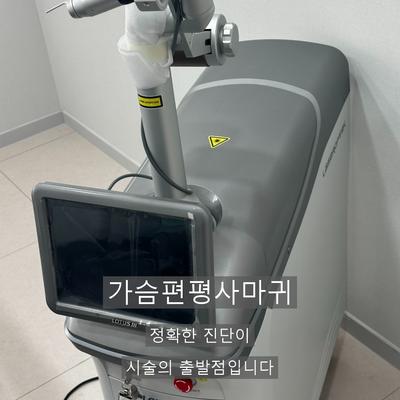
Differential diagnosis comes first
Flat warts are viral lesions caused by HPV (Human Papillomavirus) infection in the skin epidermis. Their surface is flat, their color is close to skin tone or slightly brownish, and their size is often within a few millimeters. When multiple lesions appear in clusters, flat warts can be strongly suspected.
Milia are white papules formed by keratin buildup inside sebaceous glands, and skin tags are soft protrusions caused by stretched skin. Unlike flat warts, these two are not viral lesions. Different causes require different approaches.
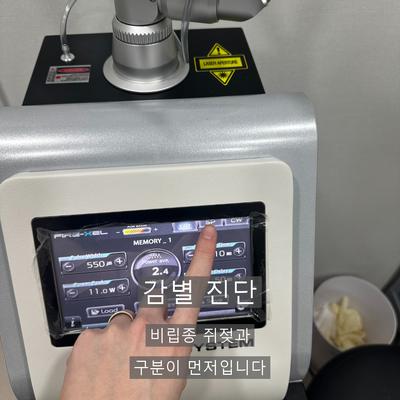
Distinguishing between viral and non-viral is the starting point for choosing a procedure. If it is viral, an approach beyond simple removal is necessary. This is because if latent viruses are not treated together, they can recur in the same spot or spread to surrounding areas.
Since it is difficult to distinguish with the naked eye, a diagnostic step of illuminating the lesion with a light or examining its shape with a magnifier precedes treatment. Skipping this step and applying a laser makes it difficult to expect effective results.
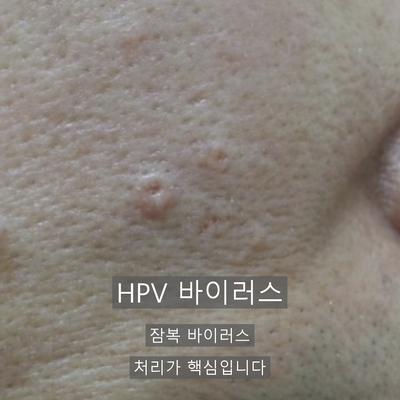
HPV Virus and Recurrence Characteristics
HPV has the characteristic of remaining latent in the skin for a certain period. Even if visible lesions are removed, viruses latent in the surrounding skin can later create new lesions. This is the main reason for the recurrence of flat warts.
There is also a characteristic called autoinoculation. If a lesion is scratched with hands or irritated by shaving, the virus can transfer to the surrounding skin, creating new lesions. The chest area is an environment where clothing repeatedly rubs, so this risk is relatively higher.
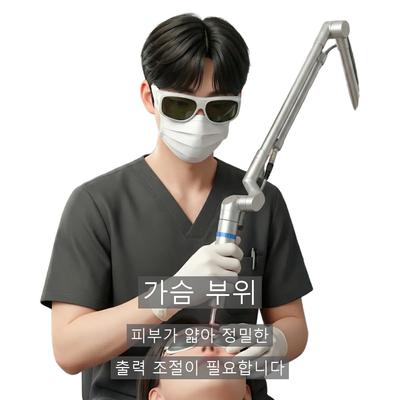
Characteristics of the Chest Area
The skin on the chest is thin and not exposed to UV light for long periods, so its inherent resistance is relatively low. It is an area where power adjustment must be particularly precise during laser procedures.
In the case of chest flat warts, visiting before the number of lesions increases is beneficial for both the treatment area and recovery time. The wider the lesions spread, the larger the treatment area and the longer the overall recovery time.
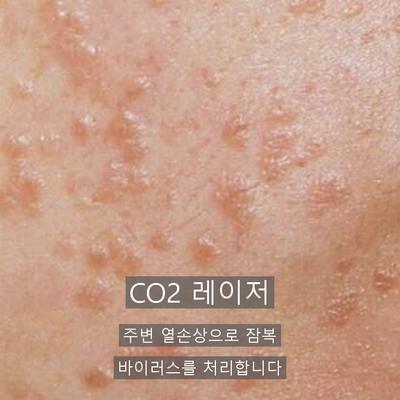
Principle of Laser Selection
CO2 laser (carbon dioxide laser) and Er:YAG laser are mainly used for removing chest flat warts. The two lasers operate in different ways.
CO2 laser vaporizes tissue while causing thermal damage to the surrounding area. It has a hemostatic effect, and thermal effects spread to surrounding tissues after the procedure. In flat warts, this characteristic of thermal damage is strategically utilized. This is because latent HPV viruses beneath the lesion surface can be treated with heat at the same time.
Er:YAG laser has a high absorption rate in water molecules, allowing for precise tissue ablation. It causes less surrounding thermal damage compared to CO2, and downtime after the procedure is shorter. While more limited than CO2 in terms of treating latent viruses, its strengths lie in precise removal and fast recovery.
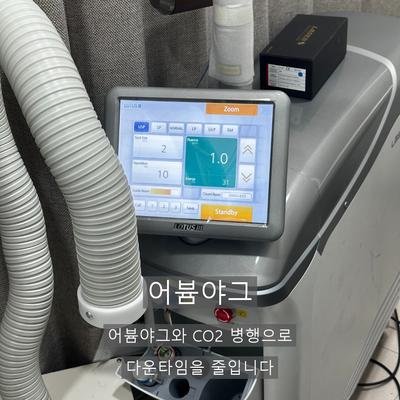
This is why combining these two lasers is recommended for flat wart treatment. Downtime is minimized by the precision of Er:YAG, and recurrence suppression is supplemented by the thermal damage characteristic of CO2. It requires designing a combination that leverages the advantages of both lasers, rather than choosing just one.
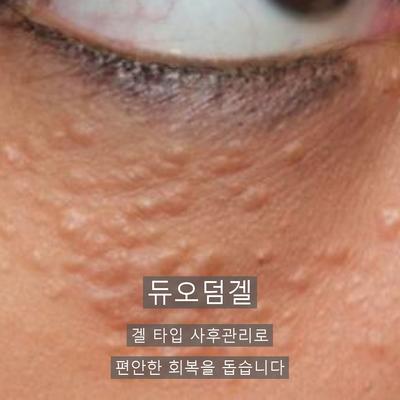
Using DuoDERM Gel after the procedure helps with recovery. Unlike general sticker types, the gel form is easy to apply and replace, and comfortable to use even on skin sensitive to sticker materials.
Kkeut Korean Medicine Clinic's Unique Approach to Flat Warts
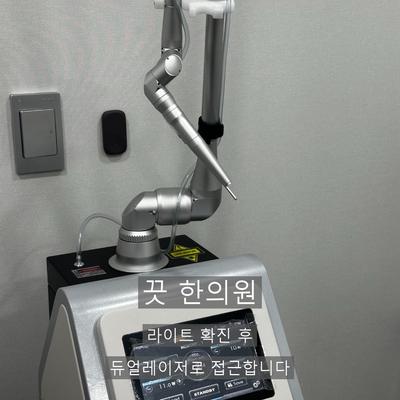
At Kkeut Korean Medicine Clinic, before the procedure, we illuminate the lesion with a light in the consultation room to confirm the presence of flat warts. This differs from starting with a laser without a diagnosis. Understanding the nature of the lesion first ensures the correct laser selection.
Kkeut Korean Medicine Clinic adheres to a dual-laser approach combining Er:YAG and CO2. It's structured to intentionally utilize the peripheral thermal damage of CO2 to treat latent viruses together, and to reduce downtime with Er:YAG. Rather than simply possessing two lasers, the combination is designed based on an understanding of the latent characteristics of the HPV virus.
Frequently Asked Questions
Q. How are chest flat warts and milia distinguished?
A. Chest flat warts are HPV viral lesions that appear flat and in clusters. Milia are white papules with a keratin-filled structure. Since the two lesions have different causes, the treatment approach also differs. Accurate differentiation is only possible after a diagnostic step, such as light magnification.
Q. Isn't chest flat wart laser treatment too irritating?
A. Chest flat wart procedures are performed after applying anesthetic cream, so pain during the procedure is not severe. Since chest skin is relatively thin, power settings must be precisely adjusted, and this is one reason why combined use of Er:YAG and CO2 is necessary.
Q. What if chest flat warts recur after removal?
A. Due to the nature of viral lesions, there is a possibility of recurrence. If you choose Kkeut Korean Medicine Clinic's unlimited treatment option, you can receive touch-up treatments at no additional cost if recurrence occurs. This provides real peace of mind for those concerned about the recurrence of chest flat warts.
Q. Can all chest flat warts be removed in one session?
A. Due to the nature of latent viruses in chest flat warts, residual lesions may appear after a single treatment. The treatment plan varies depending on the number and condition of the lesions, and it is important to proceed with an understanding of this characteristic.

Kkeut Korean Medicine Clinic's Sincerity
Kkeut Korean Medicine Clinic first identifies the nature of the lesion through a light-based diagnostic stage before designing the treatment. This approach yields different results compared to applying lasers without a diagnosis.
Kkeut Korean Medicine Clinic utilizes a dual-laser method that intentionally leverages the peripheral thermal damage of CO2 to treat latent viruses. We operate a protocol that considers recurrence suppression at the design stage, rather than just simple surface removal.
Kkeut Korean Medicine Clinic includes touch-ups when the unlimited treatment option is chosen. Since viral lesions can recur, this allows for management without additional cost, reducing the patient's burden throughout the treatment process.
A Kkeut Difference, Different Results — Experience it at Kkeut Korean Medicine Clinic.
Related notes
Procedure notes worth reading next.


Loading menu…