

Why is it important to carefully check for genuine Ultherapy devices and the number of shots? Beomgye, Pyeongchon, Beomgye Station, Pyeongchon Station, Hogye-dong, Bisan-dong, Gwanyang-dong, Dongan-gu, Indeogwon, Geumjeong, Anyang
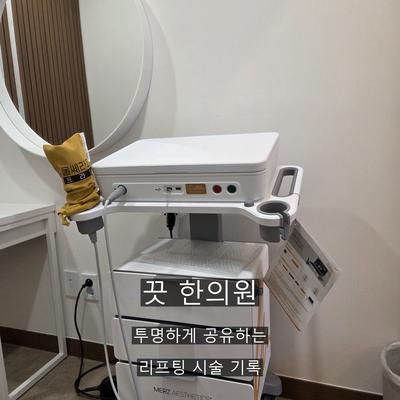
This is Gyeonggi Anyang Beomgye KKEUT Korean Clinic's procedure note on Why is it important to carefully check for genuine Ultherapy devices and the number of shots.
Ultherapy is a lifting treatment device that concentrates and delivers ultrasound energy deep into the skin.
Ultherapy is one of the most frequently inquired treatments for those looking to improve facial sagging. However, even with the same equipment, the changes felt after the procedure can vary from person to person.
These differences begin with verifying the use of genuine tips and the actual number of shots delivered.
When choosing a lifting procedure, it's crucial to carefully check whether genuine equipment and tips are used, and the actual number of shots delivered.
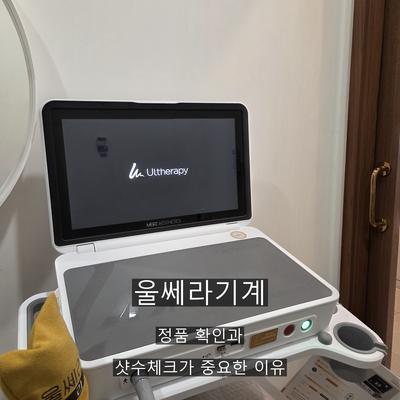
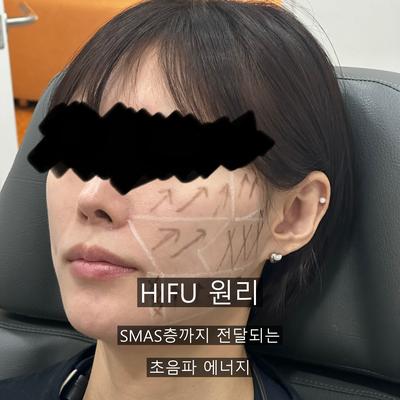
Ultherapy utilizes High-Intensity Focused Ultrasound (HIFU) technology.
This method focuses ultrasound energy not on the epidermis but on the deep fascial layer, the SMAS layer, promoting collagen production and inducing tissue contraction.
The difference in treatment results depends on whether the energy reaches the correct skin layer.
The ability to observe ultrasound images of the treatment area in real-time is a unique feature of Ultherapy, differentiating it from other lifting devices.
It can be considered for application on areas with overall reduced skin elasticity, such as sagging cheeks, a weakened jawline, and loss of elasticity around the eyes and forehead.
Beyond sagging due to simple aging, improvement can also be expected through the treatment in cases where facial support structures are weakened due to insufficient skin volume.
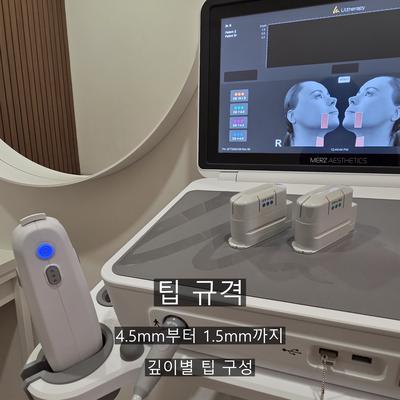
The depth to which ultrasound energy reaches with Ultherapy equipment is determined by the type of tip (4.5mm, 3.0mm, 2.0mm, 1.5mm).
For energy to be accurately delivered to the desired depth of the skin layer, the tip specifications must match.
Even within a single face, skin thickness varies across different areas such as above the cheekbones, the cheek area, and under the chin. Therefore, multiple types of tips are often used during treatment to adjust the energy.
This is precisely why verifying the use of genuine tips is important.
If the tip specifications are not accurate or the equipment settings deviate from the standard, there's a possibility that even with the same treatment, the energy may not reach the target depth properly.
Therefore, verifying authenticity should be understood as more than just checking if a specific brand is used; it's a process of ensuring that core treatment criteria, such as tip specifications and energy shot length, are correctly applied.
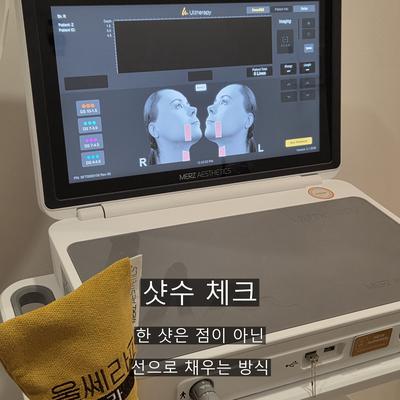
One shot is a line, not a dot
In Ultherapy treatment, one shot delivers energy in a line shape, not a single dot.
This method involves continuously delivering ultrasound energy at very short intervals to form a single thermal coagulation line, and these lines are precisely arranged to deliver energy across the entire face.
The length of this single line is fundamentally set to 25mm, which is the standard specification for the equipment.
If the length of this line is arbitrarily reduced, the treatment time may be shortened, but the actual area reached by the energy per shot will also decrease.
The position of the SMAS layer varies from person to person, and even within the same face, there are differences across areas. Therefore, it can be difficult to precisely target the correct layer with tip specifications alone.
Consequently, even if a person receives the same 600 shots, the total amount of ultrasound energy actually delivered to the skin can vary.
For this reason, rather than merely checking the number of shots, also verifying the actual length of each shot delivered can provide a more accurate understanding of the treatment details.
Since it is a treatment method that densely fills the entire face with fine line-shaped energy, an appropriate minimum number of shots should be applied proportionally to the treatment area.
Accurate shot count checking determines the results
Generally, 600 shots or more are recommended. However, the appropriate number of shots needed can vary individually depending on the size of the treatment area, the degree of skin sagging, and specific areas where concentrated improvement is desired.
Therefore, during pre-treatment consultation, it's crucial to discuss and determine the appropriate number of shots for the individual while deciding on the facial design.
If the number of shots is insufficient but energy is attempted to be delivered to an excessively wide area, the density of energy delivered to each area may be too low, making it difficult to achieve the desired effect.
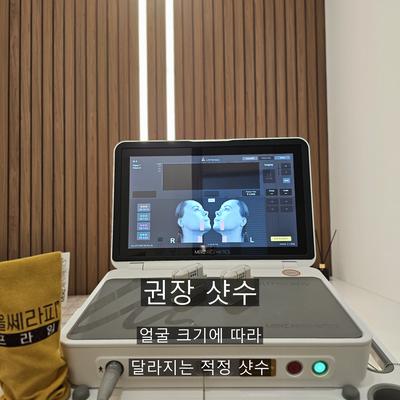
As this treatment delivers energy to deep skin layers, a slight sensation of irritation may be felt during the procedure.
Typically, anesthetic cream is applied to reduce pain during the procedure, and in some cases, individuals may receive the treatment without anesthesia.
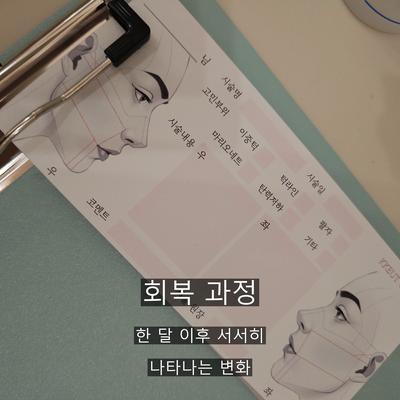
Swelling may accompany the immediate post-treatment period. While individual differences exist, skin changes can generally be felt gradually starting about a month after the procedure.
Since this treatment involves a process of tissue restructuring through ultrasound thermal stimulation, it takes some time for the effects to become apparent.
If you have concerns about the recovery period, it is helpful to have a thorough consultation with a specialist before the procedure to understand the expected swelling and recovery process.
When the recommended number of shots has been fully applied during treatment, it is generally common to consider the next treatment with an interval of about 6 months to 1 year.
If a sufficient number of shots cannot be received in a single session and must be split, an additional treatment can typically be performed at 1-month intervals to complete the planned shot count.
The cycle of Ultherapy treatment can vary depending on the individual's degree of skin sagging, so it is advisable to consult with a specialist to determine the appropriate timing.
When deciding on the timing for re-treatment, it is also important to plan by considering various factors such as the number of shots applied in the previous treatment and the intensity for each area.
Frequently Asked Questions
Q. Do I absolutely need to receive 600 shots or more with Ultherapy?
Since Ultherapy delivers energy to the entire face, the minimum number of shots appropriate for the treatment area is important. While Ultherapy typically recommends 600 shots or more, the necessary number of shots can vary depending on an individual's facial shape and degree of skin sagging. It is advisable to determine the exact number of shots through consultation with a specialist. If it is determined that the number of shots is insufficient, additional treatments can be performed over several sessions to address the missing areas.
Q. Is sleep anesthesia necessary for Ultherapy?
A. Ultherapy is performed by delivering ultrasound energy with the tip closely adhered to the skin surface. If the procedure is done under sleep anesthesia, there is a risk that the tip's adherence may decrease due to unconscious movements. At our clinic, we typically perform the procedure with topical cream anesthesia in most cases.
Q. I have little fat on my face and am worried about my cheeks hollowing out after Ultherapy.
A. Ultherapy acts on the SMAS layer beneath the skin, which is distinct from the fat layer responsible for facial volume. In fact, if there is insufficient facial volume, the supporting power may be weaker, making skin sagging even more noticeable. Therefore, for individuals with less volume, it is crucial to have a treatment plan that precisely delivers energy only to the SMAS layer while avoiding the fat layer.
Q. When can I expect to see the effects of Ultherapy?
A. Temporary swelling may accompany the procedure immediately afterward. While there are individual differences, you can generally start to notice gradual changes about one month after the treatment. This is because the process of tissue regeneration and restructuring, necessitated by Ultherapy's thermal stimulation, requires time.
Q. Are there any treatments that can be combined with Ultherapy to achieve synergistic effects?
A. Ultherapy is a treatment that delivers energy to the deep SMAS layer of the skin. Therefore, it works on a different layer than treatments that improve skin texture or elasticity on the surface. For this reason, it is common to combine Ultherapy with treatments that focus on superficial layers, such as Denssity, Onda, and Tenssrma.
Our Clinic's Treatment Philosophy
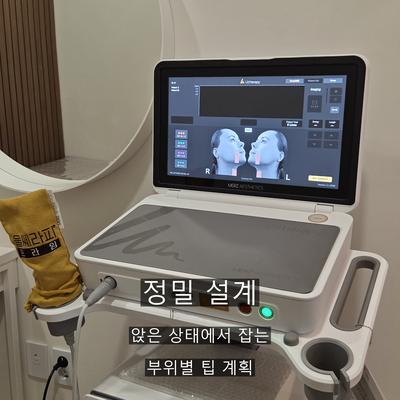
At our clinic, we meticulously plan the design in a seated position before the procedure and set appropriate tips and energy levels for each facial area. Through this process, we provide customized treatments for each individual.
During the procedure, we monitor real-time ultrasound images and thoroughly analyze the skin layers. Based on this, we aim for precise treatment using a tilting technique that finely adjusts the angle of the tip.
At our clinic, we adhere to the principle of using the full 25mm standard length tip for safe and effective treatments.
After the procedure, we provide transparent treatment information, including the type of tip used, the treatment area, and the number of shots delivered, through a lifting card.
Experience the difference made by unparalleled meticulousness at our clinic.
Related notes
Procedure notes worth reading next.


Loading menu…