

Understanding Dark Circles: Solutions Customized to Their Origins Beomgye, Pyeongchon, Beomgye Station, Pyeongchon Station, Hogye-dong, Bisan-dong, Gwanyang-dong, Dongan-gu, Indeogwon, Geumjeong, Anyang
8/5/2025
This is a procedure note for Understanding Dark Circles: Solutions Customized to Their Origins at Gyeonggi Anyang Beomgye KKEUT Korean Clinic.
Dark Circles: Causes and Treatment Approaches
Many individuals are concerned about dark circles under their eyes, often attempting to conceal them with cosmetics.
Clinic visitors frequently express concerns that, despite getting enough rest,
the area beneath their eyes still looks dark and tired.
While some may attribute this to inherent skin darkness,
detailed examination often reveals structural factors are the primary cause, rather than simply pigmentation changes.
Therefore, dark circles arise from diverse origins,
and present as a complex symptom, frequently stemming from a blend of several contributing elements.
What appears to be mere darkness under the eyes
may necessitate distinct diagnostic evaluations and tailored treatment strategies.
Addressing this demands not only a grasp of dermatological principles but also an integrated view of anatomical structures and tissue characteristics.
Dark Circle Cause #1: Under-eye Volume Loss
A significant factor contributing to dark circles is the anatomical alteration that occurs in the lower eyelid region.
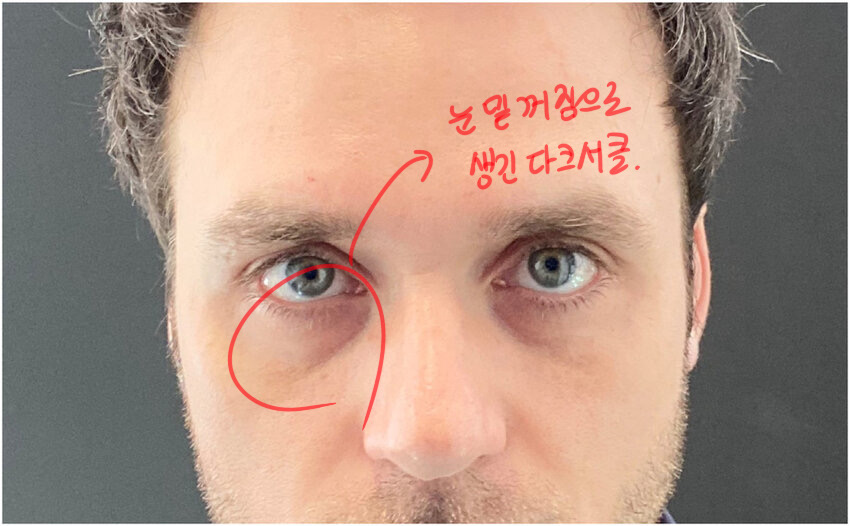
With advancing age, the tear trough region tends to deepen,
and the orbital fat positioned above it may descend under the influence of gravity,
leading to more defined under-eye boundaries and apparent shadowy areas.
Here, the actual skin complexion remains unchanged; instead, the shadows formed by the three-dimensional facial structure are interpreted as dark circles.
These effects can become more noticeable under overhead lighting, or when capturing photos in well-lit settings,
which may accentuate the under-eye depressions and often convey a fatigued appearance.
For these situations, the effective approach is not merely focused on 'enhancing skin luminosity',
but rather, carefully replenishing the depleted volume and subtly reshaping the contours to re-establish a more harmonious three-dimensional structure.
Ultimately, the key lies beyond simply addressing the hollows,
It involves a nuanced method that considers the overall facial profile and integrates the design within its natural curves.
Dark Circle Cause #2: Pigment Accumulation
Another contributing factor is dark circles resulting from hyperpigmentation.
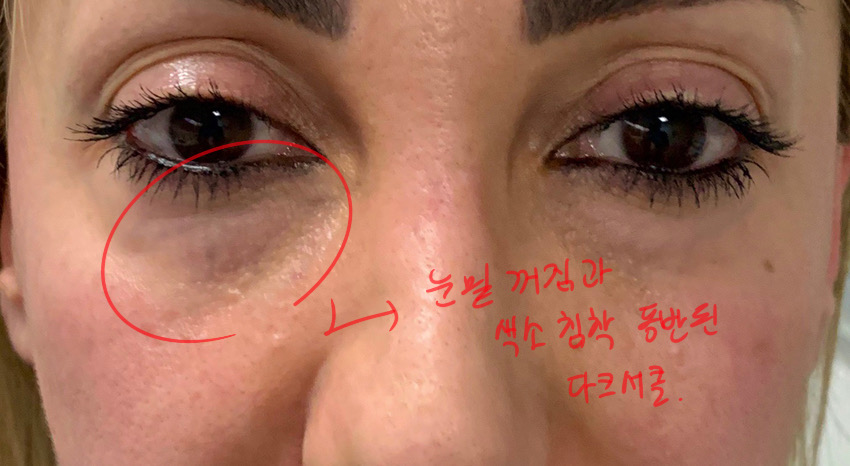
The periorbital skin is notably thin and exhibits a heightened sensitivity to various irritants.
Consequently, habits such as frequent rubbing, applying excessive pressure during facial cleansing, or prolonged exposure to sunlight,
along with chronic dermatological conditions like atopic dermatitis or allergic reactions,
may stimulate the delicate under-eye skin to produce an increased amount of melanin as a protective response.
With time, this melanin tends to gather in the sub-orbital area,
leading to a progressive darkening of the under-eye skin and the formation of dark circles.
A distinguishing feature of such cases is a persistent dark appearance, irrespective of ambient lighting conditions.
This phenomenon is observed more frequently in individuals with naturally deeper skin tones or those with sensitive skin that is susceptible to irritation.
The fundamental strategy in these instances involves modifying lifestyle habits to minimize irritation, combined with interventions to address pre-existing melanin deposits.
Actions like frequently touching or rubbing the delicate eye region, or vigorous scrubbing during cleansing,
along with inadequate UV protection, can all contribute to stimulating melanin synthesis.
Simultaneously, specialized pigmentation management to decrease existing melanin and inhibit its transfer into the skin cells may be beneficial.
Dark Circle Cause #3: Dermal Thinning and Vascular Visibility
A third contributing factor is the increased visibility of blood vessels, which often results from a thinning dermal layer and decreased skin elasticity.
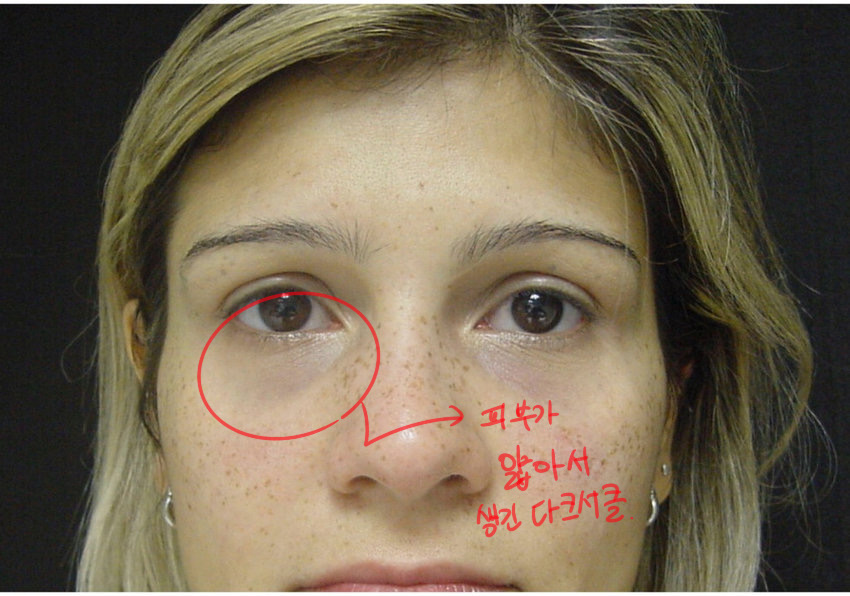
The skin in the sub-orbital area is recognized as one of the most delicate and thinnest tissues on the human body,
나이가 들면서 피부 진피층의 콜라겐과 탄력섬유가 줄어들면, 피부는 더욱 얇고 투명해질 수 있습니다.
이렇게 얇아진 피부 아래로는 푸른색의 혈관들이 비쳐 보입니다.
이 혈관들이 피부를 통해 드러나면서 다크서클처럼 보이게 됩니다.
이 경우 다크서클의 원인이 색소 침착이 아니기 때문에,
미백 화장품이나 색소 레이저만으로는 유의미한 개선을 기대하기 어려울 수 있습니다.
특히 수면 부족, 혈액 순환 저하, 눈의 피로가 겹쳐진다면,
혈액 정체가 심해져 다크서클이 더욱 두드러져 보일 수 있습니다.
이러한 유형의 해결책은 진피를 두껍게 만들고 피부 밀도를 높이는 것에 초점을 맞춰야 합니다.
콜라겐 합성을 유도하여 피부가 덜 투명해지도록 돕는 것이 필요하며,
혈관이 내부에서 덜 비쳐 보이도록 근본적인 개선이 고려되어야 합니다.
결론적으로, 다크서클은 겉보기에는 비슷해 보여도,
그 원인은 매우 다양하며, 따라서 해결 방식 또한 달라져야 합니다.
어떤 분들에게는 눈 밑 꺼짐이 주된 원인일 수 있고, 또 다른 분들에게는 색소 침착이나 피부의 투명도가 문제일 수 있습니다.
이 세 가지 원인이 동시에 복합적으로 작용하는 경우도 흔합니다.
이런 경우에는 단일한 방법만으로는 충분한 개선을 기대하기 어려울 수 있습니다.
클리닉에서는 환자 개개인의 눈가 상태를 다양한 각도에서 세심하게 진찰합니다.
그리고 정확한 원인을 설명해 드리고 필요한 만큼만 시술적 개입을 하는 방침을 지키고 있습니다.
결론적으로
다크서클은 피부가 어두워 보이는 단일한 결과물로 나타나지만,
그 근원에는 해부학적 구조, 색소 과다 침착, 그리고 진피의 투명도라는 여러 요인이 자리하고 있습니다.
세 가지 서로 다른 원인층이 있다는 뜻이지요.
눈 밑이 꺼져 입체적인 그림자를 만든다면 구조적 복원이 필요하고요,
피부 색깔 자체가 어두워졌다면 멜라닌 색소 조절이 중요합니다.
만약 피부가 얇아 아래 조직이 비쳐 보인다면 진피를 두껍게 하는 방향으로 접근해야 합니다.
정확한 진단 없이는 올바른 해결책을 찾기 어렵습니다.
단순히 레이저 시술이나 미백 제품을 무분별하게 사용하는 데에는 한계가 따르지요.
피곤해 보이는 인상 대신 건강하고 맑은 눈매를 만들기 위해서는,
무엇보다도 근본 원인을 정확히 이해하는 접근이 필요합니다.
Related notes
Procedure notes worth reading next.


Loading menu…