

Mustache Hair Removal: Why We Recommend Laser Hair Removal Instead of Shaving Beomgye, Pyeongchon, Beomgye Station, Pyeongchon Station, Hogye-dong, Bisan-dong, Gwanyang-dong, Dongan-gu, Indeogwon, Geumjeong, Anyang
This is Gyeonggi Anyang Beomgye KKEUT Korean Clinic's procedure note on Mustache Hair Removal: Why We Recommend Laser Hair Removal Instead of Shaving.
People looking into mustache hair removal have usually tried a razor first.
Even if you shave in the morning, the area above your lip looks dark again by afternoon, your makeup lifts, and taking off your mask becomes stressful.
This article lays out, in order, why to consider laser hair removal instead of shaving, from the principle to the number of sessions and aftercare.
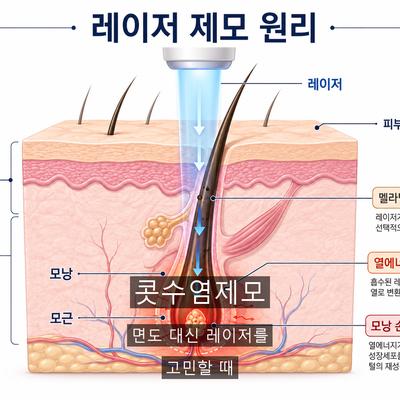
Why shaving does not solve the problem
Shaving only cuts off the upper part of the hair that has come out of the skin.
The hair root and follicle that produce the hair remain, so over time hair grows back in the same spot.
Plucking with tweezers is just as temporary.
During the period you are receiving laser hair removal, plucking hairs is prohibited. This is because the hair root that the laser is supposed to hit is gone, and the treatment loses its effect.
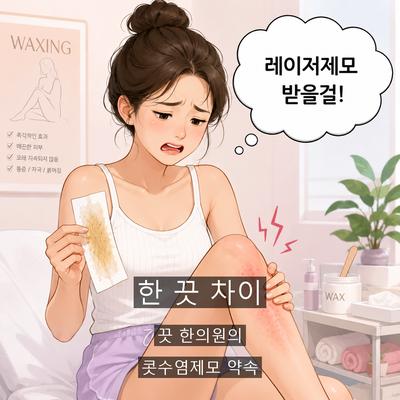
Waxing is also temporary and quite irritating to the skin. The difference is that the laser aims for semi-permanent results by destroying the follicle itself.
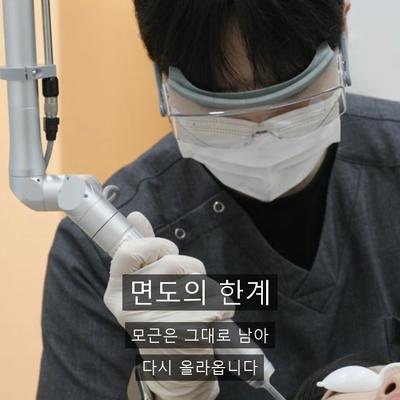
Shaving cuts the hair; laser hair removal targets the follicle
How laser hair removal works
Laser energy is selectively absorbed by the black melanin pigment in the hair and converted into heat.
This heat is the principle by which the hair root and follicle that make the hair grow are destroyed.
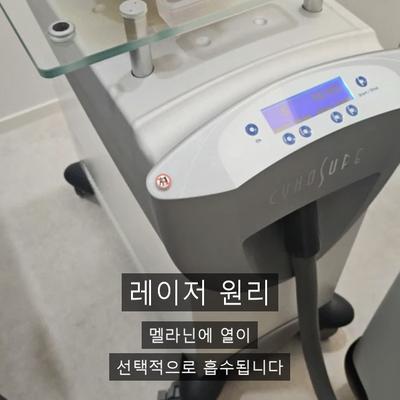
The laser works effectively only on follicles in the growth phase, when melanin activity is at its highest.
This is why repeat treatments are needed, timed to the cycle in which hairs in the resting phase return to the growth phase.
Facial areas such as the upper lip, chin and hairline have hair of very different types, from fine vellus hair to thick beard hair, so precise energy control is needed. This is why design matters in mustache hair removal.
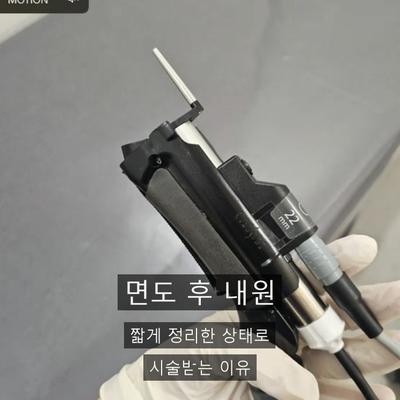
You need to shave before the treatment
If the hair is long, the energy burns up on the skin surface. The risk of burns increases, and the energy cannot reach the hair root under the skin.
Shaving is not a replacement for laser hair removal; it is used as preparation before the treatment.
After the treatment, we recommend shaving from the next day, once the skin has calmed down, rather than on the same day. This is because the hair is limp, so it may not shave as cleanly as usual.
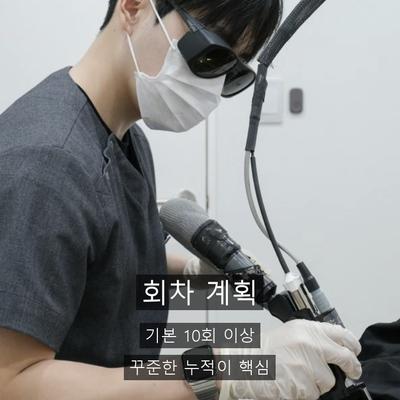
How sessions and intervals are planned
For any area, we recommend a basic minimum of 10 sessions.
The timing at which each hair enters the growth phase varies by chance, so enough accumulated sessions are needed to reach all follicles.
Men's beard growth may require 20 or more sessions over more than a year. Men starting mustache hair removal are better off knowing this pace and planning for it in advance.
The interval between treatments is at least 3 weeks, and 4 weeks is recommended. This is to protect the skin by respecting the 4-week skin cell renewal cycle, and to give new growth-phase hairs time to get ready.
There is no permanent hair removal where hair never grows back; semi-permanent hair removal is the key. Even after complete hair removal, we recommend a maintenance session once every 2 to 3 months.
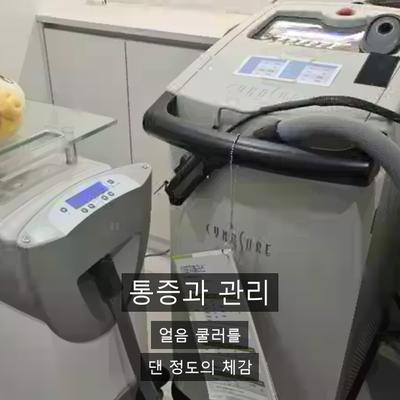
Pain and aftercare
Numbing cream only acts on the skin surface and does not numb down to the hair root. The actual sensation is similar to receiving treatment while holding an ice cooler against the skin, and it decreases greatly as sessions accumulate and the hair thins.
Because the treatment delivers heat directly to the follicle, it is a natural reaction for folliculitis to develop. It improves over time if you apply a regenerating cream well.
For 1 to 2 days after the treatment, avoid activities that heat up the face, such as exercise, saunas and drinking alcohol.
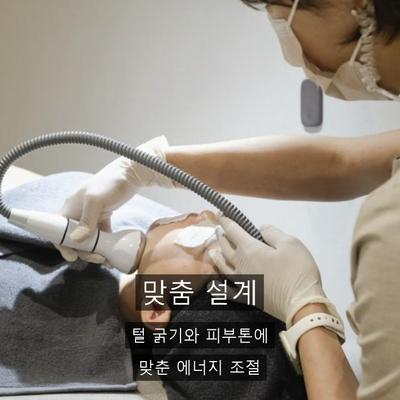
Kkeut Oriental Medicine Clinic designs treatment to match the condition of the hair
For areas with thick hair, Kkeut Oriental Medicine Clinic uses a long pulse to deliver heat gently and protect the epidermis.
For thick, dark hair, the energy density is designed to be high so that heat accumulates in the thick structure, while for thin, light hair the energy is raised or repeated pulses are used to deliver heat to the hair root.
In areas where the hair is dense, the energy is spread out to prevent burns from overheating, and for darker skin tones the output is adjusted precisely.
Kkeut Oriental Medicine Clinic is equipped with proven alexandrite-based devices such as Apogee and GentleMax. Apogee constantly sprays cold air before and after laser irradiation to reduce skin irritation.
At Kkeut Oriental Medicine Clinic, before ending the treatment, we check whether there are any additional areas to treat, and we finish only after the client gives final approval.
Frequently asked questions
Q. How is mustache hair removal different from continuing to shave?
A. Mustache hair removal is a treatment that delivers heat to the hair root and follicle to reduce the power of the hair to grow back. Shaving only cuts the hair outside the skin, so the root remains and the hair grows back in the same spot.
Q. Can I have mustache hair removal without anesthesia?
A. In mustache hair removal, numbing cream does not act on the hair root, so it is not medically essential. At Kkeut Oriental Medicine Clinic, we control pain by using cooling together.
Q. When can I shave after mustache hair removal?
A. We recommend shaving from the day after, once the skin has settled, rather than on the day of the treatment. Plucking hairs is prohibited during the laser hair removal period.
The sincerity of Kkeut Oriental Medicine Clinic
Kkeut Oriental Medicine Clinic provides differentiated results through its treatment-end confirmation, finishing only when the client says OK.
Kkeut Oriental Medicine Clinic raises patient satisfaction through pulse and energy density designs matched to hair thickness, density and skin tone.
Kkeut Oriental Medicine Clinic pursues safety and effectiveness at the same time through proven devices such as Apogee and GentleMax and the use of cooling.
A small difference makes a different result — Experience it at Kkeut Oriental Medicine Clinic.
Related notes
Procedure notes worth reading next.


Loading menu…