



Sebaceous Gland Hyperplasia: What Causes It? Beomgye, Pyeongchon, Beomgye Station, Pyeongchon Station, Hogye-dong, Bisan-dong, Gwanyang-dong, Dongan-gu, Indeogwon, Geumjeong, Anyang
6/4/2026
This is a procedure note for Sebaceous Gland Hyperplasia: What Causes It? at Beomgye(Opening Soon) KKEUT Korean Clinic.
If you have small, yellowish bumps on your face that don't seem to disappear, understanding the cause of sebaceous hyperplasia is the starting point for treatment.

Sebaceous hyperplasia is a benign lesion where the sebaceous glands within the skin abnormally enlarge and proliferate, becoming visible on the surface.
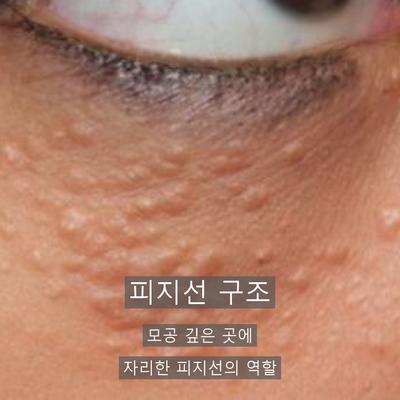
Normal sebaceous glands have a structure where multiple lobules are attached to a single pore. When sebaceous hyperplasia occurs, the number of these lobules increases, and each lobule enlarges, rising towards the skin surface. During this process, yellowish or flesh-colored papules, 1-5mm in size, with a visible central pore, form on the skin surface. When pressed, sebum may seem to emerge, and when several are clustered together, they can resemble a cluster of flowers.
While primarily appearing after the age of 40, it can also occur in people in their 30s and tends to concentrate on areas with active sebum secretion such as the nose, cheeks, forehead, and chin. The reason it often forms centrally on the face, where sebaceous gland density is high, is in the same context.
5 Main Causes of Sebaceous Hyperplasia
The cause of sebaceous hyperplasia is not a single factor but a complex interplay of various elements.
The first is hormonal changes. Sebaceous gland activity is strongly influenced by androgens (a type of male hormone). It is common for sebaceous glands to be overstimulated, leading to an increase in the number of lobules during periods of changing hormonal balance, typically after the age of 40-50. The relatively higher incidence in men is also linked to this context. In women, onset or worsening can sometimes be observed during periods of significant hormonal changes around menopause.
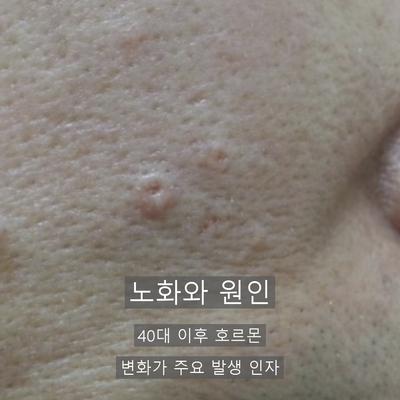
The second is aging. As we age, the skin's cell regulation function slows down, and the normal replacement cycle of sebaceous gland cells becomes disrupted. Aging itself creates an environment that promotes the hypertrophy and proliferation of sebaceous gland lobules, which is why sebaceous hyperplasia is classified as one of the age-related skin changes.
The third is cumulative UV exposure. Long-term UV damage disrupts the growth control signals of skin cells. The concentration of sebaceous hyperplasia in the central areas of the face, which are heavily exposed to sunlight, is also related to this cumulative UV effect. This is also why UV protection is considered important in the management of sebaceous hyperplasia.
The fourth is genetic predisposition. The likelihood of developing sebaceous hyperplasia increases if there is a family history of it. If the number and activity of sebaceous gland lobules are genetically set to be more active, lesions tend to appear earlier and in greater numbers even in the same age group and environment.

The fifth is oily or combination skin types. Skin with naturally active sebum secretion creates an environment where the sebaceous glands are constantly stimulated. If sebaceous glands are continuously overloaded, lobule proliferation can accelerate. This is why skin that doesn't regulate sebum well has a higher risk of developing it.
There are also clinical reports indicating a significantly higher incidence of sebaceous hyperplasia in individuals taking immunosuppressants (such as cyclosporine) long-term. In such cases, it is necessary to discuss medication adjustment with the treating medical staff.
How to distinguish it from Milia and Syringomas?
Distinguishing between similar-looking small bumps determines the course of treatment. Even if they look alike, their causes are entirely different.
Milia are white, small bumps formed when keratin (a type of skin protein) gets trapped within a hair follicle. They occur due to a problem with the stratum corneum, unrelated to sebaceous glands, and appear as hard, white granules without a visible central pore. They commonly appear around the eyes and on the cheeks.

Syringomas are lesions formed by the proliferation of sweat gland (ductal) cells. They are predominantly concentrated under the eyes, are flesh-colored to light brown, and appear flat or slightly raised. They are more commonly observed in women due to hormonal influences.
Sebaceous hyperplasia is characterized by a central pore and a rough, flower-like surface. All three lesions can look similar, making it easy for patients to confuse them. Since different causes require different approaches, an accurate differential diagnosis is the first step in treatment.
Sebaceous hyperplasia is a benign lesion, but natural resolution is rare. If left untreated, it tends to maintain its size or slowly grow. Recurrence in the same area is not uncommon with surface removal alone, because the lesion can re-form if the sebaceous gland itself is not altered. This is why a fundamental approach based on the cause of sebaceous hyperplasia is emphasized.

Kkeut Korean Medicine Clinic's Approach — We look at the sebaceous gland itself, not just the surface
Kkeut Korean Medicine Clinic does not view sebaceous hyperplasia as merely bumps visible on the surface.
Kkeut Korean Medicine Clinic differentiates between milia, syringomas, and sebaceous hyperplasia and approaches them differently. Even if they appear as similar small bumps, different causes require different treatment methods. At Kkeut Korean Medicine Clinic, after accurately distinguishing the nature of the lesions during the diagnostic stage, we apply a protocol tailored to each. A method of indiscriminate, blanket removal increases the likelihood of recurrence.
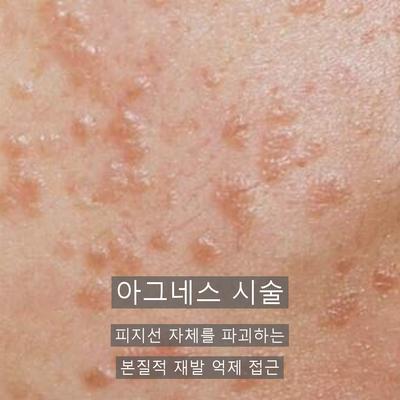
Kkeut Korean Medicine Clinic separately operates a combined program with Agnes (high-frequency insulated microneedle treatment) to prevent recurrence. Agnes involves inserting an insulated micro-needle deep into the lesion to directly deliver high-frequency energy to the sebaceous gland lobules themselves. Unlike surface removal, this approach fundamentally destroys the sebaceous glands, offering a different level of recurrence suppression. Kkeut Korean Medicine Clinic is truly committed to preventing recurrence, so much so that there is a separate pricing for procedures focused on the root cause.
After the procedure, we provide post-treatment care with DuoDERM Gel. It is a gel type, not a regular DuoDERM sticker, which can be used comfortably without allergy concerns and eliminates the hassle of peeling and sticking. At Kkeut Korean Medicine Clinic, post-treatment care that aligns with the essence of the procedure is designed as part of a single process.

Frequently Asked Questions
Q. Is the cause of sebaceous hyperplasia an excess of sebum?
A. While high sebum secretion is one of the underlying conditions for sebaceous hyperplasia, the core issue is the hypertrophy and proliferation of sebaceous gland lobules, rather than excessive sebum itself. Hormonal changes, aging, cumulative UV exposure, and genetic predisposition are complexly involved, and not all cases of high sebum secretion lead to sebaceous hyperplasia. While sebum management can help with prevention, treating existing lesions requires addressing the lobules themselves.
Q. If genetics is the cause of sebaceous hyperplasia, is prevention impossible?
A. Even with a genetic predisposition, diligent UV protection and sebum management can help delay onset or reduce the number of lesions. For existing lesions, managing them with accurate diagnosis and appropriate procedures is more realistic than prevention. Kkeut Korean Medicine Clinic provides personalized management guidance based on the causes of sebaceous hyperplasia.
Q. Even if the causes of milia and sebaceous hyperplasia are different, aren't the treatments similar?
A. Milia primarily involve the destruction of keratin cysts, while sebaceous hyperplasia stems from sebaceous gland lobule hypertrophy, so the approaches are entirely different. Kkeut Korean Medicine Clinic distinguishes between the two lesions and proceeds with different protocols for each. For sebaceous hyperplasia, a separate Agnes combined program is applied to inhibit recurrence. This is why recurrence is frequent in places that use the same removal method for both.
Q. Can sebaceous hyperplasia spontaneously improve regardless of its cause?
A. Sebaceous gland lobule proliferation, which is the cause of sebaceous hyperplasia, rarely resolves spontaneously unless the stimulus disappears. If left untreated, it tends to maintain its size or slowly grow, and surface removal alone leaves the sebaceous glands intact, making recurrence possible. Choosing a treatment method that addresses the sebaceous gland itself is key to long-term management.
Kkeut Korean Medicine Clinic's Sincerity
Kkeut Korean Medicine Clinic provides customized prescriptions to patients through accurate differential diagnosis, distinguishing between milia, syringomas, and sebaceous hyperplasia and approaching them differently.
Kkeut Korean Medicine Clinic is truly dedicated to recurrence suppression through a fundamental approach that destroys the sebaceous gland lobules themselves, utilizing a combined program with Agnes (high-frequency insulated microneedle treatment).
Kkeut Korean Medicine Clinic safely provides a comfortable recovery environment free from allergy concerns through DuoDERM Gel post-treatment care.

A Subtle Difference, Different Results — Experience it at Kkeut Korean Medicine Clinic.
Loading menu…