

Arm Laser Hair Removal: Your Guide to Semi-Permanent Reduction of Thick and Fine Hairs Beomgye, Pyeongchon, Beomgye Station, Pyeongchon Station, Hogye-dong, Bisan-dong, Gwanyang-dong, Dongan-gu, Indeogwon, Geumjeong, Anyang
7/1/2026
This is a procedure note for Arm Laser Hair Removal: Your Guide to Semi-Permanent Reduction of Thick and Fine Hairs at Gyeonggi Anyang Beomgye KKEUT Korean Clinic.
When considering arm laser hair removal, a question often comes to mind first. When the arm has a mix of thick and fine hairs, what criteria should be used for treatment to achieve different results?
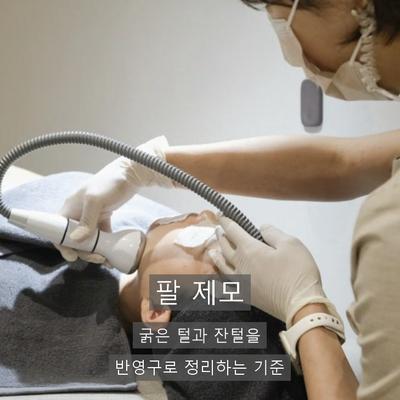
Arm hair varies in nature depending on the area. The outer forearm has thick, dark hair, while the inner arm or near the elbow has relatively fine, light-colored hair. Since these two types coexist in one area, arm laser hair removal should not be treated with a single setting, but rather by designing different parameters according to the hair's characteristics.
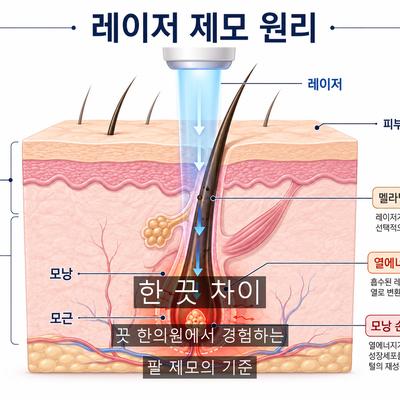
The principle of laser hair removal is selective photothermolysis. Laser energy is absorbed only by the melanin pigment in the hair, and that heat destroys the hair roots and follicles. The key is that the energy must reach only the hair follicles without damaging the epidermis. Thick, dark hair, which is rich in melanin, has a high energy absorption rate, but this also increases the risk of epidermal damage.
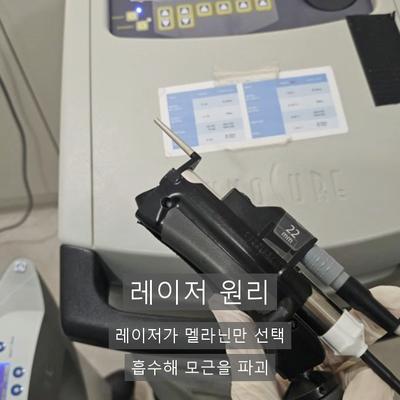
Fine hair has less melanin, so its reaction to the same energy is weak. Since there are fewer targets for the laser to hit, a different strategy must be employed, either by increasing the energy or through repeated irradiation to allow heat to accumulate in the hair roots. Ignoring this difference and applying the same setting to the entire arm can lead to a risk of burns for thick hair and insufficient results for fine hair.
Why Semi-Permanent Hair Removal Is Possible
The time when a laser is effective is limited to when the hair is in its growth phase. Hair cycles through growth, catagen, and telogen phases, but the laser only acts on hair follicles in the growth phase. This is why it's impossible to target all hair simultaneously with a single treatment. Since each follicle enters the growth phase at a different time, growth phase follicles must be destroyed sequentially through repeated treatments.
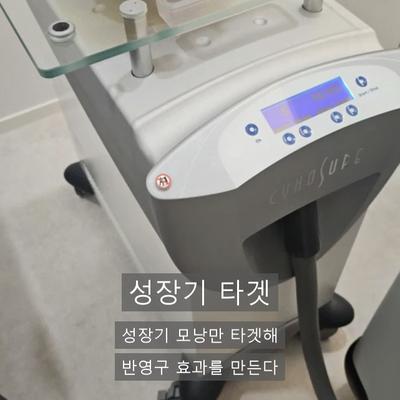
When this process accumulates sufficiently, the number of active hair follicles significantly decreases. This is what constitutes semi-permanent hair removal. Truly permanent hair removal, where not a single hair grows back for a lifetime, does not exist. After a series of treatments, you can maintain an almost hair-free state with simple maintenance treatments once every 2-3 months.
Recommended Number of Sessions and Frequency for Arm Laser Hair Removal
Arm hair removal should generally be based on at least 10 sessions. Since growth phase follicles are randomly distributed, a sufficient number of sessions is required to target most follicles. An interval of at least 3 weeks, preferably 4 weeks, is appropriate. This is because it allows time for new growth phase hairs to prepare while protecting the skin in line with its exfoliation and regeneration cycle.
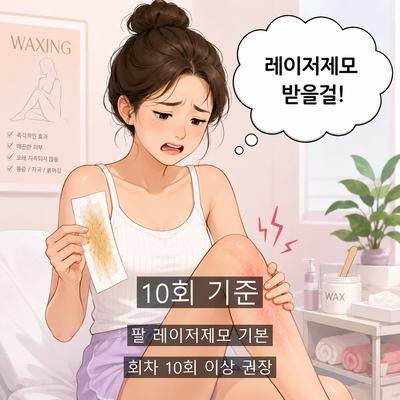
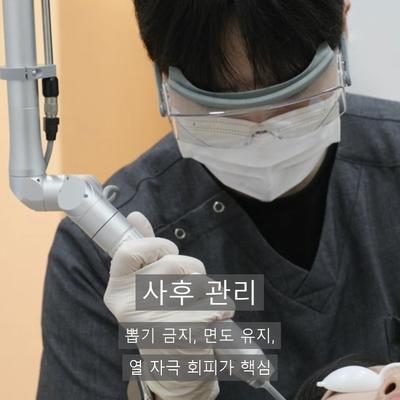
You must shave before your visit. If hairs are long, laser energy will burn on the skin surface, failing to reach the hair roots and only increasing the risk of burns. Waxing or plucking hairs is strictly prohibited during the laser treatment period. This is because if the hair root targeted by the laser is removed, the treatment effect disappears.
Folliculitis can sometimes occur after treatment, which is a natural reaction during the process of directly delivering heat to the hair follicles. Consistent application of a regenerating cream will help it subside naturally over time. Avoiding exercise, saunas, and alcohol for 1-2 days after treatment helps protect the skin.
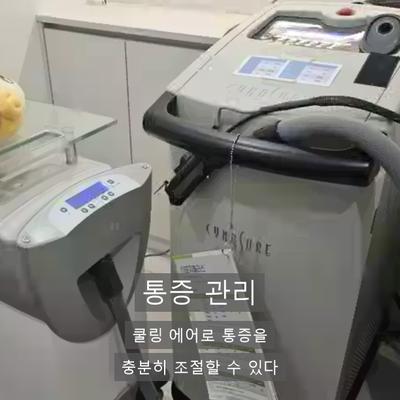
Many people experience pain as a sensation similar to having cool air applied during the procedure. As the number of sessions accumulates and the amount of hair decreases, the pain also diminishes. Numbing cream primarily acts on the skin surface and does not anesthetize the hair roots; cooling devices alone are sufficient for the procedure.
Why Kkeut Clinic Approaches Arm Laser Hair Removal Differently
Kkeut Clinic designs different pulse durations based on the thickness and color of arm hair. For thick, dark hair, which has high melanin content, injecting energy with a short pulse leads to rapid absorption, increasing the risk of epidermal damage. By using a long pulse to deliver heat gently, the epidermis is protected while sufficient heat accumulates in the hair roots.
Since fine hair has less melanin and a lower energy absorption rate, we compensate by increasing energy density or using repeated irradiation to deliver heat to the hair roots. In areas with dense hair, energy is dispersed to prevent burns from overheating, and for darker skin tones, the output is precisely lowered to prevent adverse reactions due to skin melanin. Not applying the same settings to the entire arm is Kkeut Clinic's standard.
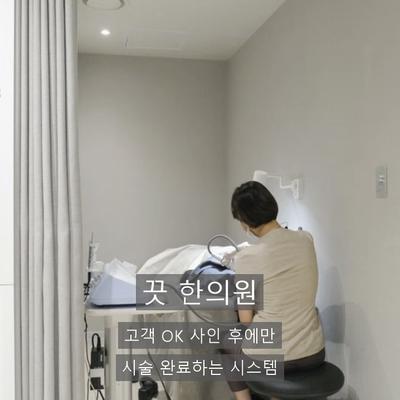
Kkeut Clinic operates on a system where treatment is only completed after the client personally confirms and gives an OK sign before the session ends. We focus more energy on areas that particularly concern each individual, and if any parts are not adequately treated, additional irradiation is performed. Treatment is not automatically considered complete just because the number of sessions has been met.
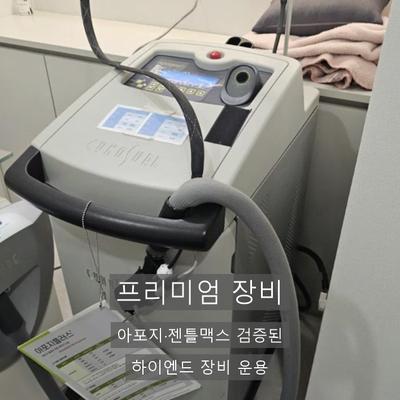
Kkeut Clinic utilizes globally verified high-end devices such as Apogee and GentleMax. Apogee employs an air cooling method that continuously sprays powerful cool air, maintaining constant cooling before and after laser irradiation. GentleMax uses DCD gas cooling, which provides strong instantaneous cooling. Both devices are proven in terms of pain control and skin protection performance.
Frequently Asked Questions
Q. Is arm laser hair removal performed in the same way for thick and fine hairs?
A. For arm laser hair removal, thick and fine hairs require different parameters. Thick hair, with its high melanin content and strong energy absorption, should be treated with long pulses to deliver heat gradually. Fine hair is compensated by increasing energy density or through repeated irradiation.
Q. How many sessions of arm laser hair removal are needed to see results?
A. For arm laser hair removal, it is appropriate to aim for at least 10 sessions. Since growth phase follicles are randomly distributed, a sufficient number of sessions is required to target most follicles. An interval of 3-4 weeks is recommended.
Q. I've been waxing continuously; can I switch to arm laser hair removal?
A. During the laser hair removal period, you must stop waxing or plucking. This is because if the hair root is pulled out, the laser has no target, and the effectiveness will decrease. After starting laser treatment, you should only manage hair by shaving.
Q. What should I do if folliculitis occurs after arm laser hair removal?
A. This is a natural reaction that occurs during the process of directly delivering heat to the hair follicles. Consistent use of a regenerating cream will help it subside over time. Avoiding thermal stimulation (exercise, sauna, alcohol) for 1-2 days after treatment aids in recovery.
Kkeut Clinic's Commitment
Kkeut Clinic enhances the perfection of arm hair removal results through precise design of pulse duration and energy density tailored to the characteristics of thick and fine hairs.
Kkeut Clinic manages treatment satisfaction with an unlimited responsibility system where treatment is only completed after the client's final confirmation and OK sign.
Kkeut Clinic minimizes pain and ensures both safety and effectiveness by utilizing globally verified high-end equipment like Apogee and GentleMax.
A Subtle Difference, Remarkable Results — Experience it at Kkeut Clinic.
Related notes
Procedure notes worth reading next.


Loading menu…