

Who is Ultherapy most effective for? Beomgye, Pyeongchon, Beomgye Station, Pyeongchon Station, Hogye-dong, Bisan-dong, Gwanyang-dong, Dongan-gu, Indeogwon, Geumjeong, Anyang
10/27/2026
This is a procedure note for Who is Ultherapy most effective for? at Gyeonggi Anyang Beomgye KKEUT Korean Clinic.
When considering Ultherapy, many people wonder if it's suitable for their face.
The suitability of Ultherapy can vary depending on the root cause of sagging. Not everyone achieves the same results, and in some cases, other types of procedures might be more necessary.
This article will explain, in order, the types of cases where Ultherapy can be effective, situations where other methods are recommended during consultation, and considerations before the procedure.
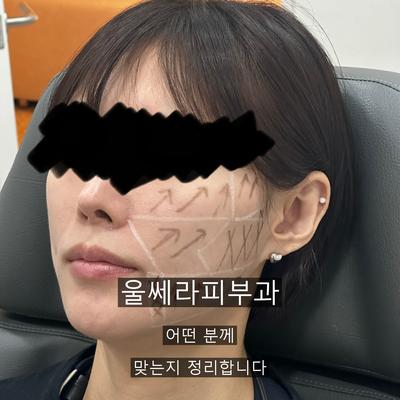
When your facial contours have sagged downwards
Firstly, for those whose facial contours have generally sagged downwards, making their mouth area or jawline indistinct.
If nasolabial folds deepen or the skin above the jawline feels heavy, there's a possibility that the problem lies with the underlying support structures rather than the skin surface.
Ultherapy uses high-intensity focused ultrasound energy to deliver heat to the SMAS layer, located beneath the skin and fat. This procedure improves the fundamental structure causing sagging.
If you haven't noticed changes in your contours when only managing the skin surface, you might consider this procedure after a consultation.
When you don't have much facial fat, but your contours appear disrupted
Next, this applies to individuals who don't have a lot of fat on their face, yet their contours appear disrupted.
Facial sagging can occur regardless of fat volume, even when the SMAS layer loses elasticity and stretches.
Especially for faces with less volume, the supporting strength can weaken, making the contours appear even more disrupted.
If there have been no changes in your facial contours even after weight loss, you can discuss and identify the cause of such sagging during a consultation.
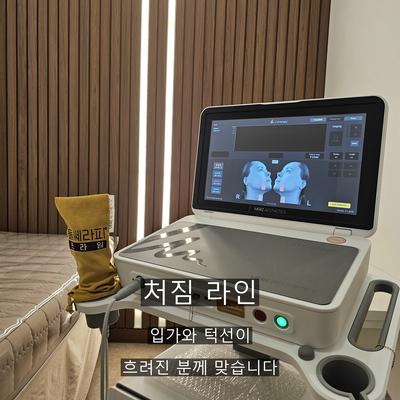
When frequent clinic visits are difficult
Thirdly, this applies to individuals who find it difficult to visit the clinic frequently due to a busy schedule, or who wish to maintain their results consistently with longer intervals between procedures.
If the recommended number of shots is administered in a single session, re-treatment can be considered at intervals of approximately 6 months to 1 year.
If the required number of shots is administered in divided sessions, it is usually done at 1-month intervals. In this case, your available schedule for visits will be coordinated during the consultation.
We generally recommend 600 shots or more, but the appropriate number of shots can vary depending on the size of the face and the degree of sagging.
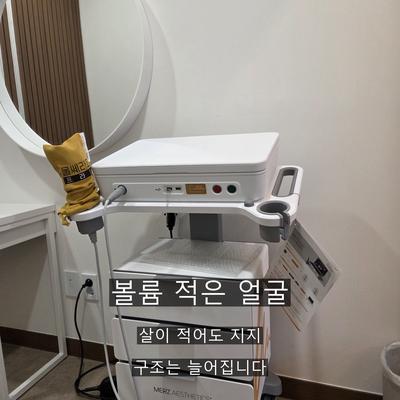
When you have concerns about superficial skin in addition to sagging
Fourthly, this applies to individuals who, in addition to facial sagging, also have concerns about the epidermal layer, such as skin texture and reduced elasticity.
Since Ultherapy works at a different depth than superficial treatments, you might consider combining them, with each procedure addressing its specific role.
It's common to plan Ultherapy alongside treatments that improve the skin surface, such as Denssity, Onda, and Tenssarma.
The order or combination of procedures may vary depending on which concern is more pressing, so it's best to determine individual priorities through a consultation.
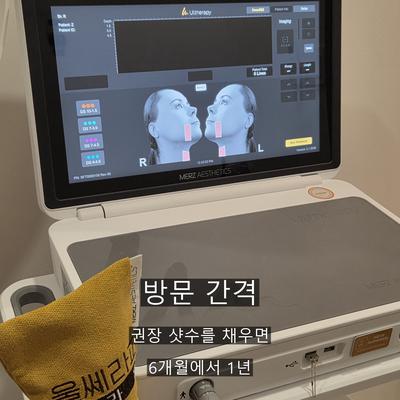
When other procedures are recommended first during a consultation
Ultherapy is not suitable for everyone.
If your primary concerns are skin texture improvement, fine line reduction, and skin radiance rather than sagging, then procedures that work on the epidermal layer will be considered first.
If you've been recommended a deep-layer targeting procedure for a face with little to no sagging, it's advisable to ask for a thorough explanation of the reasons why.
Immediately after the procedure, you may experience a temporary sensation of skin tightening or mild swelling. Therefore, if you have an important event approaching, we recommend adjusting your procedure date with ample time.
Many express concerns about pain, but usually, the procedure is performed with topical anesthetic cream, and it's not uncommon for it to be done without anesthesia.
Sedation anesthesia is generally not recommended. This is because during the procedure, the tip must be precisely adhered to the skin for energy to be delivered evenly to the intended depth.
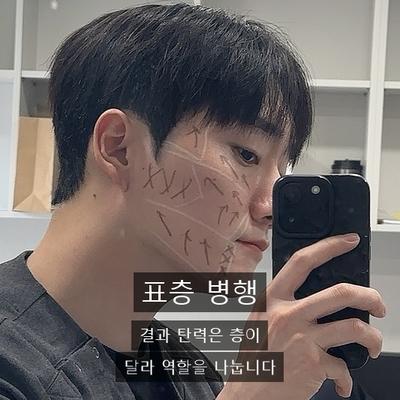
Three things to check before the procedure
If you are a candidate for the procedure, the next step is to consider where to receive it.
There are three main criteria to check.
First, during your consultation, you should confirm whether the medical staff thoroughly explains the appropriate recommended number of shots, taking into account your individual face size and degree of sagging.
Second, it's advisable to check if they assess the sagging condition of your face while you are in a seated position, accurately identify the skin thickness of each area, and create a treatment plan accordingly.
Third, it's important to confirm whether they record and inform the patient about details such as which type of tip was used and how many shots were administered after the procedure.
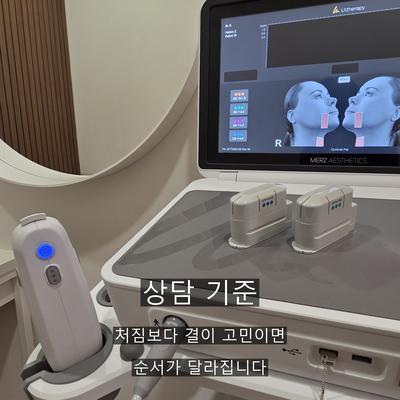
Kkeut Oriental Medicine Clinic's Unique Ultherapy Method
At Kkeut Oriental Medicine Clinic, when performing Ultherapy, the design phase is first carried out with the patient in a seated position, regardless of the actual treatment posture.
This is because when lying down, due to the effect of gravity, sagging tissues can be pushed upwards, making the sagging appear less severe than it actually is.
The skin thickness above the cheekbones, under the jaw, and on the cheeks differs. Therefore, before the procedure, a detailed plan is made regarding which areas will use the 4.5mm tip and which will use the 3.0mm tip.
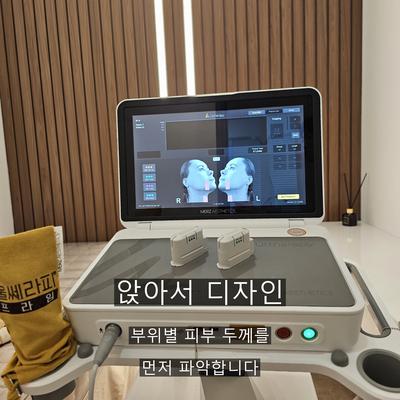
The depth of the SMAS layer varies from person to person and differs by area even within the same face. Kkeut Korean Medicine Clinic's tilting technique performs treatments considering these individual differences.
Although the focal depth of the tip is fixed, tilting the tip diagonally changes the depth at which the focus is formed. This allows energy to be delivered to various skin layers between the defined tip specifications.
During the procedure, Kkeut Korean Medicine Clinic confirms the skin layers in real-time through an ultrasound screen and delicately adjusts the tip's angle accordingly.
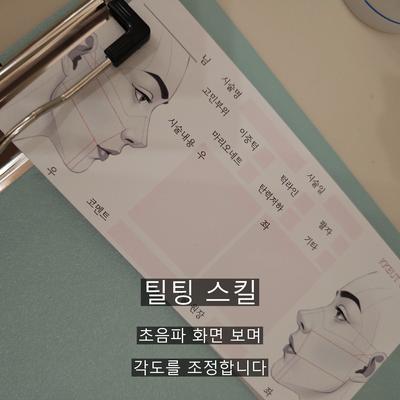
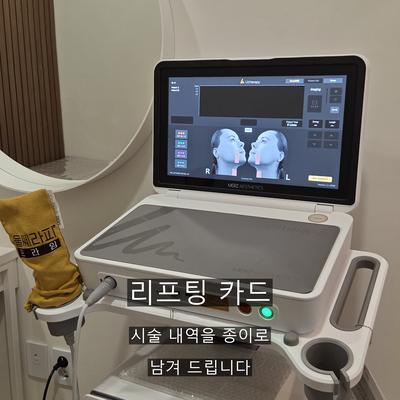
After the procedure is complete, a lifting card will be issued.
This card records detailed treatment information such as the type of tip used, the number of shots administered to each area, and intensity settings for each region. This serves as important reference material for planning future treatments.
Kkeut Korean Medicine Clinic performs treatments with a standard length of 25mm, and the equipment's settings screen is transparently shown before the procedure.
Frequently Asked Questions
Q. Who is the Ulthera Dermatology consultation intended for?
A. Ulthera Dermatology consultations are primarily for individuals whose mouth corners or jawline are sagging, those whose facial lines appear to have collapsed even without much fat, and those who also have superficial skin concerns. The consultation content may vary depending on the degree of sagging.
Q. When can I expect to see results after receiving Ulthera Dermatology treatment?
A. While changes after Ulthera Dermatology treatment can vary individually, they generally begin to appear gradually after about one month. Mild swelling may also accompany the initial phase of the treatment.
Q. How is anesthesia administered for Ulthera Dermatology treatment?
A. Cream anesthesia is mostly used for Ulthera Dermatology procedures. Due to the nature of the treatment, where the tip must adhere closely to the skin, sleep anesthesia is generally not recommended.
The Sincerity of Kkeut Korean Medicine Clinic
At Kkeut Korean Medicine Clinic, we perform skin design in a sitting position and conduct tilting treatments while observing the ultrasound screen, striving for more meticulous lifting results.
Kkeut Korean Medicine Clinic meticulously records treatment details through a lifting card, helping patients clearly understand their treatment process and assist with subsequent care.
Kkeut Korean Medicine Clinic performs treatments with a standard length of 25mm and transparently discloses equipment settings to ensure medical safety and allow for appropriate treatment effects.
A subtle difference for remarkable results, available at Kkeut Korean Medicine Clinic.
Related notes
Procedure notes worth reading next.

Loading menu…