

Double Chin: Uncovering the Causes and Our Solutions Beomgye, Pyeongchon, Beomgye Station, Pyeongchon Station, Hogye-dong, Bisan-dong, Gwanyang-dong, Dongan-gu, Indeogwon, Geumjeong, Anyang
8/3/2025
This is a procedure note for Double Chin: Uncovering the Causes and Our Solutions at Gyeonggi Anyang Beomgye KKEUT Korean Clinic.
Jawline Definition Loss: Exploring Three Structural Contributors to a Double Chin
An apparent double chin extends beyond mere aesthetics; it often signifies underlying structural elements that can diminish the clarity of the lower face.
Though frequently linked to excess subcutaneous fat, clinical experience shows a notable presence of factors unrelated to fat accumulation.
It is often observed that a distinct double chin can appear even in individuals who maintain a healthy weight and possess a naturally lean facial structure.
Such instances suggest that fat accumulation alone does not fully account for its presence.
In truth, the formation of a double chin typically arises from the combined influence of skeletal architecture, the supportive capacity of soft tissues, the way subcutaneous fat is distributed, the skin's elasticity, and habitual daily postures.
This discussion will explore the origins of a double chin, categorizing them into three primary areas: 1) Mandibular Structural Deficiencies (Recessed Chin), 2) Concentrated Fat Deposits, and 3) Reduced Soft Tissue Resiliency, followed by relevant anatomical approaches.
1. Mandibular Structural Weakness – The Recessed Chin
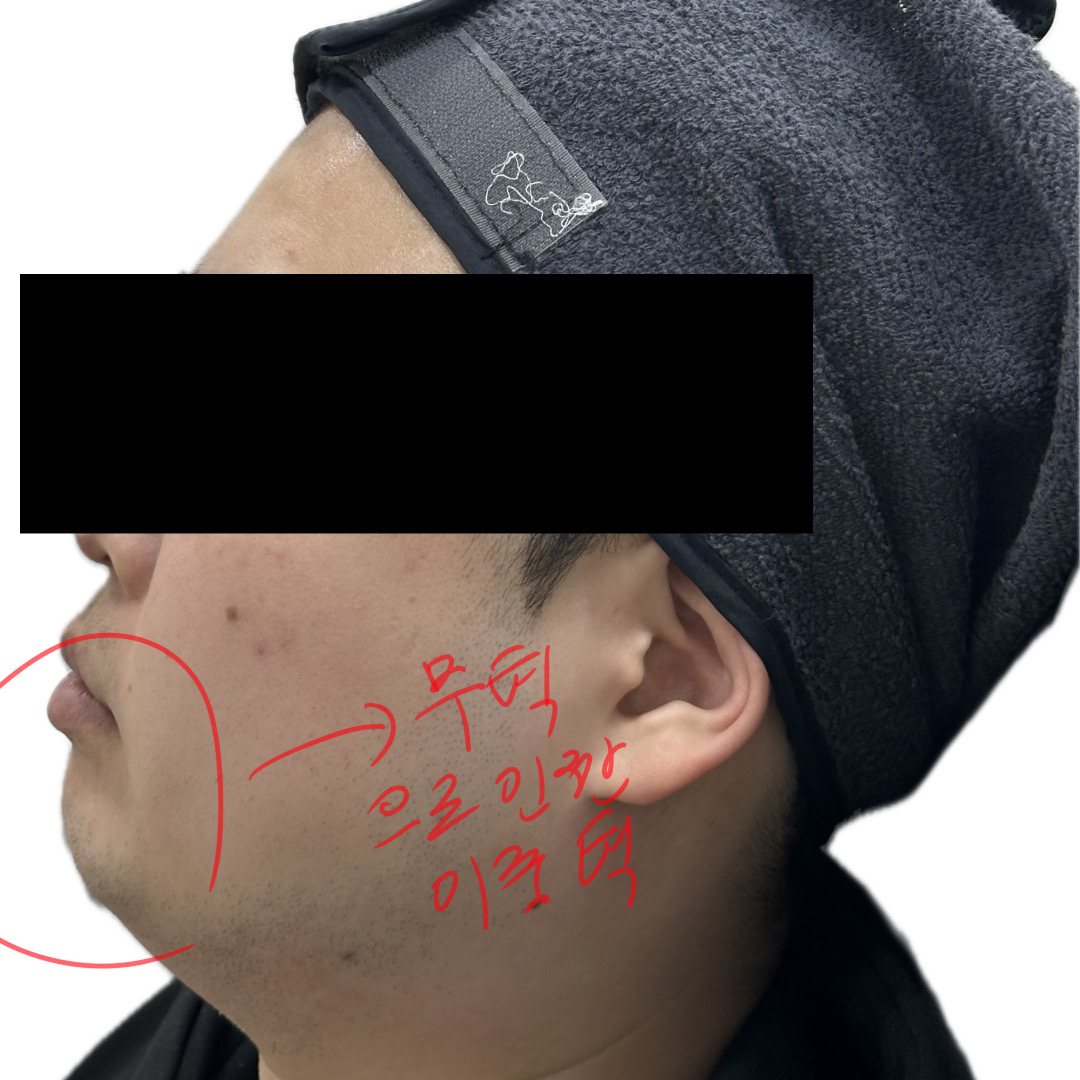
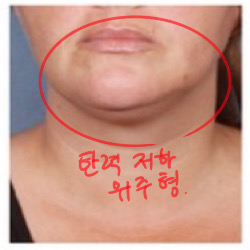
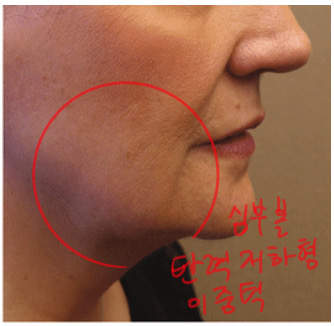
A primary underlying reason is a mandible that is either shorter than ideal or positioned further back, frequently referred to as a 'recessed chin'.
When the chin tip lacks adequate forward projection, the skeletal framework provides insufficient support for the overlying soft tissues, including skin, fat, and fascial layers.
As a result, these soft tissues tend to descend under gravitational force, contributing to the appearance of a double chin.
Notably, a lateral view often reveals a diminished cervicomental angle (the junction between the jaw and neck), blurring the clear separation of the jawline from the neck.
Within this structural context, a double chin can seem visually pronounced even when the actual amount of fat is minimal.
Thus, the approach is not solely limited to fat reduction, but also involves thorough fat management and addressing any existing laxity.
When the chin is more significantly recessed, the capacity to tolerate subcutaneous fat is reduced, which makes targeted treatments for fat reduction highly beneficial.
Consequently, for those with a recessed chin, a double chin often presents visibly even with a relatively modest amount of fat, suggesting a lower tolerance for submental fat accumulation compared to individuals with a well-projected chin.
2. Localized Fat Accumulation – Submental Fat Deposits
Another recognized contributor is the concentrated buildup of subcutaneous fat in the submental area.
Fat situated in this specific region often proves challenging to reduce with general exercise or dietary changes, owing to its inherent characteristics of reduced blood circulation and a slower metabolic rate.
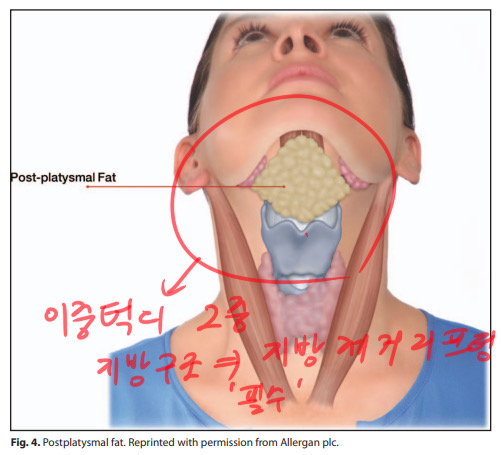
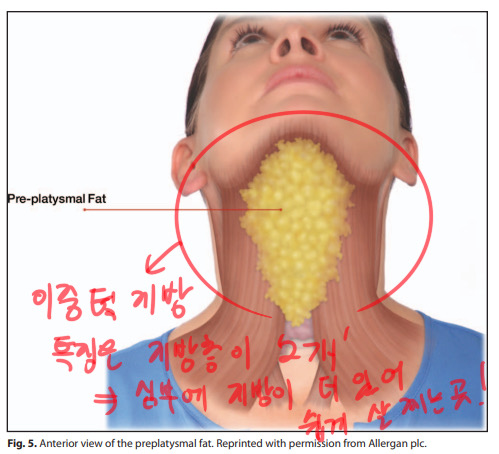
Anatomically, subcutaneous fat can be categorized into a superficial layer and a deeper layer, which includes preplatysmal and postplatysmal fat.
Regarding a double chin, specifically, an accumulation of deep fat intensifies the downward displacement of soft tissues, a condition often compounded by daily habits like 'turtle neck' posture, prolonged downward head tilt, and extensive smartphone engagement.
As fat deposits build, they not only expand in volume but also tend to develop adhesions to the surrounding skin and fascia, which can rigidify the contour.
This process can lead to a swollen appearance beneath the chin, along with visible skin laxity and a less defined contour.
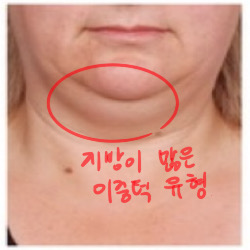
For such instances, the primary objective is to diminish both the volume and quantity of fat cells directly.
However, addressing only the fat without considering the soft tissues might potentially exacerbate skin laxity; therefore, a comprehensive treatment strategy that accounts for both tissue elasticity and structural support is crucial.
3. Reduced Soft Tissue Elasticity – Laxity in the Dermal and Fascial (SMAS) Layers
A final key contributor is the decline in elasticity within the skin and surrounding soft tissues.
The dermis, found beneath the epidermis, comprises fibrous proteins such as collagen and elastin; these components are vital for preserving skin firmness and integrity.
Nonetheless, elements like advancing age, sun exposure, tobacco use, and significant weight shifts can degrade these structural fibers, resulting in thinner skin with diminished elasticity.
Furthermore, directly underneath the skin is the Superficial Musculo-Aponeurotic System (SMAS), a fine fascial layer that, in conjunction with muscle, provides crucial support for the overlying soft tissues.
As this SMAS layer progressively loosens and its ability to counteract gravitational forces wanes, both the skin and subcutaneous fat tend to descend, contributing to the formation of a double chin.
For these specific situations, superficial interventions targeting only the epidermis or dermis typically yield inadequate results.
An integrated method that simultaneously energizes the deep dermal and fascial layers, thereby enhancing structural support, is often required for noticeable enhancement.
Summary
Although a double chin may occasionally stem from a single one of the three factors previously discussed: recessed chin, fat accumulation, or diminished elasticity, this is not always the case.
In clinical practice, these underlying factors often manifest in combination.
Focusing a treatment strategy on just one aspect might lead to less than ideal results, or in some instances, the jawline could even appear less defined.
What truly matters is a precise diagnosis of an individual's anatomical characteristics, followed by an honest and meticulously tailored treatment strategy.
The jawline significantly contributes to shaping the overall impression of one's face.
It is necessary to consider not only fat but also skin thickness, elasticity, bone structure, and the dynamics of soft tissues. A comprehensive understanding of these combined factors can lead to more favorable outcomes.
Related notes
Procedure notes worth reading next.

The Agnes Difference: Double Chin Lifting vs. Fat-Dissolving Devices like ONDA & InMode
2025. 12. 5.

ONDA Lifting: Banish Your Double Chin Effectively – Understanding ONDA's unique power for chin definition.
2025. 12. 3.

Double Chin Transformation: Enhancing Results with Shurink Universe & InMode
2025. 12. 30.
Loading menu…