

How do facial sunspots differ from melasma? Beomgye, Pyeongchon, Beomgye Station, Pyeongchon Station, Hogye-dong, Bisan-dong, Gwanyang-dong, Dongan-gu, Indeogwon, Geumjeong, Anyang
5/30/2026
This is a procedure note for How do facial sunspots differ from melasma? at Gyeonggi Anyang Beomgye KKEUT Korean Clinic.
Although facial lentigo and melasma may look similar, their causes and treatment approaches are completely different.
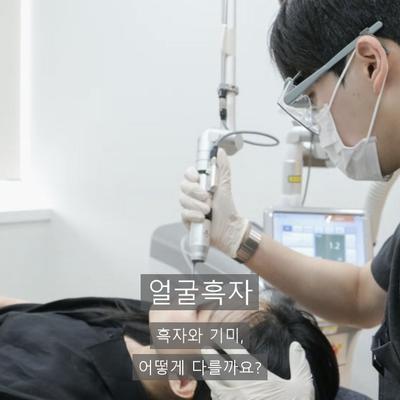
If you visit a dermatology clinic or a Korean medicine clinic and show them a 'brown, spot-like lesion', the medical staff will first determine whether it is lentigo or melasma.
There's one important reason for this distinction: an incorrect approach can actually deepen the pigmentation.
What's the difference between lentigo and melasma?
Lentigo (facial lentigo) is a lesion caused by localized over-pigmentation of melanin in the epidermal layer.
Its borders are relatively clear, and most lesions are typically a few millimeters to within 1 cm in size.
It is directly related to sun exposure, appearing concentrated in areas that have received a lot of UV radiation.
Melasma is different. Melasma is a condition where the melanocytes themselves, which produce pigment, are overactive.
Its borders are indistinct, and it tends to spread broadly and symmetrically on both sides of the face.
Since complex factors such as hormonal changes, UV radiation, and stress are involved, recurrence after treatment is also more frequent than with lentigo.
It becomes clear when understood this way: lentigo is a problem of 'the pigment itself', while melasma is a problem of 'the cells that produce pigment'.
Why you shouldn't use lasers without a diagnosis
Even if it looks like facial lentigo, it might actually be melasma, seborrheic keratosis, or another type of lesion.
If energy is applied without accurately understanding the nature of the lesion, the pigment can be stimulated more deeply, potentially leading to more severe post-treatment hyperpigmentation.
At Kkeut Korean Medicine Clinic, after imaging with a MarkVu diagnostic device, the director personally differentiates the lesions.
We first distinguish between lentigo, melasma, or seborrheic keratosis, and then determine the treatment approach.
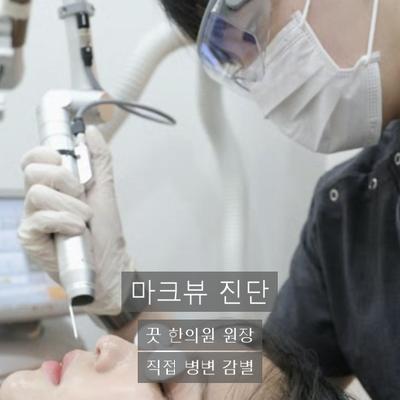
The term 'diagnosis-based treatment' might sound grand, but without this step, we cannot guarantee treatment results.
Why 532nm wavelength is used for facial lentigo removal
Depending on the wavelength, the target tissue that absorbs the laser energy within the skin varies.
The 532nm wavelength is the spectrum with the highest melanin absorption, acting precisely on epidermal pigmentary lesions.
Since facial lentigo is a lesion concentrated in the epidermis, the 532nm wavelength perfectly matches both the depth and the target.
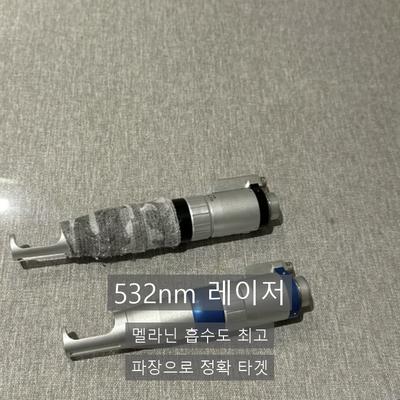
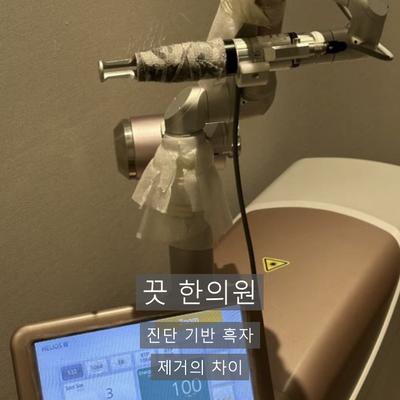
The 532nm laser used at Kkeut Korean Medicine Clinic operates in the same wavelength band as high-end lentigo lasers of the Re-Piat or Ruby series.
The medical basis of the wavelength, not the equipment name, determines the treatment outcome. Kkeut Korean Medicine Clinic operates its equipment based on this principle.
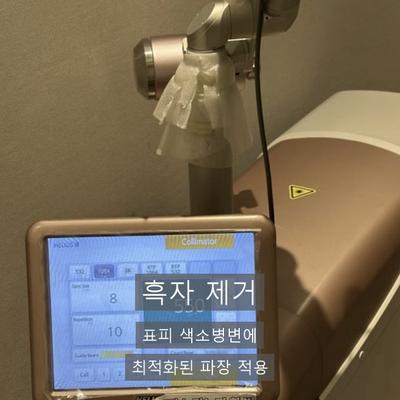
Post-treatment care: lentigo is approached differently from melasma.
Unlike melasma toning, lentigo laser treatment does not create surface wounds.
Due to the nature of the procedure, applying DuoDERM gel can actually irritate the skin.
Kkeut Korean Medicine Clinic applies post-treatment care tailored to the essence of the procedure. We do not indiscriminately follow the same protocol as mole removal or milia removal.
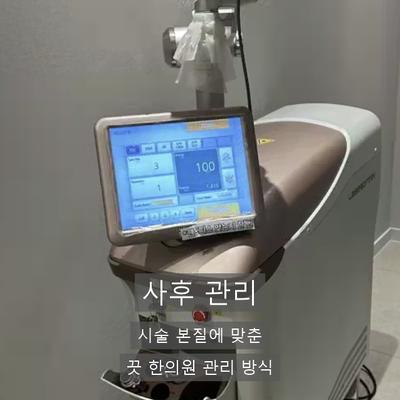
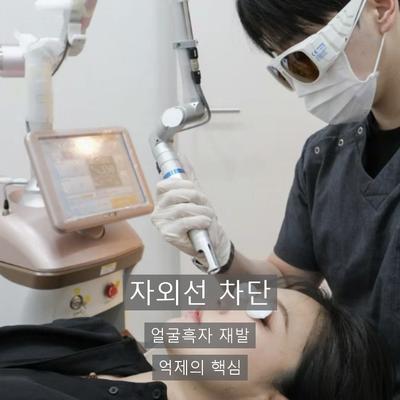
UV protection is the most important care after treatment. Repeated exposure to UV radiation during the recovery period, when melanin is easily stimulated, can lead to hyperpigmentation.
Frequently Asked Questions
Q. Can I distinguish between facial lentigo and melasma at home?
A. Facial lentigo has clear borders and appears like a spot in specific areas, while melasma tends to have blurry borders and spreads broadly. However, accurate distinction is difficult with the naked eye, requiring diagnostic imaging. At Kkeut Korean Medicine Clinic, after imaging with a MarkVu device, the director personally identifies the presence of facial lentigo.
Q. Can I immediately return to daily life after facial lentigo laser treatment?
A. Facial lentigo removal laser treatment, due to its characteristic of acting only on the epidermis, does not have a long downtime. On the day of the procedure, you might experience mild redness and stinging, but these usually subside within a short period. Kkeut Korean Medicine Clinic provides detailed post-procedure precautions on the day of treatment.
Q. Does lentigo not recur after removal?
A. Since UV radiation is the primary cause of facial lentigo, thorough UV protection management after the procedure is key to preventing recurrence. Kkeut Korean Medicine Clinic also provides guidance on post-procedure care to lower the possibility of recurrence.
Q. How is treatment approached if both melasma and facial lentigo are present?
A. If both lesions coexist, we design separate approaches tailored to each. Facial lentigo is treated with a 532nm laser, while melasma is addressed with a separate protocol. Kkeut Korean Medicine Clinic also proceeds with mixed lesions by diagnosing and separating the treatment directions.
Kkeut Korean Medicine Clinic's Sincerity
Kkeut Korean Medicine Clinic pre-emptively blocks the risk of hyperpigmentation through diagnosis-based treatments, where the director personally differentiates lesions after imaging with a MarkVu diagnostic device.
Kkeut Korean Medicine Clinic operates its equipment based on the medical evidence of the 532nm wavelength, delivering the most efficient energy to epidermal facial lentigo lesions.
Kkeut Korean Medicine Clinic applies post-treatment care tailored to the essence of each procedure, without indiscriminately following the same protocols as other treatments.
A subtle difference, a different result — Experience it at Kkeut Korean Medicine Clinic.
Related notes
Procedure notes worth reading next.


Loading menu…