

Freckles vs. Melasma: Why Are Their Treatments Different? Beomgye, Pyeongchon, Beomgye Station, Pyeongchon Station, Hogye-dong, Bisan-dong, Gwanyang-dong, Dongan-gu, Indeogwon, Geumjeong, Anyang
6/19/2026
This is a procedure note for Freckles vs. Melasma: Why Are Their Treatments Different? at Gyeonggi Anyang Beomgye KKEUT Korean Clinic.
When visiting a dermatology clinic or a traditional Korean medicine clinic, freckles and melasma are often discussed together.
However, their causes, how they function within the skin, and thus their treatment approaches are distinctly different.
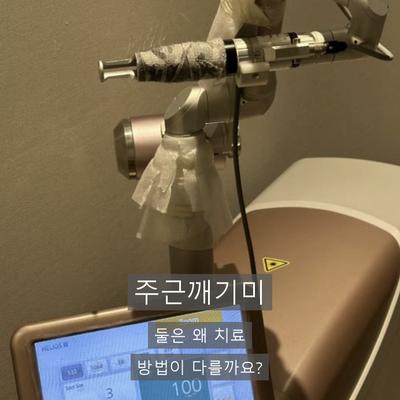
Freckles vs. Melasma: What's the Difference?
Freckles are pigmentary lesions with a strong genetic predisposition.
The number of melanocytes (cells that produce melanin) itself is normal, but individual cells react hypersensitively to UV radiation, producing much more melanin locally than their surroundings.
As a result, small, round brown spots appear scattered around the cheeks and nose.
A typical pattern is that they deepen in summer and lighten in winter, and management is relatively easy if UV protection is consistently applied.
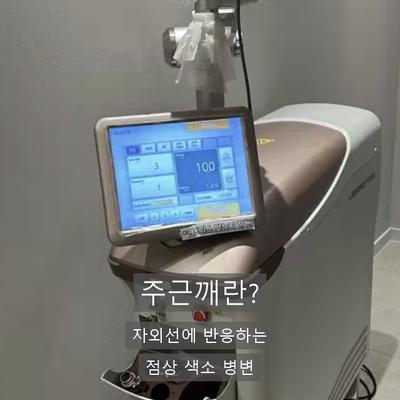
Melasma is a different story.
With melasma, melanin produced by melanocytes can be deposited not only in the epidermis but also in the dermis, and the melanocytes themselves are widely distributed in an excited and overactive state.
It occurs due to a complex interplay of UV radiation, female hormones (pregnancy, birth control pills), chronic stress, and heat stimulation.
It often appears with ill-defined borders and spreads symmetrically on both sides, and it does not easily improve with UV protection alone.
Why Treatment Approaches Differ
For freckles, destroying the locally high concentration of melanin directly is an efficient approach.
By precisely targeting only the lesion with a laser that has high melanin absorption, such as a 532nm wavelength, the pigment is removed relatively quickly.
On the other hand, for melasma, the logic that 'aggressively destroying melanin leads to faster improvement' does not apply.
If strong energy is applied to overactive melanocytes, it can exacerbate their excitement, leading to a rebound phenomenon (PIH, post-inflammatory hyperpigmentation) where they produce even more melanin.
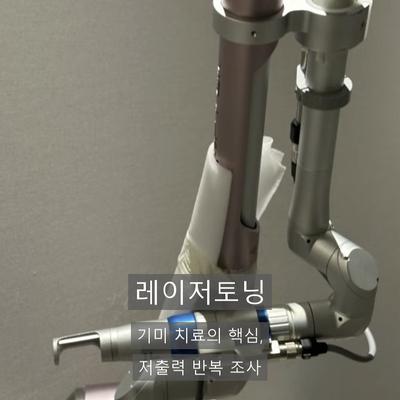
Therefore, for melasma, the laser toning method, which involves repeated low-output laser irradiation, has become the standard.
When a 1064nm Q-switched or picosecond laser is applied at low energy for thousands of shots, it gently calms the excited melanocytes without stimulation, gradually breaking down melanin.
In summary, although freckles and melasma may look similar, the design of treatment wavelengths, energy levels, and repetition counts differs.
This means that even if the same laser equipment is used, the output settings and treatment design must be different.
If the two lesions are not distinguished and treated with the same energy, melasma can actually worsen.
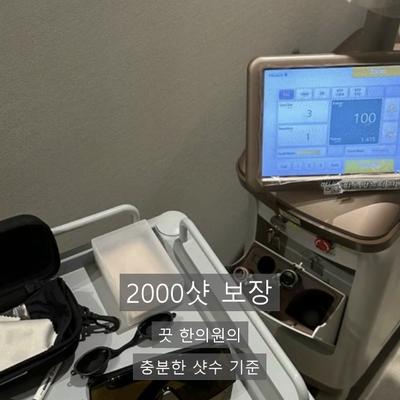
This is also why the number of shots is important in laser toning.
Sufficient shots must be accumulated for excited melanocytes to stabilize and for energy to be evenly delivered to the entire skin.
If the number of shots is insufficient, both the calming effect and the melanin-breaking effect are reduced by half.
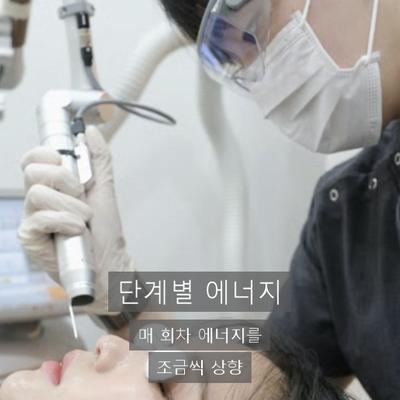
As the sessions progress, the skin adapts to the laser energy and its barrier strengthens, so if the same energy is continuously used, stimulation gradually decreases, and the effect becomes stagnant.
For this reason, a design that gradually increases the energy with each session is necessary throughout the entire treatment process.
There are also differences in post-treatment care.
After freckle laser treatment, strict UV protection is key while the scabs on the treated area naturally fall off.
After melasma laser toning, in addition to UV protection, avoiding heat stimulation (saunas, strenuous exercise) and parallel moisturizing care to protect the skin barrier must be practiced.
Reviewing overall lifestyle habits to prevent melanocytes from being stimulated again is key to preventing recurrence.
Kkeut Korean Medicine Clinic's Laser Toning Approach
Kkeut Korean Medicine Clinic guarantees over 2,000 shots per laser toning session.
After the procedure, we have a process where you can directly check the shot count with the director. Clear numbers ensure clear tracking of treatment progress.
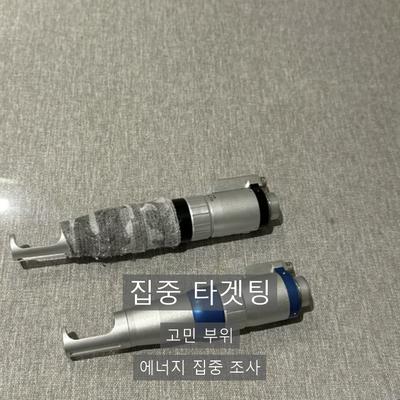
Kkeut Korean Medicine Clinic specifically targets areas of concern.
Instead of uniformly irradiating the entire cheek, we apply energy more densely to areas with concentrated pigment to increase treatment efficiency.
Kkeut Korean Medicine Clinic applies a method of gradually increasing energy with each session.
Instead of proceeding with the same output from start to finish, we incrementally raise the energy while observing the skin's condition and reaction, designing each session to be a meaningful stimulation.
Frequently Asked Questions
Q. How are freckles and melasma treated if they are mixed together?
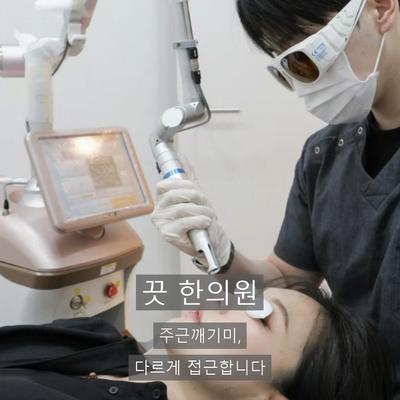
A. When freckles and melasma coexist, the basic principle at Kkeut Korean Medicine Clinic is to first clearly distinguish the two lesions and then approach each with the appropriate wavelength and energy. Even within the same session, the irradiation method varies depending on the lesion.
Q. How many laser toning sessions are needed for freckles and melasma?
A. For freckles, it depends on the size and depth of the lesion. For melasma, a cumulative treatment of usually 10 sessions or more is recommended to stabilize melanocytes. When freckles and melasma are mixed, the number of sessions is designed based on the response of each lesion.
Q. Can melasma become darker after laser toning?
A. If the energy setting is not suitable for melasma or if post-treatment sun protection is insufficient, a temporary rebound phenomenon where pigmentation darkens may occur. Kkeut Korean Medicine Clinic prevents this by providing low-output design tailored to melasma characteristics along with post-treatment care guidance.
Q. Can freckles and melasma improve simply by good sun protection?
A. While sun protection plays a key role in preventing the worsening of freckles, laser treatment is necessary to remove existing freckles and melasma. Melasma is entangled with complex factors in addition to UV radiation, such as hormonal and heat stimulation, so it cannot be completely resolved by sun protection alone.
The Commitment of Kkeut Korean Medicine Clinic
Kkeut Korean Medicine Clinic guarantees over 2,000 shots per laser toning session and operates a procedure where patients can directly confirm the shot count with the director after treatment. Because it is a treatment proven by numbers, treatment progress can be reliably tracked.
Kkeut Korean Medicine Clinic separately targets problem areas, applying energy more densely to areas where pigmentation is concentrated. This is a precise design tailored to each individual's skin map, not uniform overall irradiation.
Kkeut Korean Medicine Clinic applies a method of slightly increasing energy in each session, designing all treatments from the first to the last session to be a meaningful stimulus. This structure allows effects to accumulate as sessions progress.
A Subtle Difference, Different Results — Experience it at Kkeut Korean Medicine Clinic.
Related notes
Procedure notes worth reading next.

3 Criteria to Consider When Choosing a Clinic for Melasma Treatment
2026. 10. 5.

Criteria for Choosing a Melasma Treatment Clinic: Accurate Diagnosis, Customized Treatment Plan, Thorough Aftercare
2026. 10. 9.

Melasma Always Comes Back? The Solution to Persistent Recurrence is 'Laser Treatment'.
2025. 11. 28.
Loading menu…