

Nasolabial Folds: Why Creams Can't Smooth Them and How Shurink Lifting Works Beomgye, Pyeongchon, Beomgye Station, Pyeongchon Station, Hogye-dong, Bisan-dong, Gwanyang-dong, Dongan-gu, Indeogwon, Geumjeong, Anyang
This is Gyeonggi Anyang Beomgye KKEUT Korean Clinic's procedure note on Nasolabial Folds: Why Creams Can't Smooth Them and How Shurink Lifting Works.
Nasolabial folds (the lines running from the nose to the corners of the mouth) are a concern that barely smooths out no matter how steadily you apply cream.
A moisturizing cream is a product that fills the skin surface with moisture and tidies the texture.
Nasolabial folds are creases formed as the support structure beneath the surface sags, so with surface care alone the line often stays as it is.
In this article, Kkeut Oriental Medicine Clinic goes through, in order, how nasolabial folds form, the approach that is needed, and how Shurink lifting works.
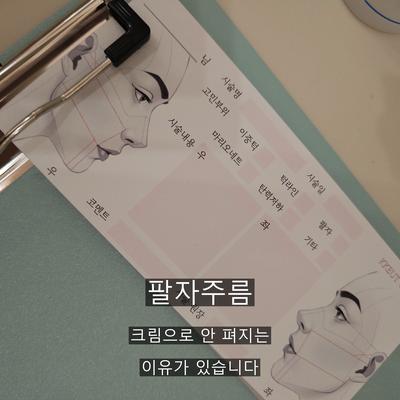
Why do nasolabial folds form?
The nasolabial fold is a crease line running down from beside the nose to the corner of the mouth.
It is a structure in which tissue in the cheek descends, catches near the corner of the mouth, and folds.
Beneath the skin is a fat layer, and under that a fascia layer called the SMAS acts as a support.
With age, this support layer loosens and collagen decreases, so the cheek tissue descends in the direction of gravity.
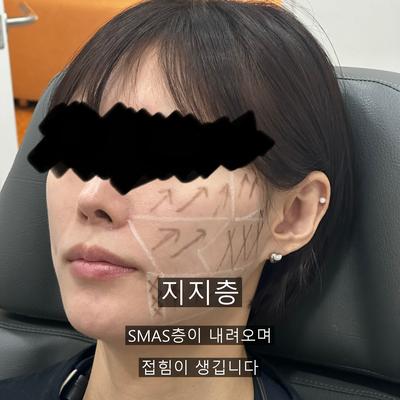
That is why the line remains even when you are not making an expression, and it looks deeper when you are sitting or standing than when you are lying down.
Sagging can come from having a lot of fat, but it also occurs when there is little volume and the support structure has stretched.
For people with less volume, the support structure is weak, so the line can look even more collapsed.
When the cause is different, the approach is different too.
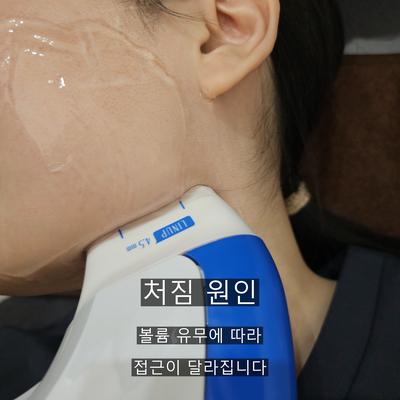
Why creams cannot smooth them out
A cream is a product that stays on the surface, so it is hard for it to affect the support structure beneath the fat layer.
Because the cause of the crease lies deeper, no matter how well you moisturize the surface, the position of the line does not change.
Two things are needed for nasolabial folds.
First, a force that lifts the descended tissue back up.
Second, stimulating collagen regeneration so that the weakened structure rebuilds itself.
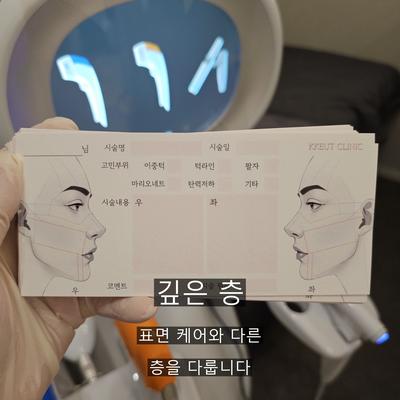
Both are possible only by working on the deep layers of the skin.
How Shurink lifting works
Shurink is a lifting treatment that uses high-intensity focused ultrasound, that is, HIFU.
Ultrasound energy is gathered onto a single point so that it passes through the skin surface and generates heat in the deeper layers.
The tissue that receives the heat stimulus contracts, and collagen regeneration follows in the process of remodeling afterwards.
Because it re-tightens the descended support layer, it works on a different layer from surface products.
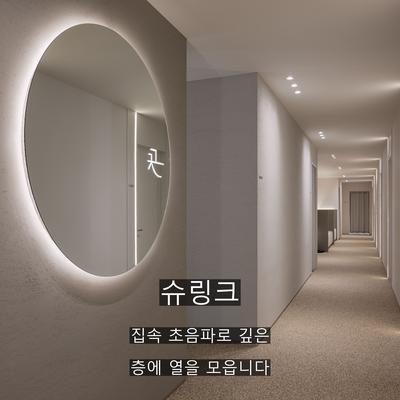
With Shurink, we use the 4.5mm main tip and switch among 3.0, 2.0 and 1.5mm tips to suit each area.
This is because the thickness differs between the cheeks and around the mouth even within the same face.
It is not a one-time treatment but is approached as a cumulative treatment.
A 1-month interval is the established recommendation, and the timing of the next treatment is adjusted according to the number of shots in a session.
The change to expect for nasolabial folds
Shurink is a treatment that tidies up the sagging cheek line and changes the conditions under which the fold of the nasolabial line forms.
It is not a treatment that fills in an already deeply etched wrinkle, so it is important first to distinguish whether sagging or lack of volume is the main issue.
The degree of change varies with the degree of sagging, the depth of the wrinkle and the number of shots.
How Kkeut Oriental Medicine Clinic operates Shurink
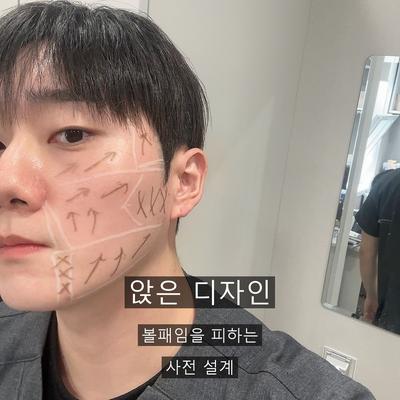
Kkeut Oriental Medicine Clinic sets the design with you in a seated position before lifting.
Lying down pushes sagging tissue back and up so that it looks less saggy than it really is, so we first check the real shape of the sagging in a seated position and the spots where we should avoid causing a hollowed cheek.
In addition to the 4.5mm main tip, Kkeut Oriental Medicine Clinic treats by switching to customized 3.0, 2.0 and 1.5mm tips.
Tip selection is not decided on the spot during treatment but according to a plan for each area.
If needed, we also offer the option of proceeding at an intensity raised up to Ultherapy level.
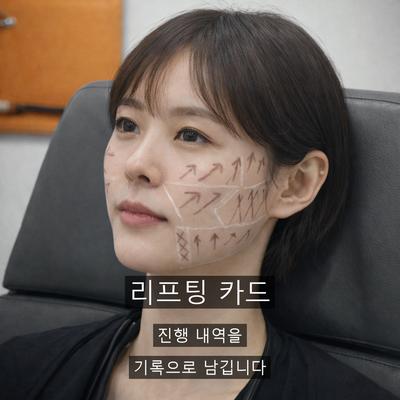
After treatment, Kkeut Oriental Medicine Clinic writes up the lifting progress as a lifting card and shares it with you.
A record remains of which tip was used on which area, which becomes the basis for discussing what to do differently at the next session.
Frequently Asked Questions
Q. Won't nasolabial folds fade if I just keep applying cream?
A. Nasolabial folds are lines linked to sagging of the support structure rather than the surface, so it is hard for cream alone to change them. Moisturizing is meaningful for skin texture care, but it cannot change the position of the line.
Q. How many Shurink sessions do I need for nasolabial folds?
A. It depends on the depth of the folds, the degree of sagging and the number of shots, so a consultation is needed. Kkeut Oriental Medicine Clinic views it as cumulative treatment and recommends a 1-month interval.
Q. My cheeks are thin. I am worried about hollowing if I get Shurink for nasolabial folds.
A. For people with less volume, the support structure is weak and the nasolabial line can stand out more, so the design is important. Kkeut Oriental Medicine Clinic first checks the spots where hollowing should be avoided through a seated design.
The Sincerity of Kkeut Oriental Medicine Clinic
Kkeut Oriental Medicine Clinic provides differentiated results by avoiding cheek hollowing through a seated design.
Kkeut Oriental Medicine Clinic raises patient satisfaction through customized tip changes for each area.
Kkeut Oriental Medicine Clinic pursues safety and effectiveness together through sharing a lifting card.
A Kkeut of difference, a different result — experience it at Kkeut Oriental Medicine Clinic.
Related notes
Procedure notes worth reading next.


Loading menu…