

Why a combination of Erbium YAG and CO2 lasers is needed for body mole removal Beomgye, Pyeongchon, Beomgye Station, Pyeongchon Station, Hogye-dong, Bisan-dong, Gwanyang-dong, Dongan-gu, Indeogwon, Geumjeong, Anyang
7/20/2026
This is a procedure note for Why a combination of Erbium YAG and CO2 lasers is needed for body mole removal at Gyeonggi Anyang Beomgye KKEUT Korean Clinic.
When considering mole removal on the body, a different approach is needed compared to facial moles.
Moles that appear on the body vary in size and the depth of pigment, making laser selection crucial.
Depending on the area such as the neck, back, arms, or legs, the thickness of the mole and skin differs, so even for moles of the same size, laser settings must be applied differently.
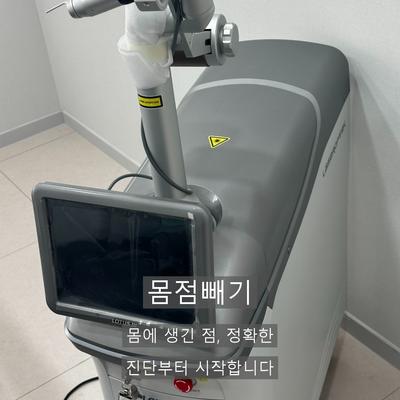
The most commonly used equipment for body mole removal is the Er:YAG laser.
The Er:YAG laser works by precisely ablating mole tissue, layer by thin layer.
Because it ablates while controlling the epidermal and dermal junction, moles with shallow pigment can be cleared cleanly in a relatively short time.
However, moles that appear on the body are often larger than facial moles, and the pigment often extends to deeper layers of the dermis.
In such cases, using only an Er:YAG laser can result in residual pigment or difficulty controlling bleeding.

The equipment used alongside it in such situations is the CO2 laser.
The CO2 laser has the characteristic of evenly spreading heat to surrounding tissues, providing excellent hemostatic effects.
During body mole removal procedures, for large moles or areas where bleeding is expected, combining the procedure with CO2 laser for hemostasis is necessary to ensure a clean treatment surface.
Moles with deep pigment can also benefit from the CO2 laser's heat transfer characteristics.
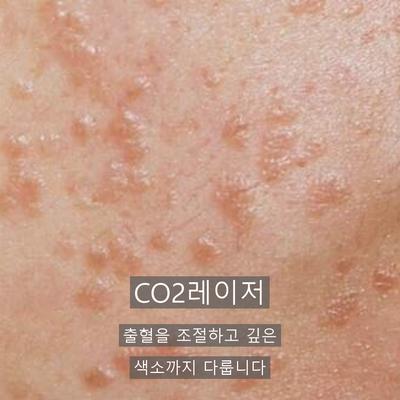
The reason why body mole removal requires a combination of Er:YAG and CO2 lasers is to simultaneously address pigment depth and bleeding control.
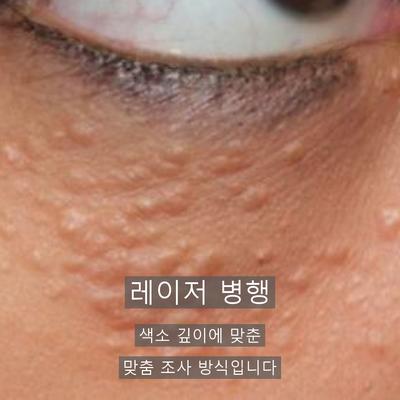
During a body mole removal consultation, it's crucial to first examine the mole with a light to determine whether the pigment is confined to the epidermis or has penetrated into the dermis.
Looking at the procedure process, a consultation first takes place to check the shape and depth of the mole.
Laser settings vary depending on whether the mole is raised or flat.
After applying anesthetic ointment, mole tissue is gradually removed with an Er:YAG laser.
For moles with bleeding or large moles, hemostasis is completed with a CO2 laser.
For areas with thin and curved skin, such as the neck or back, precise procedures are required due to the difficulty in controlling laser angle and output.
Areas with relatively thick skin, such as the arms and legs, often have deeply seated pigment, requiring repeated irradiation.
Procedure time varies depending on the size and number of moles, but it is generally short.
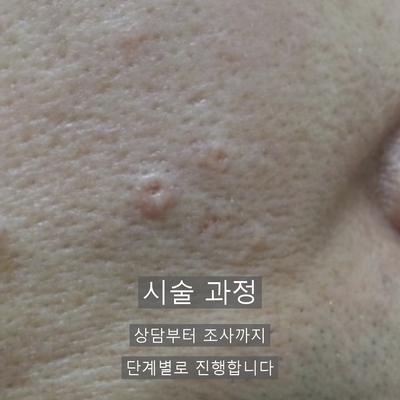
The number of sessions depends on the pigment depth of the mole.
Shallow moles are often cleared in one session, while moles with deep pigment frequently require additional treatments at intervals of 2 to 4 weeks.
After body mole removal, a scab naturally forms and then falls off.
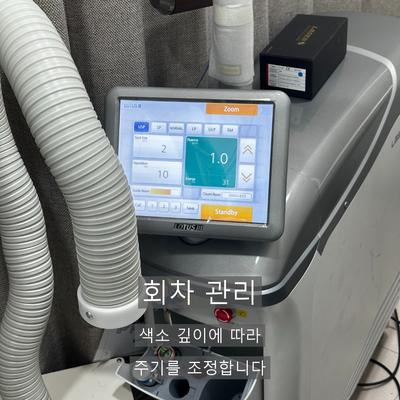
During downtime, UV protection and moisturizing care are important.
Immediately after the procedure, redness and slight oozing may occur, which is part of the natural healing process.
It is advisable to prevent water from directly touching the treated area during face washing or showering.
Many people think that a mole will completely disappear with a single laser treatment, but it is important to remember that moles with deep pigment require additional sessions.
Moles that have been arbitrarily squeezed out at home or removed by general extraction often have remaining roots and regrow, so precise laser treatment is necessary to minimize recurrence.
After body mole removal, applying scar ointment or regenerative cream for a few days can aid recovery.
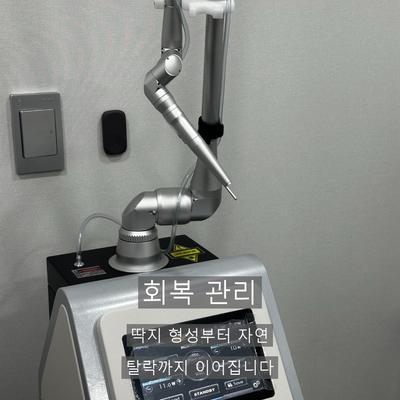
The unique and differentiated body mole removal know-how of Kkeut Clinic
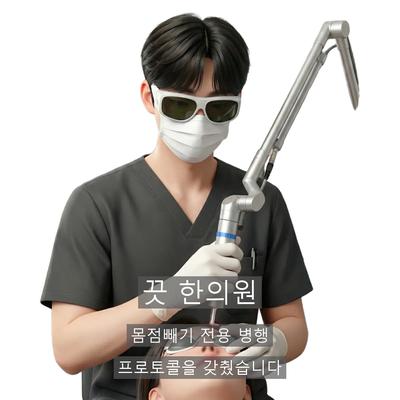
Kkeut Clinic aims to be a place where a wide range of mole removals are possible, including raised moles and moles in challenging areas like near the eyes.
At Kkeut Clinic, we adhere to a safety protocol where if a mole suspected of being malignant is found, it is immediately referred to a higher medical institution.
If a new mole on the body rapidly grows or changes shape, an accurate diagnosis is prioritized over removal for cosmetic purposes.
In such cases, Kkeut Clinic does not arbitrarily proceed with treatment but prioritizes safety by adhering to the principle of referral to a higher medical institution.
Combined Procedures Possible Only at Kkeut Clinic
Kkeut Clinic is equipped with both high-end Er:YAG and CO2 lasers and performs body mole removal procedures.
To minimize downtime, procedures are primarily performed with the Er:YAG laser, while areas requiring hemostasis are supplemented with the CO2 laser.
Kkeut Clinic accurately understands the characteristics of both the Er:YAG and CO2 lasers, meticulously adjusting the ratio of their use according to the size of the mole and the depth of its pigment.
Thanks to this meticulous combination, procedures are performed in a way that reduces the burden of scarring after body mole removal while also lowering the possibility of recurrence.
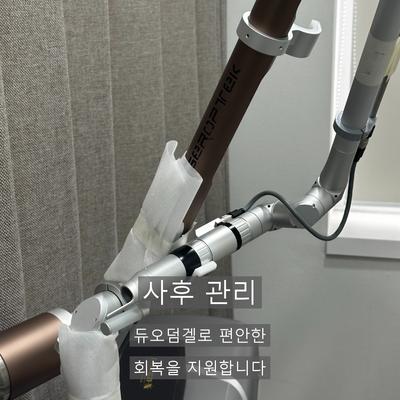
Kkeut Korean Medicine Clinic's aftercare makes a difference even in the finishing touches.
After mole removal, we use DuoDERM Gel, allowing even those with allergies to sticker-type DuoDERM to receive comfortable care.
Continue comfortable recovery care with the gel type, without the hassle of applying and removing.
Frequently Asked Questions
Q. Can mole removal be completed in one session?
A. The number of sessions for mole removal varies depending on the depth of the mole's pigment. At Kkeut Korean Medicine Clinic, we combine Er:YAG and CO2 lasers to reduce the number of sessions.
Q. Can scars remain after mole removal?
A. If hemostasis and laser depth control are properly managed during mole removal, the risk of scarring is low. At Kkeut Korean Medicine Clinic, we use combined procedures to ensure a clean treatment area.
Q. How is mole removal aftercare managed?
A. After mole removal, it's important to manage with DuoDERM Gel and pay attention to UV protection. Kkeut Korean Medicine Clinic uses gel-type DuoDERM to reduce the burden of allergies.
Q. Is it possible to remove raised moles?
A. Raised moles are also candidates for removal. Kkeut Korean Medicine Clinic widely addresses moles even in difficult areas.
Kkeut Korean Medicine Clinic's Sincerity
Kkeut Korean Medicine Clinic provides differentiated results through a combined Er:YAG and CO2 laser protocol.
Kkeut Korean Medicine Clinic enhances patient satisfaction with a wide range of treatments, including raised moles and moles near the eyes.
Kkeut Korean Medicine Clinic pursues both safety and comfort through DuoDERM Gel aftercare.
A subtle difference, distinct results — Experience it at Kkeut Korean Medicine Clinic.
Related notes
Procedure notes worth reading next.


Loading menu…