

Acne Pigmentation Laser: The Principle of Treating Red and Brown Marks Differently Beomgye, Pyeongchon, Beomgye Station, Pyeongchon Station, Hogye-dong, Bisan-dong, Gwanyang-dong, Dongan-gu, Indeogwon, Geumjeong, Anyang
7/3/2026
This is a procedure note for Acne Pigmentation Laser: The Principle of Treating Red and Brown Marks Differently at Gyeonggi Anyang Beomgye KKEUT Korean Clinic.
Even after acne heals, traces remain on the skin. There are two types: red marks and brown marks. Most people searching for "acne pigmentation laser" want to remove both marks at once. However, the causes of these two marks are different, and the laser methods required to approach them also differ.
Red Marks vs. Brown Marks — Different Causes
The official name for red marks is PIE (Post-Inflammatory Erythema). While acne inflammation progresses, the skin expands surrounding blood vessels to repair damage. Even after the inflammation subsides, these expanded blood vessels don't constrict back to their original state, leaving red marks. PIE is a vascular issue, not a pigmentation issue. If the mark turns white when you gently press it with your finger and then turns red again, it is likely PIE.
Marks that remain brown or yellowish-brown are PIH (Post-Inflammatory Hyperpigmentation). When acne inflammation stimulates skin cells, melanocytes, which produce melanin, become overactive. This excessively produced melanin accumulates in the epidermal layer, leading to brown/yellowish-brown marks. PIH is caused by melanin pigment, not blood vessels. If the color does not change when you press the skin and remains the same, it is pigmented PIH.
The fact that these two types of marks have different causes is key in laser selection. Vascular PIE requires a laser with a wavelength that selectively targets blood vessels. Pigmented PIH requires a laser that selectively destroys melanin. If both types of marks are present on the skin, approaching them with methods tailored to each will yield proper results.
Acne Pigmentation Laser — The Principle of Laser Toning for PIH
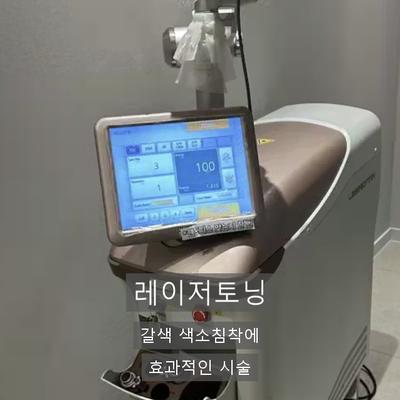
Among acne pigmentation lasers, laser toning is an effective method for brown pigmentation (PIH). It works by repeatedly irradiating the skin with a 1064nm wavelength laser at a low energy level, gradually destroying melanin pigment accumulated in the epidermal layer. Since this wavelength is selectively absorbed by melanin pigment, damage to surrounding normal tissues is minimized. The key is not to irradiate strongly in one go, but to accumulate a sufficient number of shots within a safe energy range.
Picotoning is a method of irradiating extremely short laser pulses in picosecond (one trillionth of a second) units. The principle is that short pulses break melanin particles into finer fragments, helping their faster discharge. Compared to general laser toning (nanosecond units), picotoning is advantageous for targeting even finer particle units. Which method is more suitable depends on the skin condition and the depth of pigmentation, and will be determined during consultation.
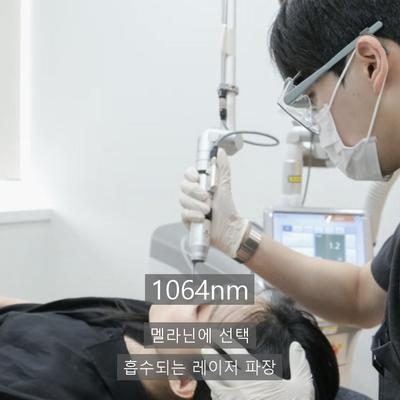
The improvement in pigmentation becomes more noticeable with each accumulated session.
Laser toning typically recommends 10 or more cumulative treatments. Since it gradually lowers the activity level of melanin pigment cells, it's not about expecting dramatic changes in a short period, but rather a concept of consistently receiving treatments to progressively reduce pigment concentration. Treatment intervals are usually 2-4 weeks, treatment time is short, and pain is minimal. There is also almost no downtime, allowing for immediate return to daily life after treatment.
The most important post-treatment care is sun protection. If UV rays stimulate melanocytes, melanin can be overproduced again, causing pigmentation to recur or darken. Thoroughly using sunscreen with SPF 50 or higher after treatment is the first condition for maintaining its effectiveness. Moisturizing after cleansing is also important. Stable skin barrier speeds up pigmentation recovery.
There is a common misunderstanding. Some people expect that one session of acne pigmentation laser toning will completely remove brown marks. Laser toning is not a method that removes all accumulated melanin at once. It is a cumulative treatment that gradually lowers the activity level of pigment cells over multiple sessions. Even if no significant change is felt in the first few sessions, consistent treatment will gradually lighten pigmentation. Consistently receiving treatment without interruption determines the results.
Why Kkeut Clinic Operates Laser Toning Differently
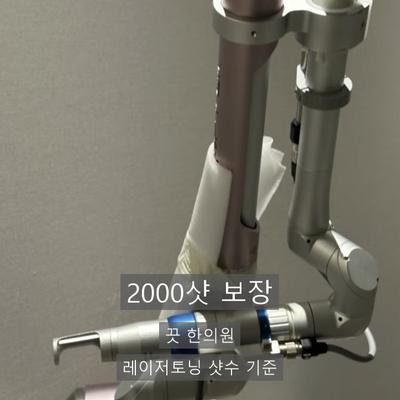
Kkeut Clinic guarantees over 2,000 shots during laser toning. If the number of shots is insufficient, the cumulative stimulation applied to melanin is inadequate, leading to reduced effectiveness. At Kkeut Clinic, after the treatment, there is a procedure to directly verify the number of shots performed with the director. Because there is a process of verification by numbers, the treatment is not ambiguous.
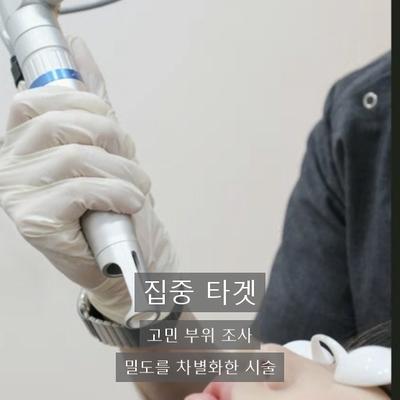
Kkeut Clinic intensively targets areas of concern. For areas where acne marks are concentrated or pigmentation is dense, energy is applied more intensely. Instead of uniformly treating the entire skin, the irradiation density is adjusted based on the pigment concentration and skin condition of each area. This is why faster changes can be achieved in areas where concerns are concentrated.
Kkeut Clinic operates a protocol that gradually increases energy in each session. We do not start with strong energy from the beginning, but gradually raise energy levels while observing skin reactions. This method enhances the speed of pigmentation improvement while reducing the risk of side effects. Kkeut Clinic's acne pigmentation laser is designed so that each session applies progressively higher stimulation, not the same stimulation.
Frequently Asked Questions
Q. Can acne pigmentation laser treatment address both red and brown marks?
A. The approach for acne pigmentation laser treatment varies depending on the type of mark. Brown marks (PIH) are gradually broken down by melanin pigment using laser toning. For red marks (PIE), a method that selectively targets blood vessels is effective. If both types of marks are present, treating them separately with appropriate methods is the way to enhance results.
Q. How many sessions of acne pigmentation laser toning are needed to see results?
A. Acne pigmentation laser toning is a treatment that gradually lowers the activity level of pigment cells, so usually 10 or more cumulative sessions are recommended. The number of sessions required may vary depending on the depth and concentration of the pigmentation. It is generally recommended to proceed consistently at 2-4 week intervals.
Q. Why is sun protection important after acne pigmentation laser treatment?
A. After acne pigmentation laser treatment, exposure to UV rays can re-stimulate melanocytes, causing pigmentation to recur or darken. Thoroughly using sunscreen with SPF 50 or higher is crucial for maintaining the effectiveness.
Q. What is different about receiving acne pigmentation laser treatment at Kkeut Clinic?
A. We guarantee over 2,000 shots and verify the shot count directly with the director after the procedure. Areas with dense pigmentation are intensively targeted, and a protocol of gradually increasing energy in each session is applied. Kkeut Clinic's acne pigmentation laser is designed so that the effects accumulate with each successive session.
Kkeut Clinic's Sincerity
Kkeut Clinic provides treatments with guaranteed effectiveness through its assurance of over 2,000 shots and direct verification of the shot count with the director after the procedure.
Kkeut Clinic enhances patient satisfaction by using a customized area-specific irradiation method that intensively targets areas with dense pigmentation.
Kkeut Clinic pursues both safety and effectiveness simultaneously with a protocol that gradually increases energy in each session.
A Subtle Difference, Different Results — Experience it at Kkeut Clinic.
Related notes
Procedure notes worth reading next.


Loading menu…