

Ultherapy 200 Shots: 3 Important Things to Consider Besides the Number of Shots Beomgye, Pyeongchon, Beomgye Station, Pyeongchon Station, Hogye-dong, Bisan-dong, Gwanyang-dong, Dongan-gu, Indeogwon, Geumjeong, Anyang
This is Gyeonggi Anyang Beomgye KKEUT Korean Clinic's procedure note on Ultherapy 200 Shots: 3 Important Things to Consider Besides the Number of Shots.
Those who have consulted about Ultherapy or researched information related to it have probably often seen the number '200 shots'.
Shot count tends to attract attention first because it is an intuitively easy number to compare.
However, the content implied by the expression 'the same number of shots' can vary for each treatment.
At Kkeut Korean Medicine Clinic, we explain three factors that should be considered when looking at shot counts.
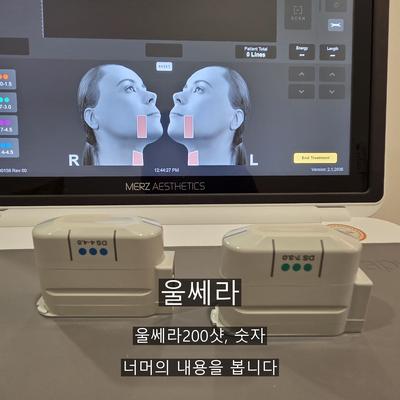
Ultherapy is a method of delivering ultrasonic energy deep into the skin in a consistent 'line' shape.
Here, one shot refers to a line, not a dot, and it is a method of irradiating energy to the facial area by regularly arranging these lines.
Therefore, the shot count can be a criterion for covering a specific area of the face.
With just the information 'Ultherapy 200 shots', it is difficult to determine which part of the face is being treated and with what density.
Due to the nature of the treatment, which delivers energy in thin lines across the entire face, generally, more than 600 shots are recommended.
The appropriate number of shots can be determined differently depending on an individual's face size, skin sagging condition, and the degree of focus required on a specific area.
At Kkeut Korean Medicine Clinic, we establish the treatment design through thorough consultation with the patient and determine the appropriate number of shots accordingly.
Skin sagging can occur due to a simple increase in fat, but it can also appear when the SMAS layer loses elasticity, even if there isn't a lot of fat.
The SMAS layer, which Ultherapy focuses on, is distinct from the layer that forms the skin's volume.
Therefore, it is important not only to look at the shot count but also to consider which skin layer the energy is delivered to and how precisely.
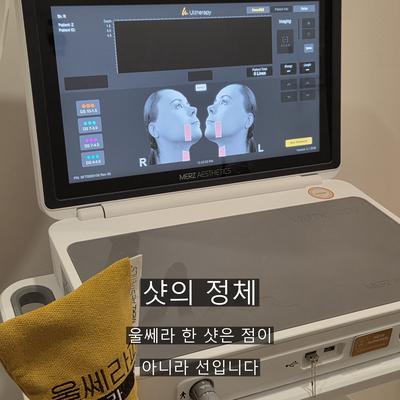
First, please check the length of one Ultherapy shot.
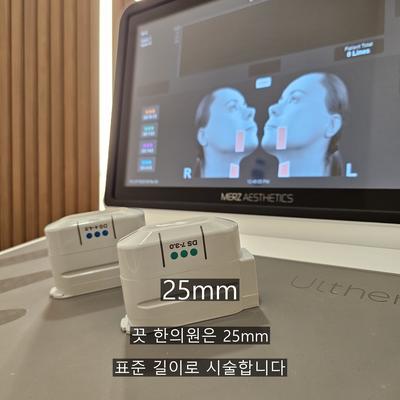
In Ultherapy, the basic length of one shot is set to 25mm.
This is the standard length recommended by the equipment manufacturer.
However, this length can also be adjusted and reduced in the treatment settings as needed.
If the shot length is reduced, the irradiation time per shot is shortened, which can reduce the total treatment time.
However, the area covered by one shot decreases proportionally.
Ultimately, more shots are required to cover the same treatment area.
This means that even if the visible shot count is the same, the actual treatment content can differ.
For example, even with the same 600 shots, the total amount of energy actually irradiated to the skin can vary.
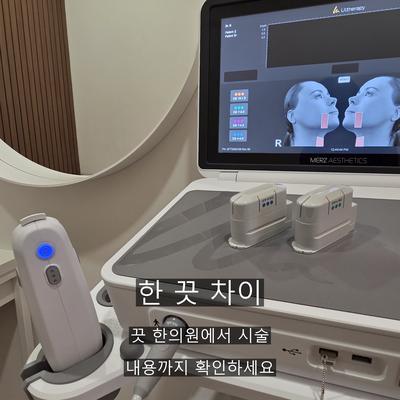
At Kkeut Korean Medicine Clinic, we maintain the standard length of 25mm during Ultherapy and transparently show the patient the equipment setting screen before treatment.
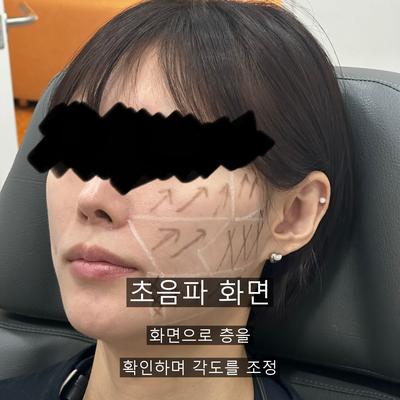
Second, check whether the skin layers are being monitored in real-time during the procedure.
The tips used in Ultherapy are designed to focus on different fixed depths.
For example, a 4.5mm tip focuses energy at a depth of 4.5mm, and a 3.0mm tip focuses energy at a depth of 3.0mm.
However, the depth of the SMAS layer varies among individuals, and even within the same face, the depth can differ by area.
For instance, let's assume the SMAS layer is located at a depth of 3.8mm.
In this case, the 4.5mm tip would deliver energy deeper than the SMAS layer, and the 3.0mm tip would form a focal point above the SMAS layer.
If the tip is only irradiated perpendicularly to the skin, both tips will have difficulty reaching the exact target layer.
In such situations, the depth of focus can be adjusted by tilting the tip diagonally during irradiation. This makes it possible to deliver energy even to layers between the tip specifications.
This technique is called 'Tilting'.
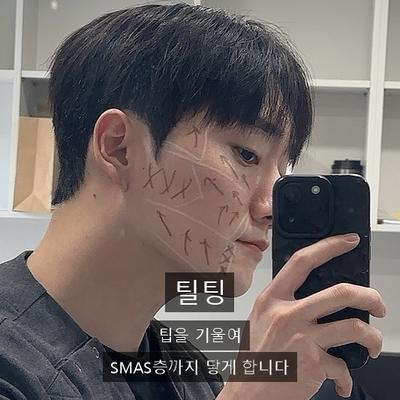
At Kkeut Korean Medicine Clinic, we identify the precise location of the skin layers through real-time ultrasound imaging and meticulously adjust the tip's angle accordingly during the treatment.
This angle adjustment process requires time for each area, so it might seem somewhat inefficient if only treatment speed is considered.
Therefore, this process is also a part that can easily be overlooked or omitted for the sake of treatment efficiency.
Additionally, depending on the treatment design, there are cases where energy is irradiated not only to the SMAS layer but also to the fat layer.
This is because when volume is excessively distributed in a specific area, effective improvement may be difficult with SMAS layer lifting alone.
Similarly, such precise measures are treatment directions only possible when the skin layers are accurately identified.
Kkeut Korean Medicine Clinic does not spare the time required for such meticulous procedures.
Third, make sure there's a record of your procedure
After a lifting procedure, it can be difficult to know exactly what was done.
Due to the nature of procedures performed directly on the face, it's hard for patients to see the process themselves, and often they are only simply informed of the total number of shots.
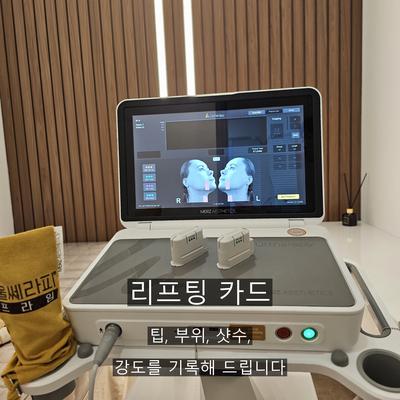
At Kkeut Korean Medicine Clinic, we provide a lifting card after the procedure is complete.
This card details which tips were used, how many shots were applied to each area, and the intensity settings used for each part.
This record card serves as an important basis for discussing with the medical staff what adjustments or improvements should be made in comparison to the previous session during your next procedure.
If you undergo multiple procedures, your personal treatment history will be systematically accumulated.
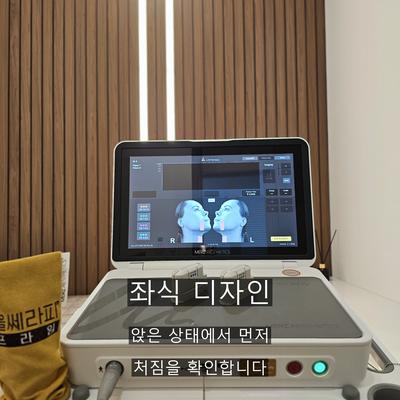
At Kkeut Korean Medicine Clinic, Ultherapy design is first performed while you are seated, and the actual procedure is performed while you are lying down.
This is because when you lie down, the direction of gravity changes, causing sagging tissues to shift backward and lift.
When lying down, facial sagging appears less prominent, so if the design is done at this time, areas that actually need improvement when the patient stands up might be overlooked.
While seated, we directly feel and visually confirm the skin to precisely determine the skin thickness of each area.
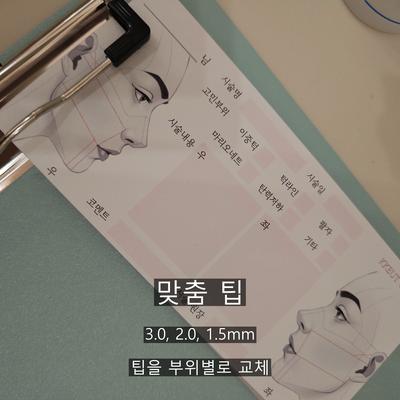
Each area, such as the upper cheekbones, under the jaw, and cheeks, has different skin thicknesses, and accordingly, 4.5mm and 3.0mm tips are used as appropriate.
Tip selection is not decided spontaneously during the procedure; instead, a precise plan is established for each area before the procedure begins.
At Kkeut Korean Medicine Clinic, in addition to the primary 4.5mm main tip, we utilize various customized tips such as 3.0mm, 2.0mm, and 1.5mm.
If one relies only on the equipment screen without a plan, the procedure can become impulsive; conversely, if only the plan is prioritized without checking the screen, accuracy may decrease.
Kkeut Korean Medicine Clinic believes both of these elements, planning and real-time screen verification, are crucial.
The number of shots is merely the starting point of a consultation; the quality and content of the actual procedure hold greater importance.
Therefore, by also checking the length of each shot, which layer the energy reaches, and whether the procedure is recorded, your criteria for comparing and choosing a clinic will become clearer.
Frequently Asked Questions
Q. Is 200 shots of Ultherapy sufficient?
A. Whether 200 shots of Ultherapy is appropriate can vary depending on an individual's face size, degree of skin sagging, and the scope of specific areas requiring improvement. Ultherapy is a method that delivers energy in thin lines beneath the skin to promote overall improvement. At Kkeut Korean Medicine Clinic, we generally recommend 600 shots or more, and the detailed shot count is determined during the consultation as we establish the design plan.
Q. Do I need sedation for 200 shots of Ultherapy?
A. Whether it's 200 shots or any other number, Kkeut Korean Medicine Clinic does not recommend sedation for Ultherapy procedures. The treatment tip must be in full contact with the skin for energy to be delivered evenly and to reach the precise planned depth. During sedation, the patient's head may move unknowingly, which can compromise the precision of the procedure. We primarily use topical anesthetic cream, and the sensations felt during the procedure can sometimes help the medical staff pinpoint the exact location where energy is being delivered.
Q. When do changes appear after receiving 200 shots of Ultherapy?
A. The timing of changes appearing after an Ultherapy procedure can vary by individual. Generally, many individuals start to notice gradual changes about one month after the procedure. In the initial period after the procedure, some swelling may occur, which is a natural process as the heat-stimulated tissues gradually reconstruct. The next treatment cycle varies depending on the individual's degree of skin sagging, so it is best to determine it through consultation with a professional medical team.
Q. I have little facial fat, and I'm concerned about hollow cheeks if I get 200 shots of Ultherapy.
A. The SMAS layer targeted by Ultherapy is located at a different depth than the fat layer that constitutes skin volume. Therefore, for individuals with relatively less volume, meticulous design that avoids the fat layer and precisely delivers energy only to the SMAS layer becomes even more crucial. Design performed while seated and the tilting technique using an ultrasound screen contribute to enhancing this accuracy. Since the treatment plan can vary depending on an individual's skin condition and structure, it is advisable to decide after a thorough consultation with the medical staff.
Kkeut Korean Medicine Clinic's Commitment
Kkeut Korean Medicine Clinic adheres to the principle of 25mm standard length treatments and transparently shares treatment information beyond just the number of shots by publicly displaying the equipment settings screen before the procedure.
Our Kkeut Korean Medicine Clinic performs Ultherapy with precise design while seated, combined with a tilting technique using an ultrasound screen to confirm the exact layer for each treatment area.
Kkeut Korean Medicine Clinic records detailed treatment information on a lifting card, supporting it to become an important reference for setting the direction of future treatments.
The Kkeut difference for distinct results, experience it for yourself at Kkeut Korean Medicine Clinic.
Loading menu…