

Sagging Jawline: Jaw Lifting Procedure Selection Criteria and Analysis of Causes for Loss of Definition (Part 2) Beomgye, Pyeongchon, Beomgye Station, Pyeongchon Station, Hogye-dong, Bisan-dong, Gwanyang-dong, Dongan-gu, Indeogwon, Geumjeong, Anyang
This is Gyeonggi Anyang Beomgye KKEUT Korean Clinic's procedure note on Sagging Jawline: Jaw Lifting Procedure Selection Criteria and Analysis of Causes for Loss of Definition (Part 2).
When considering a jawline lifting procedure, many people often want to understand the fundamental cause of their sagging jawline before figuring out which device is effective.
While the previous article compared the characteristics of Ulthera and Shurink devices, this content analyzes the causes of jawline sagging and explains the criteria for selecting a suitable procedure for each individual.
Accurately understanding the causes of jawline sagging can help you choose a more effective method from various jawline lifting procedures for yourself.
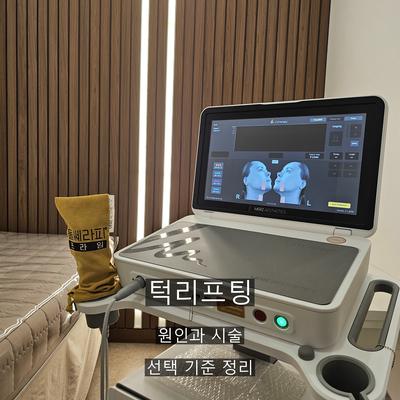
Multiple factors can contribute to jawline sagging
Jawline sagging is not simply caused by excessive fat volume.
Even with less facial fat, sagging can occur if the elasticity of the SMAS (superficial musculoaponeurotic system) layer decreases.
The SMAS layer is a supporting structure that envelops the muscle membrane beneath the skin; if this layer weakens, the facial line sags downwards.
Conversely, if there is an overall lack of facial volume, the supporting strength weakens, making the jawline appear to sag more easily.
Excessive fat accumulation under the chin, making the jawline appear dull, can also be considered another cause.
Even if it appears to be the same jawline sagging on the surface, the treatment method can vary depending on whether the cause is SMAS layer laxity or a problem with the fat layer.
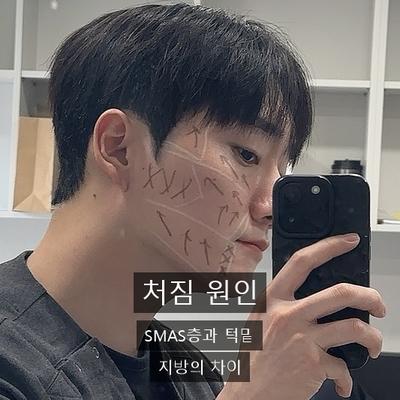
Jawline sagging may appear less severe than it actually is when lying down
While lifting procedures are typically performed with the patient lying down, the precise design work begins with the patient in a seated position.
When the patient lies down, the effects of gravity change, causing the sagging tissues to shift upwards, making it difficult to accurately assess the actual extent of jawline sagging.
If the treatment area is designed only while the patient is lying down, there's a possibility that crucial areas that actually need lifting when standing up might be missed.
Therefore, it is crucial that jawline design begins with a meticulous check of which lines are sagging while the patient is in a seated position.
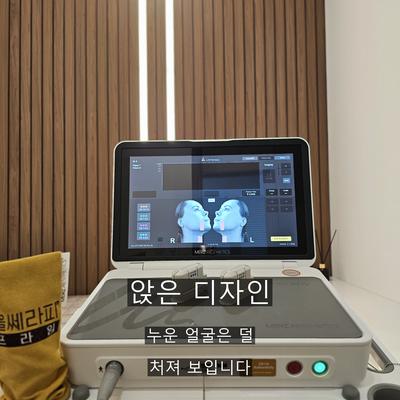
Skin thickness varies across different facial areas
Even within the same face, the skin thickness around the cheekbones, under the chin, and on the cheeks varies.
Before a lifting procedure, medical staff directly touch and visually examine the patient's skin to ascertain the skin thickness of each area.
Based on this skin thickness, areas suitable for a 4.5mm tip and areas requiring a 3.0mm tip, for example, are determined in advance.
Therefore, the type of tip to be used for the procedure is not decided spontaneously during the treatment but is planned beforehand according to each area before starting.
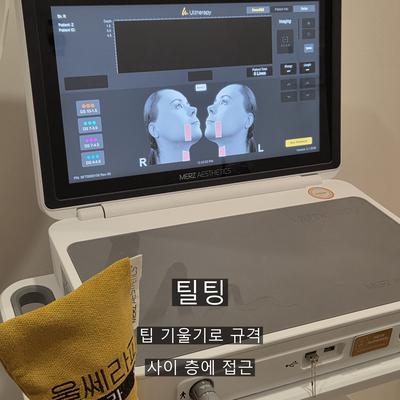
During Ulthera treatment, the tilting technique targets the fine layer between tip specifications
Ulthera tips deliver energy focused at a specific depth; for example, a 4.5mm tip concentrates energy precisely at a 4.5mm depth, and a 3.0mm tip at a 3.0mm depth.
However, the actual location of the SMAS layer within the skin rarely precisely matches the fixed depth of the tip.
If the SMAS layer is located at a depth of 3.8mm, a 4.5mm tip would deliver energy deeper than the SMAS layer, and a 3.0mm tip would deliver it to a shallower depth.
In such cases, by utilizing the 'tilting' technique, which involves angling the treatment tip diagonally, the focal depth can be finely adjusted to deliver energy to the desired layer between the standard depths.
Tilting is a technique that involves precisely adjusting the tip's angle while confirming the skin layers via real-time ultrasound imaging to deliver energy to the exact target area.
Sometimes, depending on the treatment design, energy may be delivered to a specific fat layer rather than the SMAS layer.
This is because areas with excessive volume are difficult to adequately improve by lifting only the SMAS layer.
Shot count should not be viewed merely as a number but should comprehensively consider the treatment content
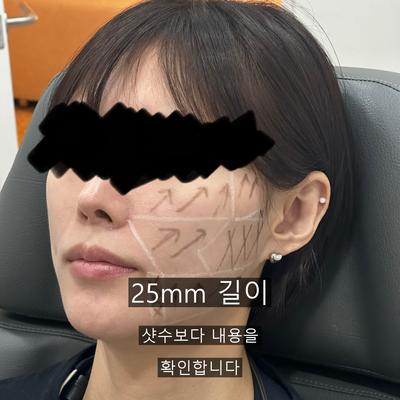
In Ulthera treatment, each shot delivers energy in a 25mm long line, not a dot.
The length of the shot is adjustable; setting a shorter length can reduce treatment time, but the area treated by a single shot will decrease.
Consequently, even with the same 600 shots, the total amount of energy delivered to the skin or the coverage area can vary.
The appropriate shot count can vary depending on the patient's face size and degree of sagging, and treatment plans often suggest 600 shots or more.
Three Criteria to Consider When Choosing a Jawline Lifting Procedure
Ulthera, Shurink, and InMode FX are all popular procedures that can be used for jawline lifting.
When choosing a procedure, it's better to base your decision on the specific condition of your sagging jawline rather than merely on the name of the device.
First, you need to ascertain whether the primary cause of jawline sagging is an issue with the SMAS layer or the accumulation of submental fat.
If improving submental fat or a double chin is the main objective, InMode FX treatment can be an effective alternative.
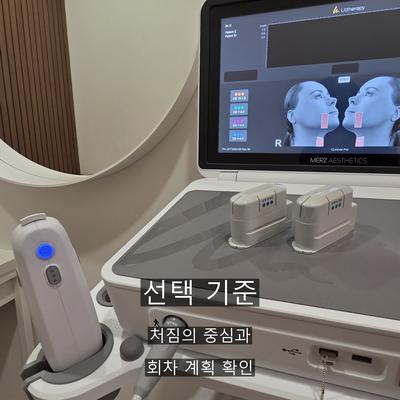
Secondly, you need to plan whether to achieve the treatment effect in a single session or to expect cumulative effects through consistent management.
Shurink is a procedure where cumulative effects are expected through repeated treatments at regular intervals rather than a single session, and it is generally recommended to receive treatment every 1 month.
If the recommended number of shots for Ultherapy treatment has been completed, it is generally advisable to consider a 6-month to 1-year interval. If shots are received in divided sessions as needed, it is common to plan treatments at 1-month intervals.
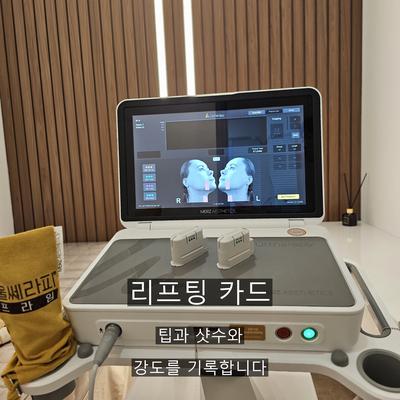
Third, it is important to ensure that information about the procedure is accurately recorded.
Considerations Before Treatment
During Ultherapy treatment, ultrasound energy is delivered when the specialized tip is fully in contact with the skin.
For the energy to accurately reach the target depth, consistent contact of the tip must be maintained throughout the procedure. For this reason, treatments are primarily performed using topical cream anesthesia rather than sleep anesthesia.
The treatment effects may vary among individuals and generally begin to appear gradually about one month after the procedure.
In the initial stages of treatment, you might experience a pulling sensation in the skin or slight swelling. This is a natural reaction that occurs as the tissue is newly reorganized after heat stimulation.
Unlike Ultherapy, which targets deep skin layers, treatments like Densify, Onda, and Tenstherma focus on improving superficial skin texture and enhancing elasticity. Because they act on different layers, they are often considered together.
It is best to consult with a specialist to determine which treatment combination is suitable for your skin condition.
Kkeut Clinic's Jawline Treatment Plan
At Kkeut Clinic, we plan the design in a seated position before the lifting procedure to prevent potential cheek hollowing that may occur after treatment.
At Kkeut Clinic, in addition to the basic 4.5mm main tip, we use various customized tips such as 3.0mm, 2.0mm, and 1.5mm, considering the specific characteristics of each area.
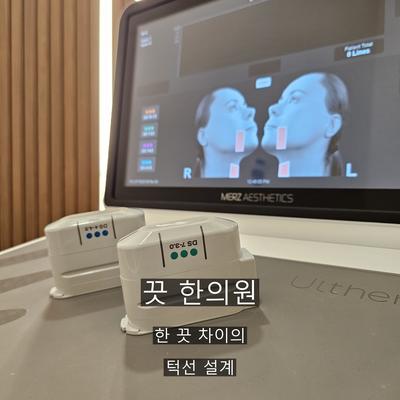
At Kkeut Clinic, during Ultherapy treatments, we strive to accurately target the SMAS layer by adjusting the tip angle while monitoring the ultrasound screen in real-time.
Kkeut Clinic performs treatments based on a standard length of 25mm, and before the procedure, we show the equipment's setting screen directly to the patient.
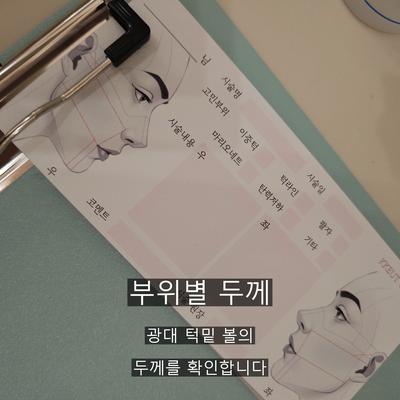
The lifting card provided by Kkeut Clinic details the type of tip used, the number of shots for each area, and the intensity applied. This can be important data for future treatment consultations.
Questions You Might Have
Q. When considering jawline lifting, is it necessary to first identify the cause of the sagging jawline?
A. Jawline lifting approaches vary depending on whether the SMAS layer has loosened or if fat has accumulated under the chin, so accurately identifying the cause is a priority. At Kkeut Clinic, we meticulously check the patient's jawline in a seated position.
Q. For jawline lifting, what is the usual recommended number of Ultherapy shots?
A. The required number of shots may vary among individuals depending on the treatment area and the degree of jawline sagging. Generally, 600 shots or more can be considered, and at Kkeut Clinic, we create a treatment plan together with the patient through a design consultation.
Q. When can I expect to see results after a jawline lifting procedure?
A. The effects of jawline lifting may vary per individual, but generally, changes can gradually be felt after about one month. Any swelling that appears in the initial stages of treatment can be considered a temporary reaction during the tissue's reorganization process.
Kkeut Clinic's Meticulous Approach
Kkeut Clinic meticulously plans the treatment design with the patient in a seated position and carefully checks the skin thickness of each area to ensure a more precise procedure.
Kkeut Clinic enhances treatment efficiency by appropriately switching personalized tips and utilizing techniques to precisely adjust the tip angle during the procedure.
Kkeut Clinic aims to meet both treatment safety and expected results through procedures that maintain a standard length of 25mm and by sharing information via lifting cards.
The Difference Meticulous Details Make - Experience it at Kkeut Clinic.
Related notes
Procedure notes worth reading next.


Loading menu…