

Fraxel Treatment and Potenza: What makes Potenza, with its minimal downtime, so special? Beomgye, Pyeongchon, Beomgye Station, Pyeongchon Station, Hogye-dong, Bisan-dong, Gwanyang-dong, Dongan-gu, Indeogwon, Geumjeong, Anyang
This is Gyeonggi Anyang Beomgye KKEUT Korean Clinic's procedure note on Fraxel Treatment and Potenza: What makes Potenza, with its minimal downtime, so special.
One of the most frequently asked questions for those considering Fraxel treatment is the recovery period.
Fraxel has been a widely used treatment device in the past, and Potenza can be seen as an advanced device that improves upon the principles of Fraxel.
Since these two devices have different fundamental principles and goals, we will explain the changes in sequence.
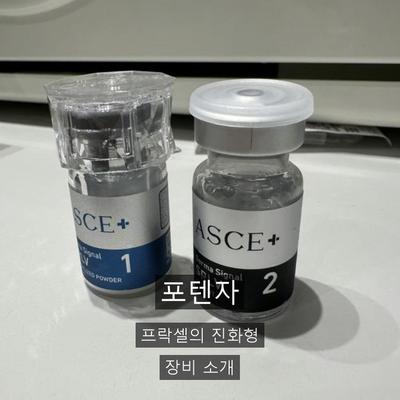
The name Fraxel is still frequently mentioned as a representative treatment for concerns such as scars, pores, and skin texture.
Many people desire effective skin regeneration, but they also worry about significant disruptions to their daily lives after treatment.
Fraxel was a device that induced the regeneration of new skin by ablating the skin surface.
Because it directly dealt with the outer layer of the skin, recovery time was needed after treatment, which was one of the long-standing concerns for patients.
Potenza was developed to reduce the burden of such recovery periods, focusing on the dermal layer beneath the skin surface.
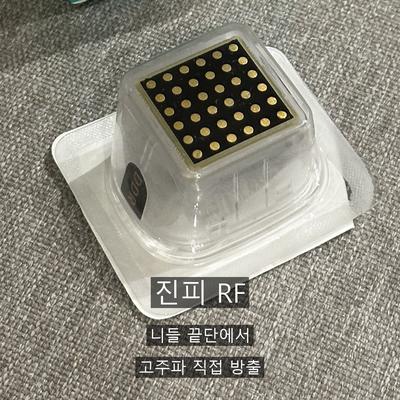
Potenza works by having micro-needles reach the dermis to create tiny channels, and then directly emitting radiofrequency (RF) energy from the needle tips.
The main principle is that this RF energy stimulates the production of collagen and elastin, aiding in skin regeneration.
When using non-insulated tips, while leaving minimal damage on the skin surface, the energy can be effectively concentrated in the dermal layer beneath the skin.
This method aims to reduce the burden of post-treatment recovery time and enhance improvement effects through skin regeneration.
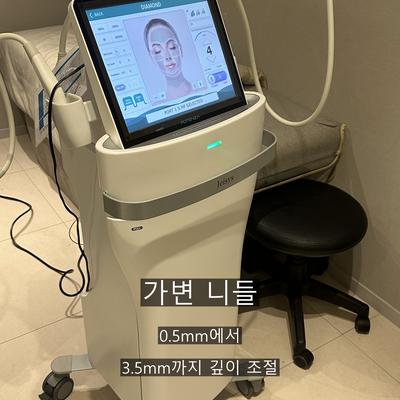
During treatment, the depth of the needles can be adjusted from 0.5mm up to 3.5mm.
Instead of treating the entire face at a uniform depth, the treatment plan is tailored by setting different depths for each area of the patient's skin concern.
Various tips are utilized according to the treatment purpose; for instance, a non-insulated tip if skin elasticity improvement is needed, or a pumping tip if drug penetration is the primary goal.
Since the basic principles of all needle RF devices are similar, differences in treatment outcomes can ultimately stem from the medical staff's skilled operational ability.
The main indications for which Potenza can be applied can be broadly divided into four areas.
First, melasma and hyperpigmentation. Melasma refers to a state where pigment-producing melanin cells are excessively activated, and Potenza's radiofrequency energy can help calm this melanin cell activity, improving the pigment environment.
Second, it is used for improving acne scars, general indented scars, and enlarged pores.
Third, it aims to alleviate fine wrinkles, improve skin texture, and enhance skin elasticity.
Fourth, it helps manage acne and other skin troubles by regulating excessively active sebaceous glands.
Treatment Principle: Focusing on the Dermis, Not the Skin Surface
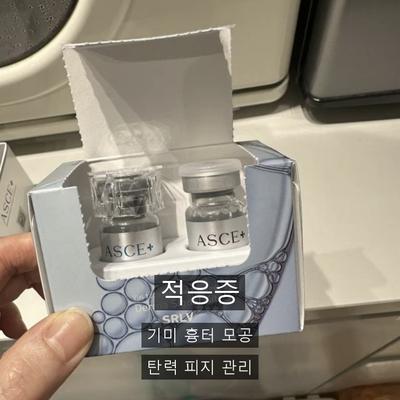
Immediately after the treatment, the skin may appear somewhat red or show tiny pinpoint bleeding.
These symptoms typically subside within 1-2 days, but can last up to a week depending on the treatment intensity and individual skin characteristics, so there may be individual differences.
It is difficult to definitively determine the post-treatment recovery period because the treatment intensity and individual skin types vary.
The procedure is performed after applying anesthetic cream, and the pain is generally known to be tolerable compared to other lifting treatments or needle-based procedures.
Makeup is possible from the day after the treatment, but it is recommended to refrain for about 3 days for skin protection and smooth recovery.
For 1-2 days after treatment, avoid activities that can raise body temperature such as saunas, strenuous exercise, and alcohol consumption, and pay careful attention to skin moisturizing and sun protection.
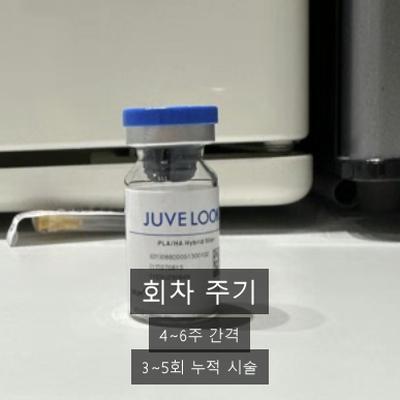
The recommended treatment cycle is every 4 to 6 weeks, considering the skin regeneration cycle.
For scar improvement or skin elasticity recovery, 3 to 5 repeated treatments may be considered.
While changes in skin texture can be felt even after a single treatment, the fundamental regeneration of deep scars can be gradually achieved through multiple sessions.
When choosing Potenza treatment, it is advisable not to just look at the device name, but to check the types of available tips, the expertise in setting treatment depths, and the availability of sufficient shot counts.
Kkeut Korean Medicine Clinic's Potenza Treatment Method
At Kkeut Korean Medicine Clinic, through thorough pre-treatment consultation, we accurately identify the patient's areas of concern and carefully determine the appropriate tip type and depth.
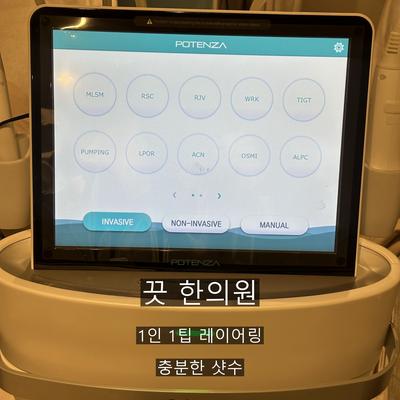
When combining with skin boosters, we use Potenza's dedicated pumping tip.
The pumping tip utilizes the positive pressure generated when the needle exits the skin to effectively deliver medication into the dermal layer. This can help increase the penetration efficiency of active ingredients compared to other traditional injection methods.
This pumping tip is a unique feature provided only with Potenza devices.
For hygiene and safety, Kkeut Korean Medicine Clinic adheres to the principle of using all treatment tips only once per patient and immediately disposing of them after use.
Kkeut Korean Medicine Clinic carefully adjusts the needle depth according to the patient's area of concern and strives to increase treatment density by applying a layering technique where treatment areas overlap.
At Kkeut Korean Medicine Clinic, we ensure that all promised shots are utilized during treatment, so that radiofrequency energy is evenly delivered throughout the skin.
Frequently Asked Questions
Q. Are dermatological Fraxel and Potenza the same procedure?
A. In the past, a device called Fraxel was sometimes used, but Potenza is a device that utilizes a different principle. Since their mechanisms of action and goals are different, they are not classified as the same procedure. At Kkeut Korean Medicine Clinic, we perform procedures using Potenza.
Q. If I receive Potenza instead of dermatological Fraxel, how long will the redness last?
A. Many people are concerned about the recovery period after conventional Fraxel procedures. The redness or tiny bleeding points that appear during a Potenza procedure tend to subside mostly within 1-2 days. However, there may be a difference of up to 1 week depending on the intensity of the procedure or individual skin characteristics.
Q. If I want a regenerative effect like dermatological Fraxel, how many sessions do I need?
A. If your goal is to improve scars or enhance skin elasticity, we generally recommend receiving 3 to 5 sessions at intervals of 4 to 6 weeks. The treatment plan may vary depending on your individual skin condition and concerns.
Kkeut Korean Medicine Clinic's Treatment Philosophy
At Kkeut Korean Medicine Clinic, we use a dedicated pumping tip during Potenza procedures to ensure that skin booster medications are efficiently delivered to the dermis layer of the skin.
Kkeut Korean Medicine Clinic adheres to the principle of one tip per person for hygiene. Furthermore, we apply layering techniques tailored to each individual's areas of concern and skin characteristics, considering the efficiency of the procedure.
At Kkeut Korean Medicine Clinic, we ensure that the prescribed number of shots is fully utilized during procedures to achieve satisfactory results, and we always prioritize patient safety.
Small yet subtle differences make all the difference in results. Discover Kkeut Korean Medicine Clinic's unique treatment approach.
Loading menu…