

Why Your Facial Elasticity Declines Faster Than Your Age and How to Improve It Beomgye, Pyeongchon, Beomgye Station, Pyeongchon Station, Hogye-dong, Bisan-dong, Gwanyang-dong, Dongan-gu, Indeogwon, Geumjeong, Anyang
This is Gyeonggi Anyang Beomgye KKEUT Korean Clinic's procedure note on Why Your Facial Elasticity Declines Faster Than Your Age and How to Improve It.
Facial elasticity does not vanish overnight; it first shows up as the contours sagging little by little.
Even at the same age, some faces keep their contour while others look saggy sooner.
Here we sort out, layer by layer, why facial elasticity declines faster than age and how to improve it.
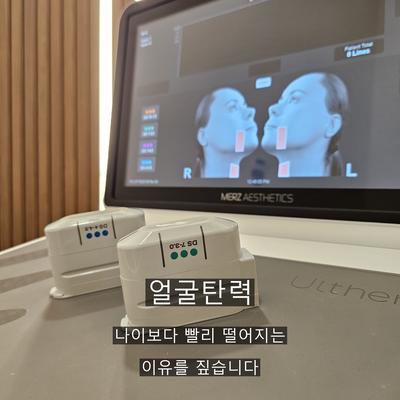
The face is supported by three layers
The skin, the fat layer and the SMAS layer beneath overlap to form the shape of the face. The SMAS layer is the structural layer that supports the contour, so when this layer stretches, the contour sags even if the skin looks fine.
Sagging can occur from having a lot of fat, but it also occurs when the SMAS layer stretches even with little fat. People with less volume have a weaker supporting structure, so their contour can look even more collapsed.
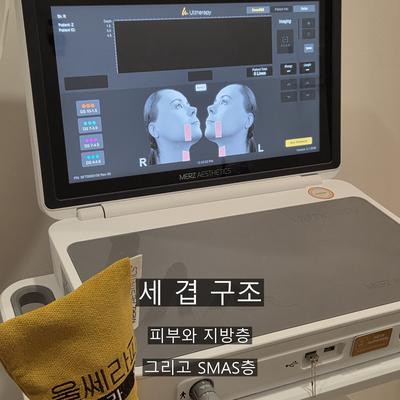
Why it feels faster than your age
This is because each layer changes at a different speed. Some people lose surface texture and elasticity first, some lose volume so the contour collapses first, and some have the supporting layer stretch so sagging comes first. When these three overlap, the difference in facial elasticity looks large even at the same age.
Everyday factors such as UV exposure, dryness and weight changes also affect skin condition. That is why you first need to work out in which layer the change began.
What you need is an approach that fits the layer
Sagging in the deep layer needs a treatment that works on the deep layer. Surface texture and elasticity are a separate area and the layers do not overlap, so many people also combine treatments that work on the surface, such as Density, Onda and TenTherma.
Kkeut Oriental Medicine Clinic explains ultrasound lifting such as Ulthera and Shurink separately according to the location and degree of sagging.
Ulthera works on the SMAS layer
Ulthera is a treatment that delivers ultrasound to the deep layer to give heat stimulation. Because the tissue goes through a process of reconstruction after the heat stimulation, it takes time. One shot is not a point but a line, and these lines are placed side by side to fill the face.
Changes usually begin to appear gradually from about 1 month onward, with individual differences. In the early period, a slight tightening feeling and swelling often come together.
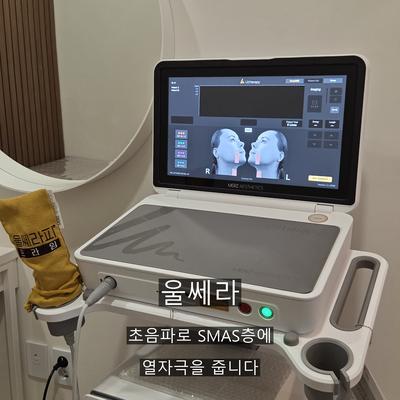
Usually 600 shots or more are recommended, but the appropriate shot count varies with the face size, the degree of sagging and the areas that need focus. For the interval, we advise 6 months to 1 year if the recommended shot count is completed in one session, or filling it in at 1-month intervals if divided into several sessions.
Because energy goes into the deep layer, there is some sensation. Most treatments are done with numbing cream, and many people have it without anesthesia.
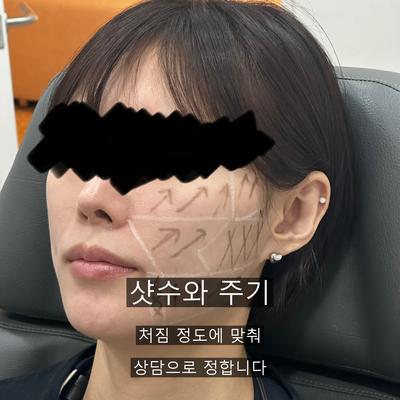
A 1-month interval is the accepted recommendation for Shurink, and it is approached as a cumulative treatment rather than a one-off. The timing of the next treatment varies with the shot count of each session. Kkeut Oriental Medicine Clinic switches between customized 3.0, 2.0 and 1.5mm tips in addition to the 4.5mm main tip.
TenTherma, a radiofrequency method, designs the tip's grid pattern while the patient sits so that heat is evenly distributed, and keeps the cumulative energy heat delivery high with the SuperPass technique.
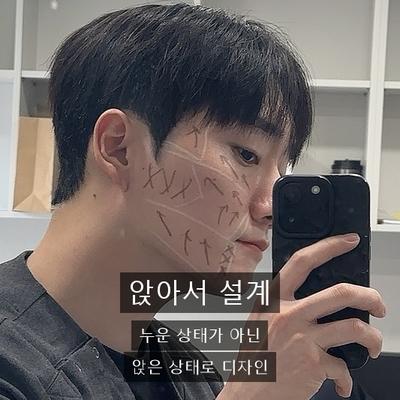
Before treatment, we design it first while you sit up
The design is made with the patient sitting, not lying down. This is because when lying down, sagging tissue is pushed back and up and looks less saggy than it really is. Kkeut Oriental Medicine Clinic checks the collapsed contour while you sit, feels the skin thickness of each area by touch, and plans the 4.5mm and 3.0mm tips before starting.
The Ulthera tilting skill unique to Kkeut Oriental Medicine Clinic
The tip depth is fixed, but the depth of the SMAS layer differs from area to area. If the layer lies at 3.8mm, the 4.5mm tip passes below it and the 3.0mm tip passes above it. In that case, tilting the tip at an angle changes the focal depth so that it reaches the layer between the standard sizes.
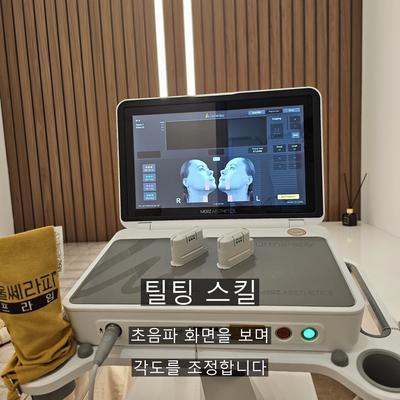
Kkeut Oriental Medicine Clinic adjusts the angle while watching the layer on the ultrasound screen, and does not skip this time-consuming process.
25mm, we do not shorten it
If the basic line length of 25mm is shortened, treatment is faster but the area covered by each shot shrinks, so even with the same 600 shots the amount delivered differs. Kkeut Oriental Medicine Clinic treats with the standard 25mm length and shows you the setting screen before treatment.
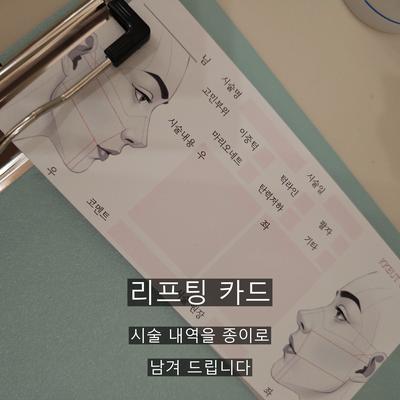
After treatment, we give you a lifting card recording the tips, the shot count by area and the intensity. With the card, where we focused this time is kept on record, and your treatment history builds up the more times you have it.
Frequently asked questions
Q. If facial elasticity declines, do people with thin faces also need treatment?
A. Declining facial elasticity occurs when the SMAS layer stretches, regardless of whether you have much or little flesh. If you worry about hollow cheeks, a design that avoids the fat layer and targets only the SMAS is important, and this is decided after consultation.
Q. Do facial elasticity treatments require sleep anesthesia?
A. Most facial elasticity treatments are done with numbing cream. Kkeut Oriental Medicine Clinic does not recommend sleep anesthesia. The ultrasound must be delivered with the tip pressed firmly against the skin, and if the head moves during sleep, the treatment position shifts.
Q. When do the results of facial elasticity treatment start to show?
A. Facial elasticity changes vary by individual but usually appear gradually from about 1 month onward. It takes time because the tissue goes through reconstruction after heat stimulation, and swelling sometimes comes along in the early period.
Q. Are there other treatments to combine for facial elasticity?
A. Facial elasticity is viewed in terms of the deep layer and the surface layer, so many people combine it with surface treatments such as Density, Onda and TenTherma. The combination is advised according to skin condition.
Sincerity at Kkeut Oriental Medicine Clinic
Kkeut Oriental Medicine Clinic delivers differentiated results through seated design and tip planning by area.
Kkeut Oriental Medicine Clinic raises patient satisfaction through tilting, in which the angle is adjusted while watching the ultrasound screen, and the standard 25mm length.
Kkeut Oriental Medicine Clinic pursues safety and effectiveness together through a lifting card that records the tips, shot count and intensity.
A small difference makes a different result — Experience it at Kkeut Oriental Medicine Clinic.
Related notes
Procedure notes worth reading next.


Loading menu…