

Why wrinkles and droopy eyelids should be considered together during a forehead lift Beomgye, Pyeongchon, Beomgye Station, Pyeongchon Station, Hogye-dong, Bisan-dong, Gwanyang-dong, Dongan-gu, Indeogwon, Geumjeong, Anyang
9/3/2026
This is a procedure note for Why wrinkles and droopy eyelids should be considered together during a forehead lift at Gyeonggi Anyang Beomgye KKEUT Korean Clinic.
When considering a forehead lift, many people tend to focus only on fine lines on the forehead.
However, the forehead and eyelids form an interconnected muscle structure, making them difficult to view independently.
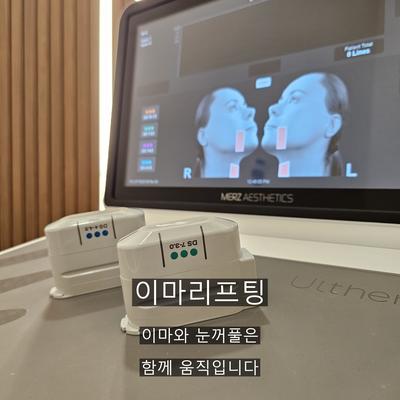
At the upper part of the forehead is the broadly spread frontal muscle.
The frontal muscle plays an important role in moving the eyebrows, and as elasticity decreases over time, its function of supporting the eyebrows also weakens.
Concurrently, the upper eyelid tissue (upper blepharon) tends to sag as its weight pulls downwards.
Ultimately, the reduced elasticity of the forehead skin and the weight of the upper eyelid tissue interact, causing sagging.
Continuously using the frontal muscle to compensate for sagging eyebrows can lead to deep horizontal wrinkles on the forehead.
As eyebrow sagging worsens, a habit of opening the eyes wide may develop, which can increase the use of forehead muscles and make wrinkles even more prominent.
If forehead wrinkles and eyelid sagging are treated individually, one side may show improvement while the other sees little change.
When planning a forehead lifting procedure, it's important to consider not only the external appearance of the forehead but also the internal structures that support the eyebrows.
Forehead sagging can be more effectively improved by lifting the internal support layer rather than just the skin surface.
This support layer is called the SMAS layer, and it is located between the skin and muscles, supporting the overall facial structure.
To accurately deliver energy to the SMAS layer, a method that focuses ultrasound energy at a specific depth is required, rather than simply heating the skin surface.
One of the representative procedures that utilize this principle is Ultherapy.
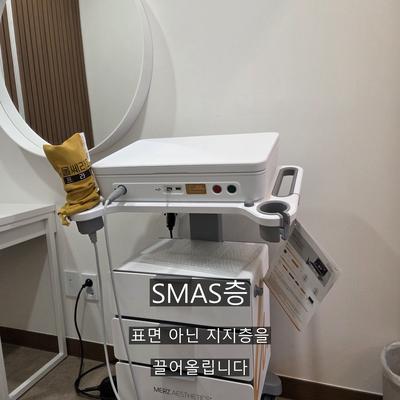
Ultherapy is a procedure that uses High-Intensity Focused Ultrasound (HIFU) to precisely deliver energy to the SMAS layer.
Each treatment tip is designed with a different focal depth, allowing for the selection of various tips such as 4.5mm, 3.0mm, 2.0mm, and 1.5mm, to match the skin thickness of each area.
Ultherapy works by delivering energy in thin line shapes to treat the entire face. Generally, the required number of shots is determined by the treatment area, and we usually recommend 600 shots or more as a guideline.
Since the tissue undergoes a restructuring process over time rather than immediately after the procedure, gradual changes can usually be expected starting about one month later.
If the recommended number of shots has been fully administered, subsequent treatments can be considered at 6-month to 1-year intervals. If the shots are divided into multiple sessions, the next treatment can be considered at 1-month intervals.
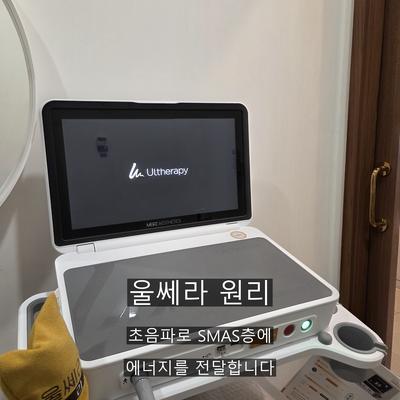
When learning about forehead lifts, you may also encounter other treatment names such as Shurink, Tenstherma, Oligio, and Densithy.
Shurink is also an ultrasound-based lifting treatment and operates on a similar principle to Ultherapy.
Tenstherma, Oligio, and Densithy use radiofrequency energy to widely and uniformly heat the dermis layer. These primarily focus on improving skin surface elasticity and texture.
Because the goal of improving sagging in the deeper skin layers and the goal of refining skin surface elasticity require different approaches, these two types of treatments are often combined.
If forehead and eyebrow sagging appear prominent, an ultrasound lift targeting the SMAS layer can be considered first. If improvement in fine lines or skin texture is also needed, it is common to add a radiofrequency treatment to the plan.
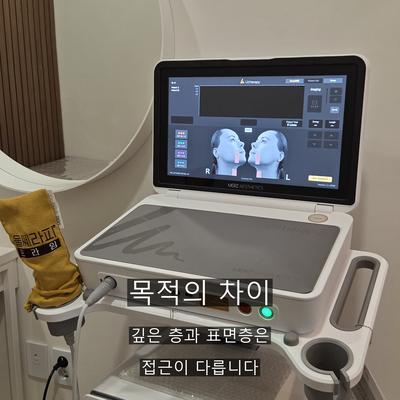
However, if eyelid sagging is severe enough to affect vision or if a functional decline of the muscle itself is suspected, lifting procedures alone may not provide sufficient improvement.
In such cases, a thorough consultation process should precede to determine which method, lifting procedure or surgical correction, is more suitable.
This is also why, before deciding on a forehead lifting procedure, it is necessary to accurately identify whether the cause of sagging is a muscle elasticity issue or a functional problem with the tissue itself.
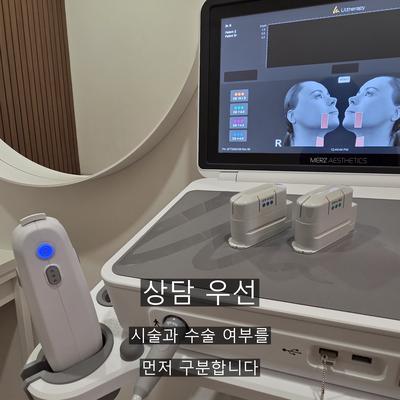
Our clinic performs the design process with the patient in a seated position before the procedure.
This is because, in a lying position, the effects of gravity can push sagged tissues upwards, making the sagging appear less severe than it actually is.
We directly check the degree of sagging in the forehead, eyebrows, and upper eyelid lines while the patient is seated, assess the skin thickness of each area, and then pre-plan which tips to use for the treatment.
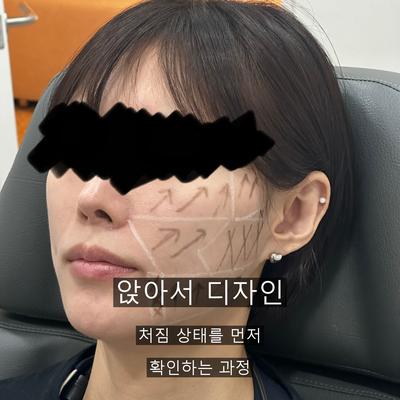
The Ultherapy tilting technique utilized at our clinic plays an important role in improving sagging.
While the focal depth of Ultherapy tips is set, the actual position of the SMAS layer can vary individually and by area.
Our clinic uses ultrasound imaging to confirm the real-time position of the SMAS layer. Based on this, we utilize a tilting technique that delicately adjusts the tip's angle, allowing energy to be precisely delivered to layers between the standard depths.
Our clinic maintains the length of the reference line for each shot at the device's standard value of 25mm.
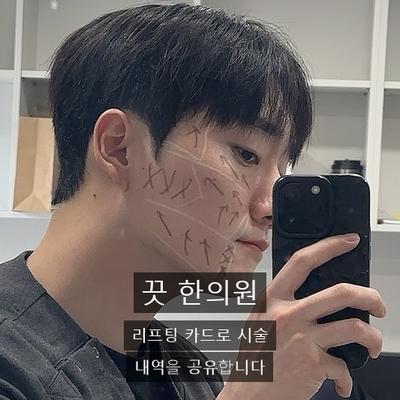
Our clinic shows the patient the setting screen before the procedure. After the procedure, we prepare and share a lifting card that records which tips were used and how much energy was delivered to each area.
Frequently Asked Questions
Q. Can a forehead lift improve eyelid sagging?
A. By lifting the SMAS layer through a forehead lift, eyebrow support can be improved, which can also help alleviate upper eyelid sagging. However, the perceived change may vary individually depending on the degree of sagging, so it is best to consult with the medical staff for detailed information.
Q. For a forehead lift, which should I choose between Shurink and Ultherapy?
A. The SMAS layer targeted in forehead lifting is an area where both Shurink and Ultherapy can deliver energy. The most suitable device may vary depending on the patient's degree of sagging, skin thickness, and desired treatment intensity, so it is advisable to consult with a specialist before making a decision.
Q. When can I expect to see changes after a forehead lift?
A. Immediately after a forehead lift, swelling may primarily occur. Since skin tissue regeneration takes time, you can generally start to notice gradual changes from the procedure after about a month.
Q. If eyelid sagging is severe, can it be improved with a forehead lift alone?
A. If eyelid sagging has progressed to the point of obstructing your vision, a forehead lift alone may not provide sufficient improvement. Especially if accompanied by weakened muscle function around the eyes, it is crucial to consult with a specialist first to determine if surgical correction is needed.
Kkeut Korean Medicine Clinic's Dedication
At Kkeut Korean Medicine Clinic, we meticulously plan the skin design in a seated position before the procedure. This allows us to establish a personalized treatment plan, striving to achieve more refined results.
Kkeut Korean Medicine Clinic utilizes a tilting technique that precisely adjusts the tip angle while monitoring the ultrasound screen in real-time during the procedure. This aims for more accurate and efficient treatments.
Kkeut Korean Medicine Clinic operates with the use of 25mm standard length equipment and a lifting card sharing system. This is part of our effort to ensure the safety of the procedure while delivering satisfactory results.
Please inquire about the subtle differences that can be created through consultation at Kkeut Korean Medicine Clinic.
Related notes
Procedure notes worth reading next.


Loading menu…