

At-home lifting: Why it's difficult to do at home, and how Shrink works. Beomgye, Pyeongchon, Beomgye Station, Pyeongchon Station, Hogye-dong, Bisan-dong, Gwanyang-dong, Dongan-gu, Indeogwon, Geumjeong, Anyang
9/28/2026
This is a procedure note for At-home lifting: Why it's difficult to do at home, and how Shrink works. at Beomgye(Opening Soon) KKEUT Korean Clinic.
When you start to feel a loss of elasticity in your face line, many people first look into at-home lifting devices.
From massage devices to ultrasonic and microcurrent methods, there are various types, making it difficult to decide which product is right for you.
While searching for online reviews or usage instructions, you might wonder if facial sagging can truly be satisfactorily improved with such methods.
Skin lifting treatments vary greatly in their methods and depth.
We can examine them step-by-step, from personal at-home care to professional salon programs, and even high-frequency or ultrasonic treatments performed at medical facilities.
For example, at-home devices offer the advantage of consistent daily use, but their stimulation intensity is limited. Medical procedures, on the other hand, can be highly effective but may require a recovery period.
Among these various methods, at-home lifting care represents an initial stage that is relatively easy to try.
Good accessibility and the ability to use them daily as part of a routine are characteristics of at-home devices.
Most at-home lifting devices use methods that utilize low-output high-frequency or microcurrent.
To ensure safe use at home, their stimulation intensity is limited within a specific output range.
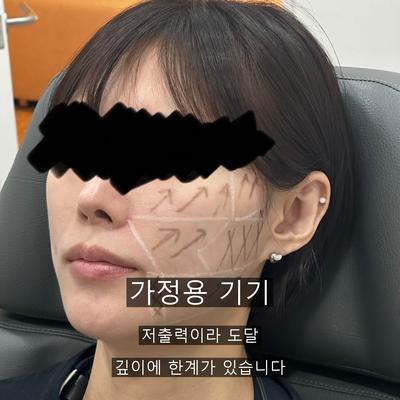
These methods with limited output often deliver stimulation only to the outermost layer of the skin or the superficial dermis.
Therefore, while you might experience a temporary feeling of smoother skin, it can be difficult to expect significant improvement in facial sagging itself.
In reality, the fundamental cause of facial sagging lies deeper within the skin.
This deeper area is located beneath the skin and fat layers, where the SMAS layer, which defines the overall shape of the face, is situated.
This is precisely why it is not easy for at-home lifting devices to deliver energy to this SMAS layer.
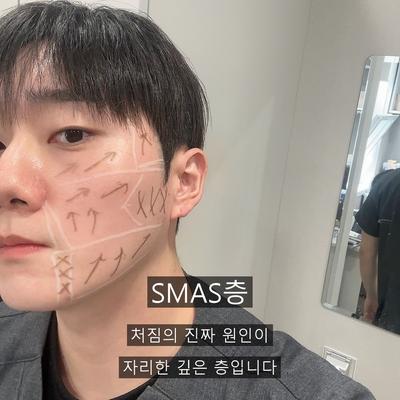
Shrink treatment directly targets this SMAS layer.
It utilizes High-Intensity Focused Ultrasound (HIFU) technology to concentrate energy at a single point, delivering thermal stimulation to the SMAS layer.
This thermal stimulation induces a reaction that contracts collagen, and subsequently, new collagen is produced, which helps improve sagging lines.
During this reaction, the skin and tissues surrounding the SMAS layer are protected in a way that minimizes damage.
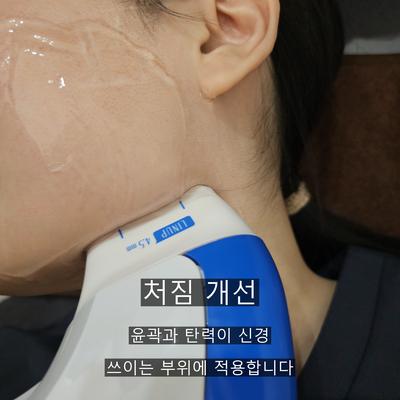
Various types of tips are used in Shrink treatment, including 4.5mm, 3.0mm, 2.0mm, and 1.5mm.
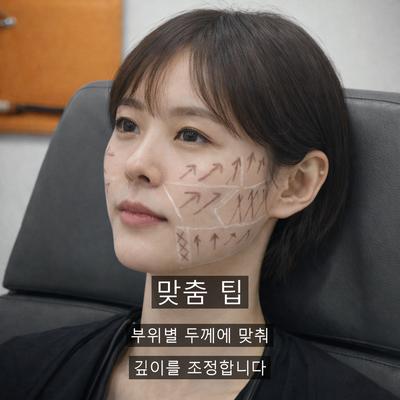
Since the thickness of the skin and fat layers varies across different facial areas, it is necessary to select the appropriate tip for the treatment area and adjust the depth to effectively reach the SMAS layer.
If only one type of tip is used to treat the entire face, there is a risk of insufficient energy delivery to thicker areas and excessive delivery to thinner areas.
It may not be appropriate to treat areas with differing skin thicknesses, such as the chin, cheeks, and eye area, with the same tip.
Shrink can primarily be applied to areas where facial sagging, disrupted contour lines, or decreased elasticity are felt.
It is one of the treatments you might consider when you feel that your overall face line is not what it used to be.
Satisfaction with treatment results can be higher when not just specific areas but the entire face line changes together.
The treatment cycle is generally recommended to be at one-month intervals.
The timing of the next treatment can be adjusted based on the number of shots used at once, and it is a procedure approached with the concept of gradually accumulating effects rather than a one-time solution.
At-home lifting care and Shrink are different treatment methods with different goals.
This does not mean that at-home care methods are entirely ineffective.
They can certainly help maintain skin surface elasticity and promote blood circulation, among other things.
However, those roles and the role of Shrink treatment are different domains.
It is important to clearly distinguish and understand that the skin depth reached by energy and the ultimate treatment goal differ from Shrink.
Generally, many people try these at-home methods first, and then consider medical facility treatments when they feel the desired changes are insufficient.
Looking at how Shrink treatment is performed can make this difference even clearer.
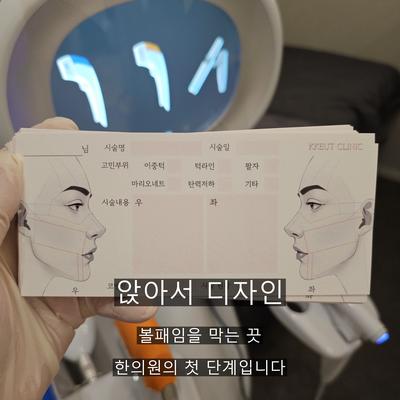
Before a Shrink treatment, design work for the face line is first carried out while the patient is seated.
This is because when lying down, the effect of gravity changes, and sagging tissues may temporarily lift, making the sagging appear less severe than it actually is.
To minimize such discrepancies, the sagging lines and skin thickness of each area are precisely checked while seated, and then a tip usage plan is formulated.
This is also an important step to avoid side effects such as excessive hollowing of the cheek area after the procedure.
Only through such meticulous processes can a customized treatment plan be designed for areas with severe sagging and areas lacking volume.
The results of Shrink treatment depend on how accurately the treatment depth is designed.
At our clinic, in addition to the main 4.5mm tip, we utilize 3.0mm, 2.0mm, and 1.5mm tips to provide treatments tailored to the specific characteristics of each area.
For severe skin sagging, we offer options to adjust the Ultherapy intensity to achieve a deep lifting effect.
We focus on creating a delicate treatment plan tailored to individual conditions.
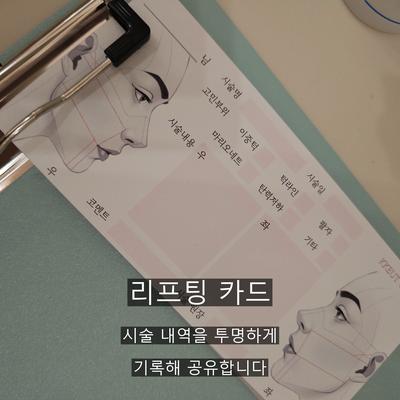
Once the treatment is complete, detailed information such as the type of tips used, application areas, and number of shots will be recorded on a lifting card and shared with the patient.
Based on this record, a more systematic and continuous treatment plan can be established for your next visit.
Frequently Asked Questions
Q. Can I achieve the same effects as Shrink by consistently doing home care lifting only?
A. Home care lifting can help manage skin surface elasticity, but it's difficult to expect the same lifting results as Shrink, which delivers energy to the deep SMAS layer.
Q. Can I combine home care lifting devices with Shrink?
A. Yes, it is possible to combine both treatments. Typically, home care lifting is used for daily skin elasticity management, while Shrink complements it by managing the deeper layers of the skin.
Q. Does Shrink hurt compared to home care lifting?
A. Shrink delivers energy to the deep layers of the skin, so you may feel heat or a specific sensation during the treatment. The intensity of this sensation may be greater than with home care lifting devices.
Q. Should I still follow the Shrink treatment cycle even when using a home care lifting device?
A. Yes, Shrink treatments are typically performed at one-month intervals to gradually build up the effect. Therefore, it can be effective to follow the recommended treatment cycle regardless of whether you are using a home care lifting device.
Q. Can I continue using a home care lifting device after receiving Shrink treatment?
A. Yes, there is no problem in continuing to use a home care lifting device in conjunction with Shrink treatment to maintain its effects and manage elasticity.
Our Clinic's Lifting Treatment Principles
We first check for skin sagging and design the treatment area with the patient in a seated position. This allows us to approach the treatment in a way that matches each individual's facial contours and condition.
We carefully use various types of tips, considering the skin thickness and structure of each area, to enhance the accuracy of the treatment.
We meticulously record and share treatment details on a lifting card, providing transparent information necessary for future treatment planning. This process aids in consistent management.
If you are curious about our treatment design based on accuracy, we recommend learning more through a consultation.
Loading menu…