

Let us tell you what makes Apple Toning different from regular laser toning. Beomgye, Pyeongchon, Beomgye Station, Pyeongchon Station, Hogye-dong, Bisan-dong, Gwanyang-dong, Dongan-gu, Indeogwon, Geumjeong, Anyang
This is Gyeonggi Anyang Beomgye KKEUT Korean Clinic's procedure note on Let us tell you what makes Apple Toning different from regular laser toning.
When they hear the name 'Apple Toning,' many people wonder if it's a treatment distinct from general laser toning, or if only the name is different.
This is also a question we frequently encounter during consultations at Kkeut Korean Medicine Clinic.
This treatment note clearly outlines the commonalities and differences between the two procedures, and provides criteria to help you understand them correctly.
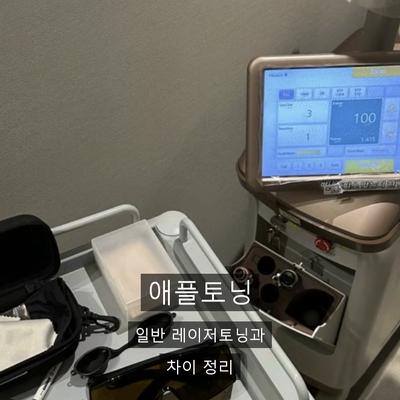
Basic Principles of Laser Toning
Laser toning is a treatment method that uniformly irradiates the entire skin with low-energy lasers to selectively destroy melanin pigments.
Q-switched or picosecond devices primarily using a 1064nm wavelength are employed. The basic principle of reacting to melanin and finely breaking down pigments remains the same.
It can be applied to improve melasma, freckles, hyperpigmentation, and dull skin tone in general.
This treatment does not ablate the skin surface; rather than removing pigments in one go with strong stimulation, it repeatedly applies gentle energy to gradually lighten them.
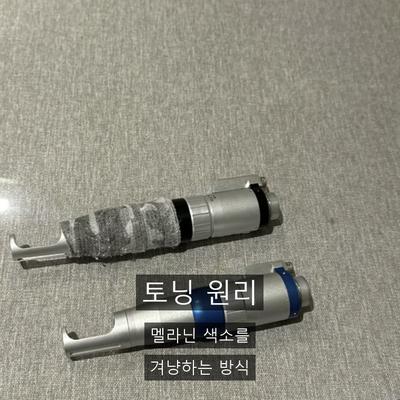
What Toning Family Names Mean
Apple Toning is used as a term to refer to one of various toning procedures.
However, each clinic may name procedures after the type of equipment used, the wavelength configuration, or the management program. Therefore, it is difficult to assume that the content of the procedure is identical just because the names are the same.
Conversely, even if the procedure names are different, it doesn't mean their fundamental principles are different.
The broad principle of targeting melanin pigments to brighten skin tone is shared by all toning-family procedures.
For these reasons, when comparing Apple Toning and general laser toning, it is more important to verify the specific details and composition of the procedure rather than simply being bound by the name.
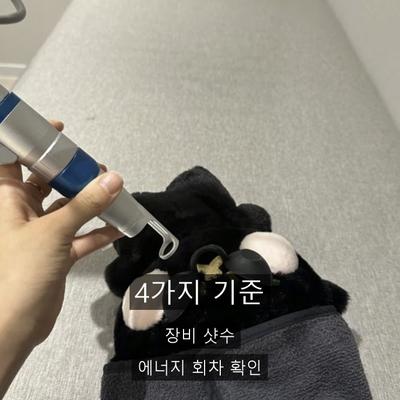
4 Criteria to Check Rather Than the Name
First, the type of equipment used and its wavelength.
You can inquire about and confirm which equipment is used and which wavelength is irradiated during your consultation.
Second, the total number of shots applied during the procedure.
Even with the same toning procedure, the density of the treatment and the energy delivered can vary depending on the number of shots irradiated in one session.
It is advisable to check whether the total number of shots is clearly communicated before the procedure and confirmed afterward.
Third, the method of setting the laser's energy.
Individual skin conditions and pigment responses can vary. Therefore, there are methods of proceeding with high energy from the start, and methods of gradually adjusting the energy.
It is important to confirm whether the energy settings are adjusted while closely observing the skin's reaction during the procedure.
Fourth, the session structure of the overall treatment.
Most pigment-related treatments often show expected improvements when consistently performed over 10 sessions or more, rather than being a one-off treatment.
Therefore, rather than concluding the effectiveness with just one session, it is wise to discuss the overall treatment plan and goals together during a consultation.
Approach Varies by Pigment Type
Even among brown skin pigments, lentigines, freckles, and melasma each have different characteristics.
For superficial pigments with clear boundaries, such as lentigines or freckles, treatments using a 532nm wavelength can primarily be considered.
For widely distributed melasma, there is also the option of combining toning to even out skin tone with RF microneedling procedures like Potenza, which stabilize sensitive melanocytes.
Therefore, if one approaches treatment relying solely on a single procedure name without accurately differentiating the type of pigment, the outcome may differ from what was expected.
At Kkeut Korean Medicine Clinic, we first analyze and diagnose the distribution and type of pigments using a Mark-Vu diagnostic device.
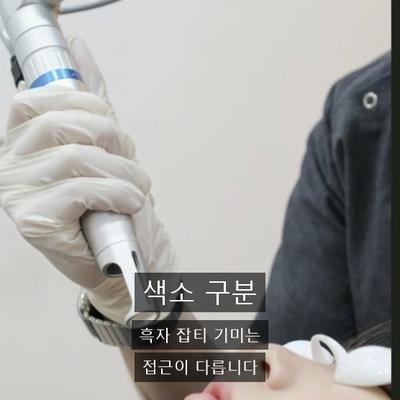
This is How Toning Procedures Are Performed
Before the procedure, the skin is thoroughly cleansed, and then the pigment distribution across the entire face is checked.
Afterward, the laser is uniformly irradiated over the entire face, and additional shots are applied to areas of particular concern for intensive management.
Once the laser irradiation is complete, the skin undergoes soothing care, followed by the application of sunscreen to finish.
The total time required for the procedure may vary depending on the total number of shots and the laser irradiation area.
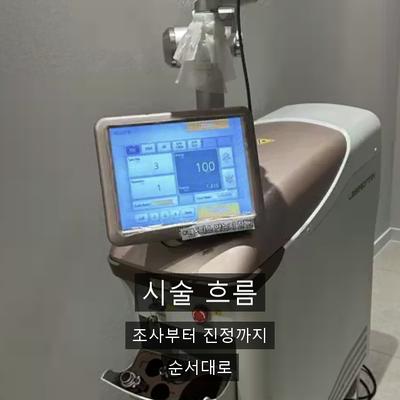
Common Misconceptions and Management
Even with a newly named procedure, all changes are not completed with just one session.
Pigment treatments generally aim for gradual changes, and the speed of these changes can vary depending on the depth and extent of the pigment, as well as the usual level of sun exposure.
When documenting the progress of change, taking photos with the same lighting and angle helps compare the condition.
Skin redness occurs due to different reasons than hyperpigmentation, so laser toning treatment may not be appropriate.
Therefore, during consultation, we first clearly differentiate whether it is a pigmented lesion or a red lesion, and then establish a treatment direction accordingly.
After the procedure, it is important to pay more attention to UV protection and thorough moisturizing care than usual.
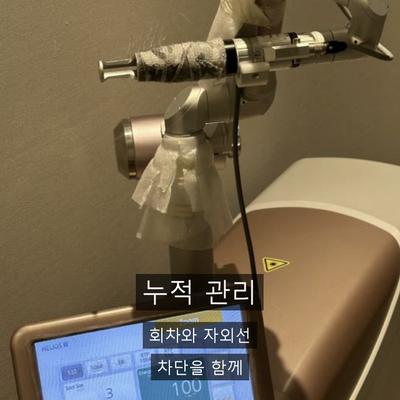
Principles Applied by Kkeut Korean Medicine Clinic for Toning Procedures
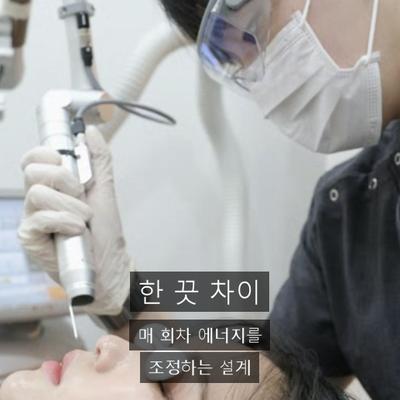
At Kkeut Korean Medicine Clinic, toning procedures are performed based on three main principles: number of shots, treatment area, and energy settings.
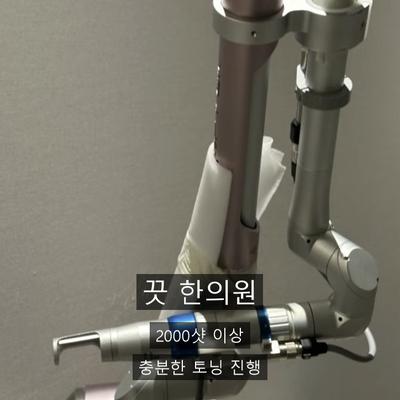
First, we ensure a sufficient number of shots, performing over 2000 shots.
If the number of shots is insufficient, it may be difficult for energy to be delivered uniformly, leading to a decrease in treatment density. At Kkeut Korean Medicine Clinic, after irradiating over 2000 shots, we go through a process of verifying the shot count with the director.
Laser toning procedures are not directly visible to the naked eye, making it difficult to accurately know the actual number of shots applied.
Considering this, Kkeut Korean Medicine Clinic verifies the shot count with the patient and keeps a record of the procedure for future reference during subsequent consultations.
Second, we focus more intensively on the specific areas that patients are concerned about.
In addition to the basic approach of uniformly irradiating energy across the entire face, we also meticulously deliver additional energy to areas with deep or long-standing pigmentation.
Third, we adjust the energy by checking the skin's reaction during each consultation.
Rather than simply repeating the same energy settings, we meticulously observe each individual's skin condition and reaction, gradually adjusting the energy as needed.
Even if you inquire by mentioning specific procedure names such as Apple Toning, Kkeut Korean Medicine Clinic conducts consultations based on the principles explained above.
After fully explaining the number of toning shots used in the procedure and the energy setting method, we go through a process of jointly confirming whether it aligns with the patient's expectations.
Frequently Asked Questions
Q. Is Apple Toning very different from general laser toning?
A. Apple Toning is also a type of laser toning, so its basic principle of targeting melanin pigment is the same as general laser toning. However, there may be differences in equipment configuration, number of procedure shots, and energy setting methods. Therefore, we recommend checking these details thoroughly during your consultation.
Q. How many Apple Toning sessions are appropriate?
A. Laser toning procedures, including Apple Toning, are generally performed consistently for more than 10 sessions. However, the number of sessions may vary depending on the type and depth of pigmentation and individual skin reactions, so it is best to establish a plan through a detailed consultation in the treatment room.
Q. What should I be careful about after an Apple Toning procedure?
A. After an Apple Toning procedure, please pay special attention to UV protection and moisturizing care. On the day of the procedure, it is recommended to avoid activities that can raise body temperature, such as saunas or strenuous exercise.
Kkeut Korean Medicine Clinic's Treatment Philosophy
Kkeut Korean Medicine Clinic aims for meticulous treatment by ensuring a sufficient number of shots (over 2000) and having the director personally verify the shot count.
Kkeut Korean Medicine Clinic strives to provide delicate and careful treatment by focusing more on the areas of concern for patients.
Kkeut Korean Medicine Clinic prioritizes patient safety by observing skin reactions during each consultation and gradually adjusting energy levels.
Kkeut Korean Medicine Clinic: Aiming for Delicate Treatment with a Meticulous Approach
Loading menu…